Updated 5 August 2026
The Amazigh — the Berber peoples of Morocco — are the country’s indigenous population, here long before the Arab conquests of the seventh century. Around a quarter of Moroccans speak an Amazigh language at home, and many more claim Amazigh ancestry. Most dislike the word Berber. Here is why, and what to say instead.
Amazigh or Berber? What to say
Amazigh is what people call themselves. It is usually translated as free people; the plural is Imazighen. Spelling in English wanders — Amazigh, Amazighs, Amazighi people, Imazighen — and it is all the same word. In French you will see les Amazighs.
Berber comes to us from the Greek and Latin word behind barbarian, applied from outside by people who did not speak the language. That is the objection, and it is a reasonable one.
Here is the part written by foreigners rarely: plenty of Moroccans say Berber themselves. Guides say it, rug sellers say it, hotel signs say it, because it is the word visitors arrive knowing. A man in the Souss may describe his own village as berbère to a French client and Amazigh to his cousin, without any contradiction he would recognise.
For a visitor the rule is simple. Say Amazigh. If someone says Berber to you, that is their choice about their own identity and it needs no correction from you.
Where the Berber peoples of Morocco actually live
Three regions, three language groups, and they are not interchangeable.
| Region | Language | Where |
|---|---|---|
| The Rif, north | Tarifit | Al Hoceima, Nador, the mountains behind the Mediterranean coast |
| Middle Atlas | Tamazight | Azrou, Khenifra, Ifrane, the cedar country |
| Souss, High Atlas, Anti-Atlas | Tashelhit | Agadir, Taroudant, Tafraoute, the valleys above Marrakech |
A Tashelhit speaker from Taroudant and a Tarifit speaker from Al Hoceima will talk to each other in Darija, because their own languages are related in the way Spanish is related to Romanian. You will see it called the Berber language; Morocco calls it Amazigh, and it is not one language. In Morocco, Berber language names change with the region, which is the single most common thing people get wrong about it. The full picture — what is official, what is spoken, what to open with — is on what language do they speak in Morocco.
Cities are mixed and always have been. Casablanca has been an Amazigh city by numbers for decades; so, quietly, has Marrakech.
Tifinagh: the alphabet on every ministry
Look at a Moroccan government building and you will see three scripts. Arabic, Latin, and a third that looks like geometry: ⵜⵉⴼⵉⵏⴰⵖ.
That is Tifinagh. The modern standardised form was adopted in 2003 by IRCAM, the royal institute for Amazigh culture, and it descends from the Libyco-Berber inscriptions carved across North Africa thousands of years ago. The Tuareg of the Sahara never stopped using their version of it.
You do not need to read it. Noticing when it appeared — and on which buildings — tells you more about the last twenty years of Moroccan history than most museums do.
What changed in 2011, and what did not
The 2011 constitution made Amazigh an official language of the state, alongside Arabic. For a language that had been kept out of schools, courts and broadcasting for most of the twentieth century, that was not a small sentence.
Then the honest half. The organic law setting out how it would be implemented did not pass until 2019, with a rollout staged over years. In practice today: Tifinagh on public signage, Amazigh on national television, the alphabet taught in a growing share of primary schools, and still no realistic chance of conducting your business at a rural courthouse in Tashelhit. It is real progress and it is unfinished, and Amazigh activists will tell you both things in the same breath.
The other visible change is Yennayer, the Amazigh new year in mid-January. It became a paid public holiday in Morocco in 2024. Families eat a seven-vegetable couscous or tagoulla porridge, and there is a hidden date stone in it for whoever gets lucky.
Amazigh and Arab: a blurrier line than visitors expect
Foreign writing on the history of Amazigh Morocco tends to arrive with two boxes and start sorting people into them. It does not work here.
Morocco has had thirteen centuries of intermarriage, migration and shared religion. Most Moroccan families are some mixture and could not produce a clean answer if you asked. There is no register of Amazigh people; Morocco counts languages spoken at home, not ancestry, which is why every figure you read is an estimate wearing a suit. The distinction people actually make day to day is linguistic and regional, not racial: which language your grandmother spoke, which valley you are from. An Amazigh man in Taroudant and an Arab-identifying man in Fes have more in common than either has with a Tuareg in Mali.
Where it does get political is language policy, employment in the south and the Rif, and how Moroccan Amazigh identity is taught in schools. None of it is settled in Morocco: Amazigh voices disagree with each other as sharply as they disagree with anyone else. Those debates are live, they are Moroccan, and they are worth listening to rather than adjudicating.
What the rugs and the tattoos encode
Amazigh history was carried in speech, weaving and song rather than in books, and the craft tradition that carried it is largely women’s work. That is why so much of it survived a century of being kept out of print.
The rugs carry it most clearly. A Beni Ourain from the Middle Atlas, an Azilal, a flatwoven hanbel from the Anti-Atlas: the diamonds, chevrons and the aza symbol are a vocabulary, and weavers will tell you what a panel means — fertility, protection, a marriage, a journey. Some of what is explained to tourists in the souks is genuine, and some is invented on the spot for the sale. If you want to know which, buy where you can meet the weaver. There is more on reading them in the souks of Marrakech.
The facial tattoos you see on older women in the Atlas and the south — chin, forehead, between the eyes — belong to the same visual language. They largely stopped being made in the 1960s and 70s, partly under religious pressure, and the women who carry them are now in their seventies and eighties. Do not photograph them without asking. Several of them ask for money and are entitled to.
Meeting Amazigh families as a traveller
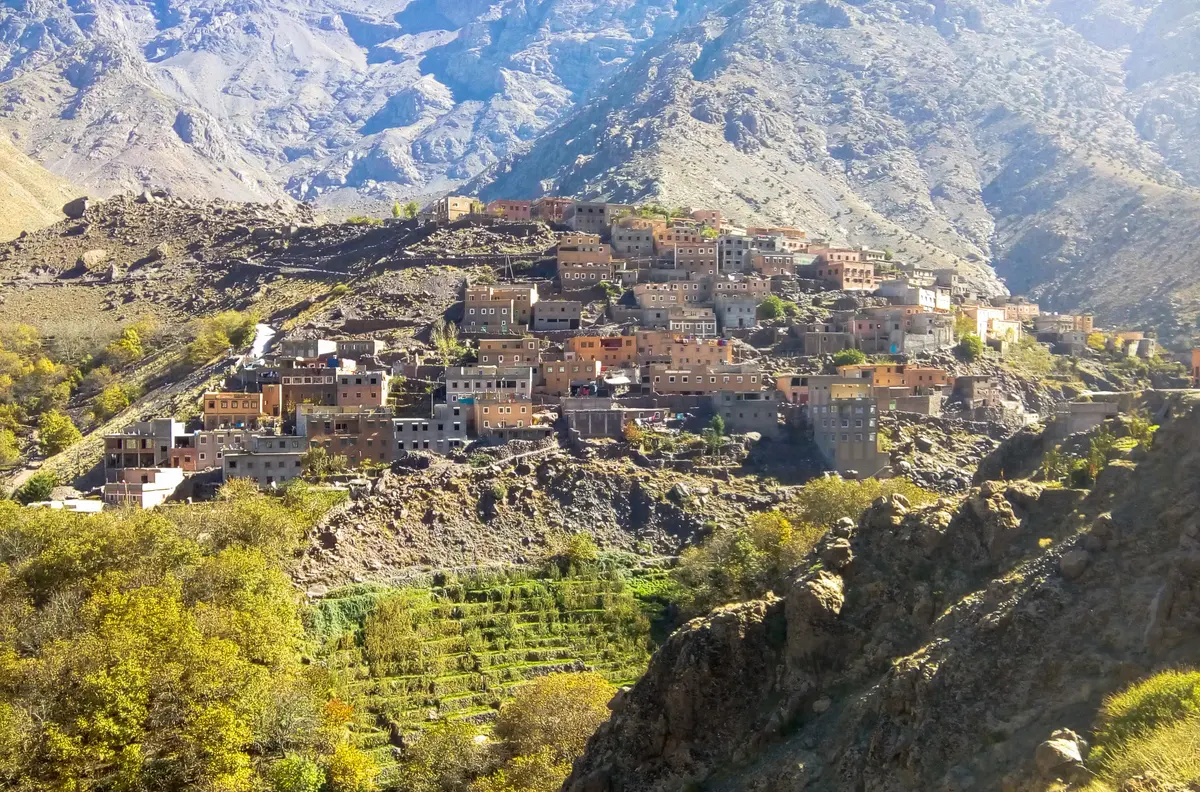
Most visitors meet Amazigh Morocco in a High Atlas village or on the road to the Sahara, and mostly through tourism.
What actually helps:
- Say azul. It is hello in Amazigh, it costs nothing, and it changes faces.
- Accept the tea. Refusing the first glass is close to refusing the household — the logic is explained in customs and etiquette.
- Ask before photographing anyone, every time.
- Do not call a house “traditional” in front of the person who lives in it. Rural does not mean historical, and satellite dishes are not a contradiction.
- If a family cooks for you, the money should reach that family. Ask how the payment works. A guide who cannot answer that question clearly is answering it.
The thing worth understanding before you go: this is not a heritage display. It is roughly a third of a modern country, arguing publicly about its own future, in a language that got its alphabet back fifteen years ago.
Our drivers and mountain guides are Amazigh, from the villages they take you to, and they are paid directly rather than through a chain of agencies.
Meet the team, or tell us what you want from your trip. More on the country’s culture is in the Moroccan culture guide.
Frequently asked questions
What does Amazigh mean?
It is usually translated as "free people" or "free man". The plural is Imazighen. The same word names the people and the language, which is why you see it used both ways.
What is Amazigh?
Amazigh is the name North Africa's indigenous population uses for itself, and the name of its language family. In Morocco it is an official language alongside Arabic, written in the Tifinagh script.
What are Amazigh people?
The indigenous people of North Africa, in Morocco since long before the Arab conquests of the seventh century. Spelling varies in English — Amazigh, Amazighs, Amazighi people, Imazighen — and it is all the same word.
Is it offensive to say Berber?
Not automatically, but it is contested. The word traces back to the Greek and Latin for barbarian. Many Moroccans reject it; plenty of others use it themselves, including in tourism. Amazigh is the safer word, and nobody will correct you for it.
How many Amazigh people are there in Morocco?
The 2014 census recorded roughly a quarter of the population speaking an Amazigh language at home. The share of Moroccans with Amazigh ancestry is far higher and genuinely disputed — many families are both, and stopped counting generations ago.
Where do the Amazigh live in Morocco?
Amazigh in Morocco means three main regions — the Rif in the north, the Middle Atlas around Azrou and Khenifra, and the Souss, High Atlas and Anti-Atlas in the south. Cities are mixed, and always have been.
What language do Amazigh people speak?
The Berber language in Morocco is really three — Tarifit, Tamazight and Tashelhit — which are related but not mutually intelligible. Most speakers also speak Darija, and many speak French.
What is Tifinagh?
The alphabet used to write Amazigh, standardised in 2003 and now on ministries, schools and road signs. Its letters look geometric, and it descends from the ancient Libyco-Berber scripts.