 10 days / 9 nightsSignature route
Marrakech
10 Days in Morocco: The Grand Tour Itinerary
Every region that matters, in one loop
- 2–12
- Easy
- 3 Oct
From€1,100 / per person
View tour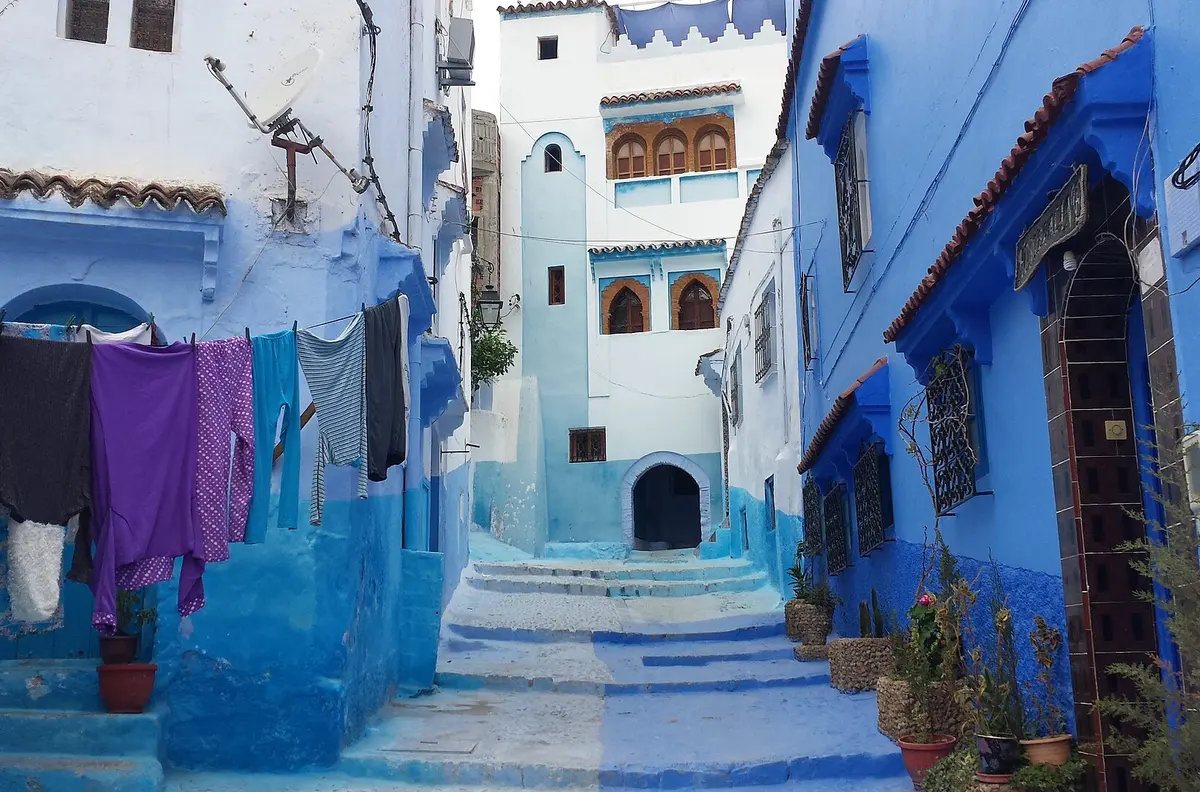
Tanger-Tétouan-Al Hoceïma
The blue city, best seen before nine in the morning
Best time to visit
April to June and September to October. It snows in the Rif in winter.
How long to stay
One night is enough for most, two if you photograph.
Getting there
Four hours from Fes, two from Tangier, four and a half from Rabat. No airport and no train — you arrive by road.
Chefchaouen is a small blue-painted town in the Rif mountains of northern Morocco, about two hours south of Tangier at roughly 600 metres. Most people come for the medina and stay one night. That one night is the whole difference, because between eleven and four the town belongs to coach parties.
Nobody can prove it. Three explanations circulate and they are not mutually exclusive.
The most repeated one credits Jewish residents who arrived in the 1930s, for whom blue carried religious meaning. A second says the lime wash was tinted to repel mosquitoes. A third, the most practical, says blue keeps the walls cooler in a town with hot summers and no shade.
What is certain is what happens now: the town repaints every year, householders are encouraged to keep to the palette, and the reason is tourism. That is not a criticism. It is simply why the blue is so uniform, and so recent-looking, in a town founded in 1471.
So why is Chefchaouen, Morocco blue in the sense that matters to a visitor? Because it is maintained that way, deliberately, and it is worth seeing.
One night, for most people.
Chefchaouen — blue city, Morocco’s most photographed town — is about a kilometre across. You can walk every lane in the medina in two hours without hurrying. There is a kasbah, a square, a river, and a hill with a view. That is the inventory.
Stay two nights if you photograph seriously, if you want to walk in Talassemtane, or if you are coming up from Tangier and going on to Fes and would rather not do both drives back to back. Three nights is a rest, not a visit.
The surrounding province is also called Chefchaouen. Chefchaouen the town — the blue medina on the hillside — is what people mean, and it is a fraction of the size the province name suggests.
The coaches from Fes and Tangier arrive from about eleven and are gone by four. Inside that window the main lanes are shoulder to shoulder and every blue staircase has a queue on it.
Before nine in the morning the medina belongs to cats, bread deliveries and people going to work. The light comes down the valley rather than straight overhead. After six the day-trippers have gone and the square fills with families.
If you are only passing through, aim for the first or last of those. If you are staying, set an alarm — this is the single most useful thing on this page.
Chefchaouen city, Morocco’s gentlest tourist town, has very little crime and is comfortable to walk after dark. Women travelling alone consistently report less comment here than in the big cities.
What visitors are not warned about is the hashish. The Rif is where Morocco’s cannabis is grown, and on Outa el-Hammam square you will be offered it — quietly, persistently, several times an evening. It is not aggressive and it does not escalate.
Two things worth knowing. Recreational cannabis is illegal in Morocco, whatever the atmosphere on the square suggests. And there are police checkpoints on the roads out of the Rif that exist for precisely this; being a foreign visitor is not protection, and it is not a story anyone wants to bring home.
“La, shukran”, once, without stopping, ends the conversation. That is the entire safety briefing for Chefchaouen. There is more general ground covered in safety in Morocco.
Almost everything in the medina is a small guesthouse — six or eight rooms around a stairwell, run by the family that owns it. Rooms are simple, the terraces are the point, and the good ones are booked out weeks ahead in spring and autumn.
Two practical warnings. The medina is built on a hillside, so “five minutes from the square” can mean five minutes of steps with a suitcase; ask before you book if that matters. And Chefchaouen sits high enough to be genuinely cold from November to March, in buildings with no central heating — a good guesthouse hands you a brazier and extra blankets, and a bad one does not.
Outside the walls there are larger hotels with parking and lifts. They are duller and considerably easier.
Rif cooking is mountain food: goat, lentils, bissara, and a fresh white goat cheese you will not find further south. The square restaurants are fine and priced for visitors; the small places on the lanes behind are better and cheaper.
The town is also unusually good for vegetarians by Moroccan standards, because the local diet leans on pulses rather than meat.
There is no airport and no railway. You arrive by road, and that is the one constraint that shapes every itinerary here.
| Route | Realistic time |
|---|---|
| Tangier → Chefchaouen | 2h – 2h 30 |
| Fes → Chefchaouen | 4h |
| Rabat → Chefchaouen | 4h 30 |
| Marrakech → Chefchaouen | 9h+ |
Signage and French sources write Chefchaouen, Maroc; Spanish maps still say Xauen, because this was the Spanish zone until 1956 and older residents still speak it; locals shorten it to Chaouen. Same town.
CTM coaches run from Tangier and Fes daily. Grand taxis leave when they are full. On a private trip the drive itself is worth something — the Rif road up from Tangier climbs through cork oak and olive terraces with places to stop.
We cover the timings in detail in the Chefchaouen day trip guide, run it as an overnight from Fes, and build it into the imperial cities and Chefchaouen week.
Akchour is forty minutes out by road, then a walk along a river to a set of waterfalls and a natural rock arch called God’s Bridge. The short version is two hours return; the long one is a full day. Grand taxis go from the edge of town.
Talassemtane National Park starts on the edge of Chefchaouen. Cedar and fir at altitude, which surprises everyone whose picture of Morocco is sand. Guides are arranged in town, and a half-day walk up to the ridge above the Spanish Mosque needs nothing more than trainers and water.
The coast is also closer than people think. Oued Laou is about an hour east on a mountain road, and it is a plain Moroccan beach town with no tourism infrastructure to speak of — worth a day if you want to see the Rif meet the Mediterranean rather than another blue lane.
April to June and September to October. The Rif is green in spring and the temperature is right for walking.
Summer is hot and busy. Winter is cold, wet and occasionally snowy — the blue against snow is remarkable and the town is nearly empty, but the mountain roads can be slow.
Chefchaouen is easy to fit badly and easy to fit well. The rest of the country is on our destinations page; tell us where you are coming from and we will tell you whether an overnight or a stop makes more sense.
Nobody can prove one answer. The most repeated version credits Jewish residents who arrived in the 1930s, for whom blue carried religious meaning. Others say it repels mosquitoes or keeps houses cool. What is certain is that the town now repaints it every year, and tourism is why.
Yes. It is a small mountain town with very little crime and it is comfortable to walk at night. The one thing visitors are not warned about is how openly hashish is offered on the main square. Decline it and nothing else happens.
For one night, yes. The blue medina is genuinely unlike anywhere else and it is beautiful in the early morning. It is also small — you can walk every lane in two hours — so two or three nights only makes sense if you are hiking or photographing.
By road only; there is no train and no airport. Tangier to Chefchaouen takes two to two and a half hours on a good mountain road. CTM runs coaches daily, grand taxis leave when full, and a private car lets you stop at the Rif viewpoints.
About 200 km and four hours by road through the Rif. That is too far for a comfortable day trip in both directions, which is why we run it as an overnight rather than a fourteen-hour day.
One night for most people, two if you photograph or want to walk in the national park. The medina is roughly one kilometre across. The value of staying over is the empty hour after sunrise, not extra sightseeing.
It will be offered to you repeatedly and it remains illegal in Morocco. There are police checkpoints on the roads out of the Rif that exist for exactly this, and a foreign passport is not protection. The sensible answer is no, said once, without a conversation.
The Kasbah museum and its Andalusian garden, Ras el-Maa where the river leaves the mountain, the Spanish Mosque walk at sunset, the Akchour waterfalls forty minutes out, and Talassemtane National Park, which starts at the edge of town.
10 days / 9 nightsSignature routeMarrakech
Every region that matters, in one loop
From€1,100 / per person
View tour 7 days / 6 nightsSignature route
CasablancaMarrakech
All four imperial capitals — Rabat, Meknes, Fes and Marrakech
From€610 / per person
View tour2 days / 1 nightFes
Stay overnight, so you get the medina at dawn without day-trippers
From€110 / per person
View tourTell us your dates and interests. We reply personally, usually within a couple of hours.
usually within 2 hoursNo deposit to planLicensed tour guide
+212 665 295 999
Try “Sahara”, “3 days”, or “Chefchaouen”.