Updated 3 August 2026
What language is spoken in Morocco? Officially two: Arabic and Amazigh (Berber). But the language Moroccans actually speak day to day is Darija, the Moroccan Arabic dialect. French runs business and government. In the north, Spanish often beats French. In tourist areas you can get by comfortably in English.
That is the short answer. What follows is the part that matters when you are standing at a taxi rank with your bag.
Morocco language at a glance
| Official languages of Morocco | Arabic and Amazigh (Berber) |
| Main language in Morocco | Darija — the Moroccan Arabic dialect |
| Business and government | French |
| Regional second language | Spanish, in the north and the far south |
| Tourism | English, increasingly, especially under 25 |
So when people ask what the Moroccan language is, there is no single answer. The main language spoken in Morocco is Darija; the Morocco official language list names Arabic and Amazigh; and the language that actually runs the economy — French — is not official at all.
Put simply: what language Morocco speaks depends on whether you mean the constitution, the street, or the bank.
The four languages you will actually hear
Darija — the Moroccan Arabic dialect. This is the language of the street, the home, the argument, the joke. Around 90% of Moroccans speak it. It is nobody’s written language and it is not taught in schools.
Amazigh — the Berber language of Morocco, official since 2011, and the first language of roughly a third of the country. It comes in three main regional varieties: Tashelhit in the south and the High Atlas, Tamazight in the Middle Atlas, Tarifit in the Rif mountains of the north. A Tashelhit speaker from Taroudant and a Tarifit speaker from Al Hoceima cannot easily understand each other.
French — not official, but everywhere in practice. Banking, medicine, engineering, higher education, government paperwork, most road signs. Educated Moroccans move between Darija and French inside a single sentence without noticing.
Modern Standard Arabic — the language of the news broadcast, the Friday sermon, the newspaper, the school textbook. Almost nobody speaks it conversationally. If you learned Arabic from an app, this is probably what you learned, and it will make you sound like a newsreader.
Do Moroccans speak Arabic? Darija is not what you think
This is the thing most guides get wrong, and it has practical consequences.
If you studied Modern Standard Arabic, or Egyptian or Gulf Arabic, you will understand less than you expect in Morocco. Darija has absorbed a great deal of Amazigh vocabulary, plus French and Spanish, and it drops short vowels aggressively. Moroccans watch Egyptian films without subtitles; Egyptians generally cannot follow a Moroccan one.
A concrete example. “Table” in Modern Standard Arabic is ṭāwila. In Darija it is mida — from Spanish mesa. “Kitchen” is kuzina, from French cuisine. “Week” is simana, from Spanish semana.
The practical upshot: your Arabic app will be politely received and imperfectly understood. Ten words of real Darija will do more work than three months of Duolingo Arabic.
Tifinagh: the third script on the signs
Look at any official sign — a ministry, a police station, a new road sign — and you will see three scripts. Arabic. Latin. And a third one that looks like geometry: ⵜⵉⴼⵉⵏⴰⵖ.
That is Tifinagh, the script used to write Amazigh. It was made official alongside Amazigh in 2011 and it is genuinely ancient — related to the scripts of the Tuareg and to Libyco-Berber inscriptions thousands of years old.
You do not need to read it. But when you notice it appearing on every government building and understand what it represents — a language that was suppressed for decades and is now constitutionally protected — you are seeing something real about modern Morocco.
Does Morocco speak French? Where it works and where it stops
French works in: Casablanca, Rabat, the new towns of any city, hotels, banks, pharmacies, hospitals, car hire, restaurants with printed menus, and with anyone under 60 who finished secondary school.
French stops working in: High Atlas villages, the deep south, small rural markets, and with older women almost anywhere outside the cities.
I have watched a French-speaking visitor try three times to ask directions in a village above Imlil and get nothing back but a patient smile — not rudeness, simply no shared language. The grandmother spoke Tashelhit and enough Darija to shop. French had never entered her life.
Using French will change your prices. Speaking French in a souk marks you as European and probably resident or a repeat visitor, which starts the negotiation lower than English does. It is not a trick, it is just a signal.
Where Spanish beats French: the north
Tangier, Tetouan, Chefchaouen, Al Hoceima, Nador — the old Spanish Protectorate. Here, older people learned Spanish, not French, and Spanish television has been the default for generations.
In Chefchaouen you will hear more Spanish than French from anyone over fifty. In Tetouan the connection is stronger still. If you speak Spanish and not French, the north is where your trip gets easier.
Down in the far south, Dakhla and Laayoune, Spanish reappears for the same historical reason.
Do they speak English in Morocco? Honestly, by situation
Honestly, by situation:
Good English: hotel reception in any tourist city, licensed guides, riad owners, staff in restaurants near the main squares, younger people in Marrakech and Casablanca. English is now the preferred second language of most Moroccans under 25, which is a real generational shift from ten years ago.
Some English: taxi drivers in tourist areas, souk sellers (they will have enough to sell to you and no more), museum staff.
Little or no English: grands taxis between towns, rural anything, pharmacies outside the cities, police, post offices, bus stations, most people over 50.
Marrakech, Fes and Agadir are comfortable in English. A village in the Middle Atlas is not.
If you are wondering specifically what language is spoken in Marrakech: Darija, a great deal of French, and enough English in the tourist core to manage.
What to open with, situation by situation
| Situation | What you will hear | Open with |
|---|---|---|
| Taxi rank, Marrakech | Darija, then French | French — and agree the fare first |
| Grand taxi between towns | Darija only | Name the destination, hold up fingers for seats |
| Hotel / riad reception | English, French | English |
| Souk stall | Whatever you speak | Darija greeting, then English |
| Restaurant with a menu | French, English | Either |
| Rural café | Darija, Tashelhit | Salam, then point and smile |
| Pharmacy | French | French — drug names are French |
| Police / checkpoint | Darija, French | French, documents ready |
| Airport | French, English, Arabic | Either |
| High Atlas village | Tashelhit | Azul (hello in Amazigh) — it will delight people |
City by city
Marrakech — Darija, heavy French, plenty of English in the tourist core. Step three streets out of Jemaa el-Fna and the English drops away sharply.
Fes — more conservative, more Arabic, less English than Marrakech. French is your better second option here.
Casablanca — the most French-speaking city in Morocco. Business runs in French. English is common among younger professionals.
Chefchaouen and the north — Spanish over French, as above.
Essaouira — a lot of English, partly from decades of surfers and musicians.
The Atlas and the desert — Amazigh first, Darija second, French patchy, English mostly among guides and camp staff.
The souk multilingual
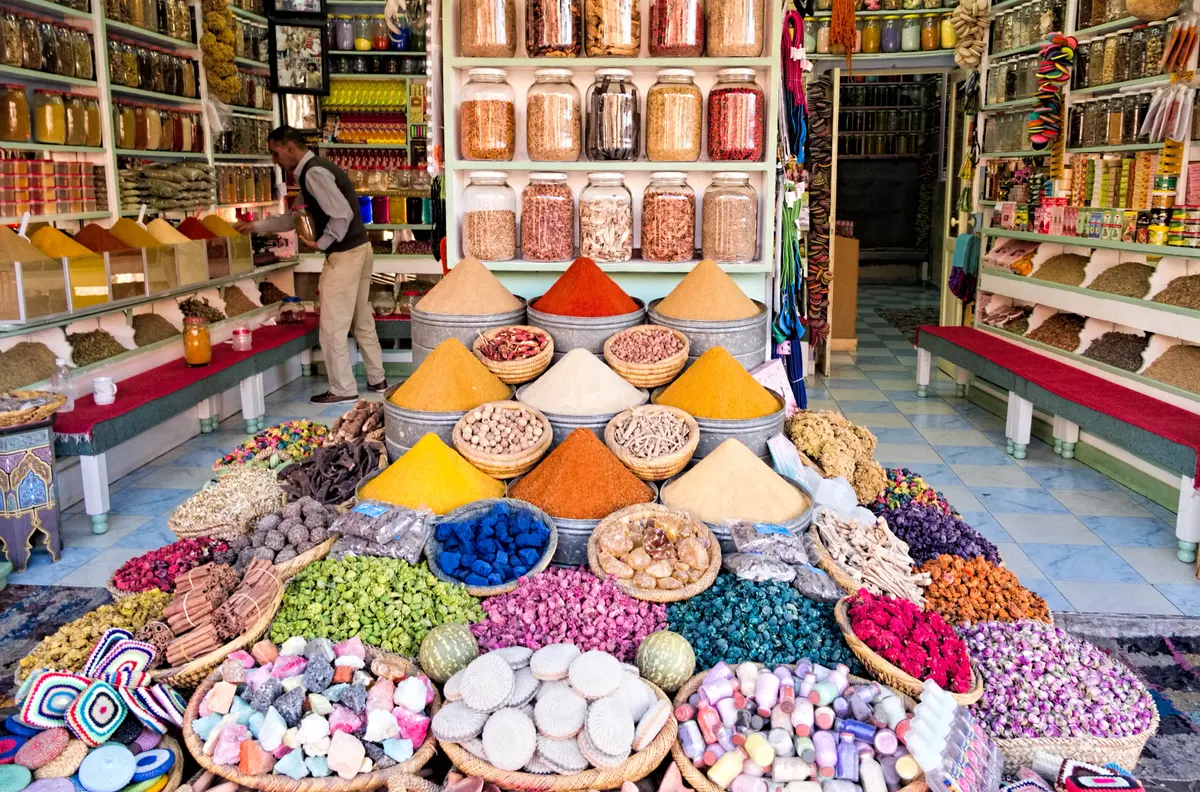
The man selling you a rug in the Marrakech souk will greet you in six languages in about four seconds. French, Spanish, English, German, Italian, Japanese.
He is not showing off. He is testing which one you answer in, and reading how confident you sound. Your accent, your hesitation and the language you settle into all feed the opening price.
This is not a scam and there is nothing to be offended by — it is a skilled trade, practised daily, and he is better at it than you are. If you want a small edge: answer in Darija, even badly. La, shukran — no, thank you. It signals that you have been here more than two days.
Numbers and prices
Prices are usually written in Western numerals — 1, 2, 3 — the ones you already read. You will also see Eastern Arabic numerals (٠١٢٣٤٥٦٧٨٩) on some official documents and older signage.
One real trap: people often quote prices in rials, an informal unit worth one twentieth of a dirham. “Four thousand” in a rural market can mean 200 dirhams. If a price sounds absurd, ask bidirham? — in dirhams? — and it will be restated.
Ten words that will carry you
Written as you would say them, not in formal transliteration.
| Darija | Meaning |
|---|---|
| salam | hello |
| shukran | thank you |
| la, shukran | no, thank you |
| afak | please |
| smeh liya | excuse me / sorry |
| bshhal? | how much? |
| ghali bezzaf | too expensive |
| wakha | OK / fine |
| safi | enough / that’s it |
| inshallah | God willing — also “probably not” |
And one in Amazigh: azul — hello. Use it in the Atlas and watch faces change.
Safi is the single most useful word on this list. It ends a negotiation, stops a waiter refilling your glass, and closes a conversation, all politely.
Should you learn Darija before you come?
Realistically, for a one or two week trip: no, and you do not need to. Darija has no standard written form, few good learning resources, and sounds that take real time. Nobody expects you to speak it.
Learn the ten words above. Say salam when you walk into a shop and shukran when you leave. That covers 95% of the social value at 1% of the effort.
The rest of what makes an interaction go well is not language at all — it is greetings, photography and the handful of customs that change how you are received.
If you are staying longer, look for a tutor rather than an app — the apps that claim to teach “Arabic” are teaching you Modern Standard, which will not help you buy bread.
Every guide and driver we work with is a native Darija speaker, most also speak Amazigh, and all of them work in French and English. They carry published licence numbers.
Meet the team you would actually travel with, or tell us what you want from your trip.
Frequently asked questions
What language is spoken in Morocco?
Darija, the Moroccan Arabic dialect, is the main language in Morocco and what you will hear everywhere. The two official languages of Morocco are Arabic and Amazigh (Berber).
What language do Moroccans speak?
Moroccans speak Darija to each other. Most also speak French, many speak an Amazigh language as their mother tongue, and younger Moroccans increasingly speak English.
What are the languages spoken in Morocco?
Four in daily use — Darija (Moroccan Arabic), Amazigh in three regional varieties, French, and Spanish in the north. Modern Standard Arabic is used in writing, news and religion but rarely spoken conversationally.
What is the Moroccan language called?
Darija. It is Moroccan Arabic — related to other Arabic dialects but heavily shaped by Amazigh, French and Spanish, and often not understood by Arabic speakers from the Middle East.
What language do they speak in Morocco?
Darija, the Moroccan Arabic dialect, is what almost everyone speaks day to day. Arabic and Amazigh are the two official languages. French is widely used in business and tourism, and Spanish is common in the north.
What is the official language of Morocco?
There are two — Arabic and Amazigh (Berber). Amazigh was made official in the 2011 constitution and is written in the Tifinagh script you see on government signs.
Do Moroccans speak French?
Most educated Moroccans do, and French is standard in banking, medicine, government and higher education. It is not an official language. In rural areas and among older people it may not be spoken at all.
Do they speak English in Morocco?
In tourist areas, yes — hotels, licensed guides, riads and restaurants near the main sights. Outside those it drops off quickly. English is now the most popular second language among Moroccans under 25.
Do Moroccans speak Arabic?
Yes, but Moroccan Darija differs enough from Modern Standard Arabic that speakers of Gulf or Egyptian Arabic often struggle to follow it. Darija has absorbed a lot of Amazigh, French and Spanish vocabulary.
What language is spoken in Marrakech?
Darija, with a great deal of French and enough English in the tourist core. Amazigh (Tashelhit) is common among people from the surrounding Atlas region.
Is Berber a language?
Amazigh is a family of related languages, not one. The three main Moroccan varieties — Tashelhit in the south, Tamazight in the Middle Atlas and Tarifit in the Rif — are not mutually intelligible.
Can I get by with only English in Morocco?
In Marrakech, Fes, Essaouira, Agadir and Casablanca, comfortably. On rural roads, in grands taxis and in small markets it gets difficult, which is where a guide or driver stops being a luxury.