Updated 5 August 2026
A tagine is two things with the same name: a conical clay pot, and the slow-cooked stew made inside it. Meat or fish, vegetables stacked around it, spices, and almost no added liquid — the cone traps the steam and returns it to the food. Two to three hours over a low flame.
That is the whole mechanism. Everything that goes wrong with a tagine — and a lot goes wrong with the ones served to visitors — comes from skipping the time.
The pot: two completely different objects
Walk through any souk and you will see hundreds of tagines. Almost none of them are for cooking.
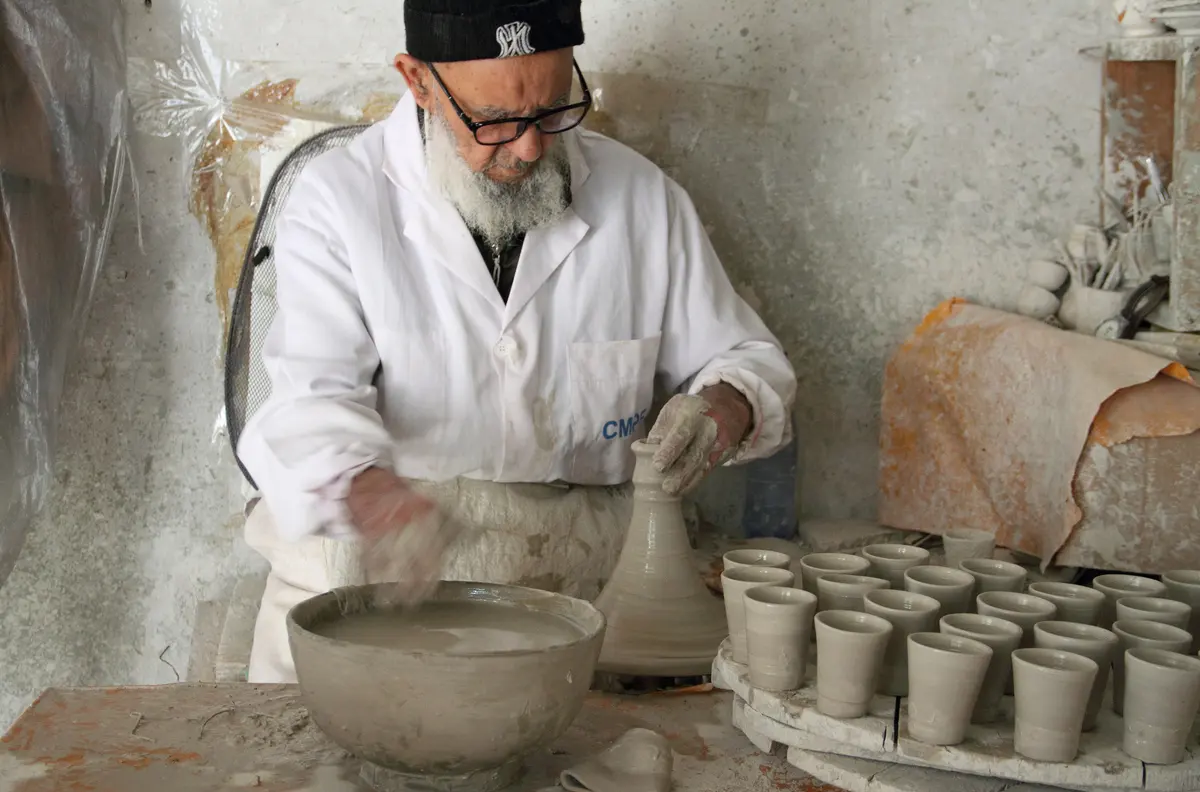
The cooking tagine is plain unglazed terracotta. It is the colour of a plant pot, usually blackened underneath, and it is not attractive. Nobody photographs it. It goes over charcoal or a low gas ring with a heat diffuser, and it gets better the more it is used.
The serving tagine is glazed, painted, sometimes enormous, and often beautiful. It carries food to the table and it is a decorative object. A lot of them have never seen heat and would crack if they did.
If you are buying one to cook in, buy the ugly one. And be careful with the decorated pieces: traditional glazes can contain lead, and no market seller is going to raise that with you. Cook in unglazed terracotta, or in a piece a reputable shop can confirm is food-safe.
The dish: what is actually in it
The structure barely changes. One protein, vegetables arranged around and over it in a cone, an oil-and-spice base underneath, and a slow, sealed cook.
Chicken with preserved lemon and olives — the most ordered tagine in Morocco. Turmeric-yellow, sharp from the lemon, salty from the olives. The one to judge a kitchen by.
Lamb with prunes and almonds — sweet, cinnamon-heavy, often finished with sesame. The dish visitors either adore or find cloying. Both reactions are reasonable.
Kefta with eggs — spiced meatballs in tomato sauce with eggs cracked in at the end. Cheap, everywhere, genuinely good, and the one Moroccan children ask for.
Fish tagine — coastal, marinated in chermoula (coriander, garlic, cumin, paprika, lemon), cooked on a bed of tomato and potato. In Essaouira this is what you should be ordering.
Vegetable tagine — the everyday household version, and the one served to vegetarians. Read the honest note below before assuming it is meat-free.
Mrouzia — lamb with honey, raisins and ras el hanout. A feast dish, mostly around Eid. If you see it on a menu out of season, someone is cooking it well or not at all.
How to tell a good tagine in one look
You can judge it before you taste it.
The sauce has reduced. It should be thick enough to cling to bread, slightly sticky, and pooled rather than watery. A thin, brothy sauce means liquid was added to speed things up.
The onions have disappeared. In a properly cooked tagine the onion base has collapsed into the sauce. If you can still identify onion slices, it has not been on long enough.
The meat falls apart against bread. You should not need a knife. If you do, it was thirty minutes, not three hours.
It took time to arrive. A restaurant that cooks tagines to order will tell you 40 minutes and mean it. That is a good sign, not a bad one.
Somewhere there is charcoal. Not essential, but the best ones still cook over it, and you can usually smell it.
The tagine you are served is often not a tagine
Here is the part that no recipe blog will tell you, because you have to work here to know it.
“Tagine of the day” on a medina terrace is frequently cooked that morning in a large pot in the kitchen, ladled into clay dishes, and held warm until someone orders it. It arrives under the cone because the cone is the photograph. At lunchtime, in a restaurant turning over two hundred covers, there is no other way to do it.
This is not a scandal and it is not a scam. It is catering. But it means a great many visitors leave Morocco having eaten a competent stew and believing they have eaten a tagine.
Where the real ones are: a house, a village lunch stop on a long drive, a riad that will cook one if you ask that morning, and small neighbourhood restaurants where the pots are lined up over charcoal at the front and the choice is whatever is in them. Two of those you cannot arrange yourself, which is most of the reason we exist.
What it costs
Bands for late 2026, and prices drift — check before you rely on them.
| Where | Price |
|---|---|
| Neighbourhood restaurant, no menu in English | 40-70 MAD |
| Tourist restaurant in the medina | 90-180 MAD |
| Riad dinner, cooked to order | 200 MAD upwards |
| Plain unglazed cooking pot in a souk | Cheap, and worth haggling for |
| Large decorated serving tagine | Several times that, and it is a serving dish |
The correlation between price and quality is weak. Some of the best tagines I have eaten cost 45 dirhams and came out of a pot on a pavement in a town nobody stops in.
What a tagine is not
It is not a tanjia. Tanjia is Marrakech’s own dish — beef or lamb sealed in a tall clay urn and cooked for five or six hours in the ash of the furnace that heats the public hammam. Different vessel, different method, and if a Marrakchi hears you use the words interchangeably you will be corrected.
It is not couscous. Different equipment, different technique, different day of the week — couscous belongs to Friday.
It is not curry. No chilli heat, no coconut, no frying of a spice paste. The spices go in cold with the oil and cook slowly with everything else.
Vegetarian: the quiet problem
Vegetable tagine reads as the safe order and frequently is not. Many kitchens build it on a meat stock, or finish it with a spoonful of the broth from something else on the stove.
“No meat” is understood everywhere in Morocco. “Nothing that touched meat” often is not — not out of carelessness, but because the question is unusual. Say it to your operator rather than to a waiter at eight in the evening, and it gets handled properly. The full position is in the Moroccan food guide.
Eating it
One tagine per person in a restaurant; one large one shared at home. Bread, not cutlery — you tear a piece with your right hand and use it to take food from the wedge of the dish in front of you, without reaching across. The rest of the table conventions are in culture and etiquette.
And if the host pushes the best piece of meat towards you, that is deliberate. Eat it.
On our trips, at least one lunch is a tagine that has been on a fire since morning, in a place with no sign, because our drivers eat there. It is not a scheduled highlight; it is just what a good day on the road looks like.
Tell us what you want from your trip, see the Marrakech to Fes desert crossing, or read about the Jemaa el-Fna stalls and how to pick one.
Frequently asked questions
What is a tagine?
Two things with one name. A tagine is the conical clay pot, and it is also the slow-cooked stew made in it — meat or fish with vegetables, spices, and very little added liquid.
Is it spelled tagine or tajine?
Both are correct. Tajine is the French transliteration and what you will see on menus in Morocco and France; tagine is the usual English spelling. Same word, same dish.
How much does a tagine cost in Morocco?
To eat, roughly 40-70 MAD in a neighbourhood restaurant and 90-180 MAD in a tourist one. To buy, a plain unglazed cooking tagine is cheap; a large decorated serving tagine costs several times more. Prices drift — check on the ground.
Can you cook in a decorated tagine?
Usually not, and you should assume not unless the seller can show you it is food-safe. The painted glazed ones are serving dishes. Traditional glazes can contain lead, and thin decorative pots crack over direct heat. Buy plain unglazed terracotta to cook in.
How long does a tagine take to cook?
Two to three hours over a low flame or charcoal. If yours arrives seven minutes after you ordered it, it was cooked earlier in a large pot and portioned into the clay dish.
Is tagine spicy?
Spiced, not spicy. Cumin, ginger, turmeric, paprika, saffron and sometimes cinnamon. Chilli is not part of the classic recipes; harissa, if it appears, comes on the side.
What is the most popular tagine in Morocco?
Chicken with preserved lemon and olives, closely followed by lamb with prunes and almonds. Both are restaurant dishes as much as home ones. The everyday household tagine is usually a vegetable one.
Can I take a tagine home on a plane?
In hold luggage, wrapped in clothes, yes — thousands of people do. It is heavy and it is fragile, and airport shops sell smaller ones for exactly this reason. Do not put one in a soft cabin bag.
Is a tanjia the same as a tagine?
No. A tanjia is a Marrakech dish cooked in a tall sealed urn in the ashes of the hammam furnace, not in a conical pot on a flame. Different vessel, different method, different city.