Marrakech-Safi
Things to Do in Marrakech
Ranked by how good they actually are, not alphabetically
Best time to visit
March to May, then September to November. July and August regularly pass 40°C.
How long to stay
Three full days for the city. Four or five if you add a day trip.
Getting there
Menara airport is 15 minutes from the centre. High-speed train from Tangier and Casablanca. 3 hours by road to Aït Benhaddou.
Things to do in Marrakech? The city takes three days. What follows is ranked by how good it actually is, and each entry gives you the price, the quiet hour, how long you really spend there, and an honest answer to the only question that matters: is it worth the detour.
Some of the answers are no. That is the point of this page.
Most lists of Marrakech attractions are the same twenty entries in the same order, with no indication of which are worth your morning and which are worth skipping. We run tours here. These are the calls we make for our own clients.
A note on scope: the best things to do in Marrakech, Morocco are concentrated in a surprisingly small area. The medina is walkable end to end in forty minutes, and eight of the ten places to visit in Marrakech below sit inside it. Distance is not your constraint here — heat and crowds are, and both are solved by going early.
The best places in Marrakech: the short answer
If you only have a day and a half, do these six and ignore everything else:
- Ben Youssef Madrasa, at opening
- Jemaa el-Fna in the morning
- The souks, on foot, without a destination
- One palace — Bahia
- Jemaa el-Fna again after dark, for dinner
- A rooftop at sunset
That is the city. Everything below is refinement.
The top ten in Marrakech, ranked
- Ben Youssef Madrasa — the most beautiful thing in the city, no argument
- Jemaa el-Fna — but twice, and not at just any hour
- The souks — even if you buy nothing
- Saadian Tombs — small, superb, badly queue-managed
- Bahia Palace — large, bright, very busy
- Le Jardin Secret — the calm Majorelle lost
- El Badi Palace — a ruin, and that is exactly the appeal
- Jardin Majorelle — beautiful, expensive, packed; at opening or not at all
- Yves Saint Laurent Museum — excellent if the subject speaks to you
- The Menara — honestly, only if you have time to spare
Jemaa el-Fna: go twice, not once
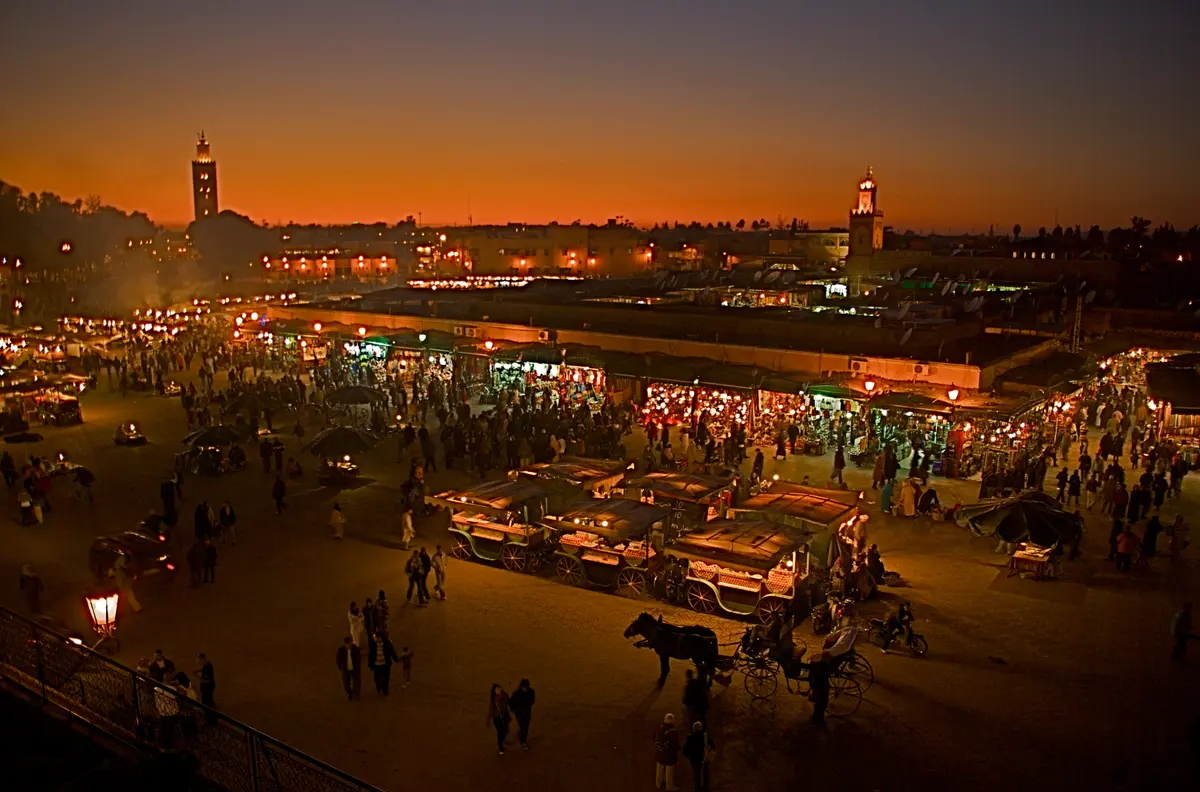
The square at 9am and the square at 8pm are two different places.
In the morning it is nearly empty. The juice sellers are setting up, you can see the ground, you understand the shape of the space, and you can cross it without being approached. This is when the photographs are.
In the evening, from about 6.30pm, the food kitchens go up, the smoke rises, the circles of musicians form. This is the show people come for.
What to know: photographs with the snake charmers, water sellers and monkeys cost money. Agree the amount first — 10 to 20 dirhams is normal, and you will be asked for more.
The café terraces overlooking the square charge for the view through a compulsory drink. It is still the best vantage point in the city at sunset.
The souks, without buying anything
The souks are a district, not a market. You can spend two hours in there without opening your wallet and it will be one of the best parts of the trip.
The layout is old and organised by trade: dyers together, metalworkers together, slipper-makers together. The sound changes as you move from one street to the next — it is the best cue you have for where you are.
You will get lost. That is expected, it does not matter, and asking “Jemaa el-Fna?” will point you back. Just be wary of young men who spontaneously offer to walk you to “the tannery” or “the Berber market that closes today.” That is a sales route, not a service.
The palaces: Bahia and El Badi
They are a ten-minute walk apart and they tell opposite stories.
Bahia is intact: painted ceilings, zellige tilework, planted courtyards. Late nineteenth century. It is the showcase of Moroccan decorative craft, and it is very busy from 10am.
El Badi is an open-air ruin. Sultan Ahmad al-Mansur built it in the sixteenth century and his successor had it stripped to build elsewhere. What remains is walls, sunken basins and stork nests. Plenty of people find it disappointing; others prefer it firmly to Bahia because you can breathe in it.
Our take: if you only do one, do Bahia. If you want quiet, El Badi.
Saadian Tombs and Ben Youssef Madrasa
The Saadian Tombs are small and the queue can outlast the visit. The twelve-column chamber is superb. Come at opening.
Ben Youssef Madrasa is the one not to miss. A former Quranic school, reopened after a long restoration, and it is the finest interior in Marrakech — carved cedar, stucco, zellige, and a courtyard of rare proportion. Allow an hour. Go early.
If you visit exactly one monument in Marrakech, make it this one.
The gardens
Majorelle is genuinely beautiful and genuinely crowded. The blue is real and so is the bamboo grove. But you move through it in single file from 10am, and the ticket is the most expensive in the city. At opening, or not at all.
Le Jardin Secret, in the middle of the medina, is the alternative: two restored gardens, a tower with a view, a café. Far fewer people and a more restful hour.
The Menara is a basin, an olive grove and a pavilion. It is free, it is a way out of the centre, and it is lovely at the end of the day when the Atlas clears. Worth it if you have time, not if you are short.
The Koutoubia: you cannot go in
The Koutoubia is the minaret you will use to navigate for three days, and it is on every list of Marrakech points of interest. What those lists tend not to say is that non-Muslims cannot enter — this is the rule at working mosques throughout Morocco, and the Koutoubia is very much a working mosque.
So what do you actually do with it?
Walk the gardens on the south side in the late afternoon, when the light is on the stonework and local families are out. Look at the ruins of the first mosque beside it — the original was built slightly off the correct alignment toward Mecca and a second was raised next to it, which is why there is a footprint in the ground next to the standing building. And listen for the call to prayer at sunset from the gardens; that is the closest you will get to the thing itself, and it is enough.
Twenty minutes, free, and best combined with the walk down to Jemaa el-Fna.
A hammam, and what actually happens
Nearly everyone books one and almost nobody knows what to expect, so: you undress to your underwear, you sit in a hot steam room until you are thoroughly softened, and then an attendant scrubs you with a coarse glove and black olive-oil soap. The amount of skin that comes off is genuinely startling. You are rinsed with buckets of warm water, and that is it.
It is not a massage and it is not delicate. It is a wash, and it is superb after a day on cobbles.
Three kinds exist. Public neighbourhood hammams cost very little, are single-sex, and are a real slice of the city — bring your own towel and flip-flops, and expect no English. Riad hammams are private, gentler, and the easiest first experience. Spa hammams are the hotel version, most expensive, least authentic, and perfectly pleasant.
Book it for the end of a walking day, not the start.
Rooftops at sunset
The terraces directly on Jemaa el-Fna have the view and charge for it through an obligatory drink. Worth it once, for the square filling up beneath you.
Better, if you want the Atlas rather than the crowd: the roof terraces in the Kasbah quarter in the south of the medina, quieter and looking toward the mountains on a clear day. And in Guéliz, the new town, the rooftops are aimed at residents rather than visitors — cheaper drinks, no view of the medina, considerably less hassle.
The mountains are visible from about November to April. In high summer the haze usually wins.
With limited mobility
Honestly: the medina is difficult. The lanes are uneven, frequently cobbled, often crowded, and mopeds use them at speed. Wheelchairs are hard work and a walking frame is harder.
What still works well: Jardin Majorelle (paved paths throughout), the Menara gardens, Guéliz for restaurants and cafés on flat pavements, and a calèche around the ramparts, which shows you the shape of the city with no walking at all. Several riads have ground-floor rooms — ask before booking rather than after, because most are built around a staircase.
Bahia Palace is mostly single-level and manageable. Ben Youssef and the Saadian Tombs involve steps and narrow doorways.
Things to do in Marrakech for free
- Jemaa el-Fna, at any hour
- The souks
- Walking the medina
- The Kasbah quarter and the ramparts at sunset
- The Menara gardens
- Watching the storks on the El Badi walls from outside
Marrakech at night
The Jemaa el-Fna kitchens from 6.30pm — pick a stall where Moroccans are eating.
The rooftops around the square for sunset. A hammam at the end of the day, when your legs have done eight hours on cobbles. And where the schedule allows it, dinner in a riad rather than a restaurant: the cooking is almost always better.
With children
The souks wear small children out fast — too many people, too much attention, nothing to orient by. What works: the square in the evening (the acrobats), a calèche around the ramparts, the riad pool in the middle of the day, and a trip out of the city — the Ourika valley, or a camel ride in the late afternoon.
Build in a real break between 1pm and 4pm. That is not laziness, it is the temperature.
What is overrated
We would rather say so.
Jardin Majorelle in the middle of the day. The garden is beautiful, the crowd makes it unpleasant, and the price no longer justifies it.
Folkloric dinner shows on the edge of town. Coach parties, industrial food, a fantasia on a timer. No relation to the country.
The tanneries. The smell is real, the visit is short, and it is almost always a pretext for a high-pressure leather sale. If tanneries genuinely interest you, do them in Fes, where they are larger and better seen.
Limited-time “Berber markets.” There is no Berber market closing in two hours. It is a shop.
Activities to do in Marrakech, beyond the monuments
Sightseeing is not the whole city. The activities to do in Marrakech that our clients remember afterwards tend not to be buildings at all:
- A cooking class — a morning in the market choosing ingredients, an afternoon making what you bought. The best-value half-day in the city.
- A hammam, as above
- A guided medina walk with a licensed guide, which is less about facts and more about being shown the doors you would never open
- A hot-air balloon at dawn over the palm groves north of the city — expensive, and the one splurge people rarely regret
- A calèche around the ramparts at golden hour
- A day in the Atlas, an hour away, for the change in temperature alone
Day trips from Marrakech
If you are staying more than three days, get out of the city:
- Ourika valley — 1h, waterfalls, terraces by the water
- Agafay desert — 45 min, stony rather than sand; this is not the Sahara, and you should know that before booking
- Ouzoud waterfalls — 2h 30, the finest falls in the country, wild monkeys
- Essaouira — 2h 30, ocean and wind, doable in a day but worth a night
- Aït Benhaddou — 3h over the Tizi n’Tichka, often the first leg toward the desert
Entry prices and opening hours
The prices below are the foreign-visitor rate. Several sites charge Moroccan residents considerably less.
| Site | Entry (MAD) | Hours | Time needed |
|---|---|---|---|
| Ben Youssef Madrasa | 50 (10 child) | 9am – 7pm | 1h |
| Bahia Palace | 100 (residents 30) | 9am – 5pm | 45 min |
| El Badi Palace | 100 (residents 30) | 9am – 5pm | 45 min |
| Saadian Tombs | 70–100 — confirm at the gate | 9am – 5pm | 30 min |
| Jardin Majorelle | 150–170 — confirm at the box office | 8am – 6.30pm (last entry 6pm) | 1h |
| Yves Saint Laurent Museum | 100 — closed Wednesdays | 10am – 6.30pm (last entry 6pm) | 1h |
| Le Jardin Secret | 120 (80 under 25) · tower +30 | 9.30am – 6pm | 1h |
| Jemaa el-Fna, souks, Menara | free | — | — |
Two things that make a real difference to the budget. Bahia, El Badi and Le Jardin Secret have all raised their prices — older guidebooks still say 70 and 80 MAD; budget 100 and 120. And for Majorelle, buy online through the official site: entry is timed, and the queue on the day can run past an hour in high season.
Rates checked against official ticketing in 2025–2026. Moroccan monument prices move regularly — verify before you travel.
What to do in Marrakech in 1, 2 or 3 days
One day. Ben Youssef at opening, the souks late morning, a long lunch and a break through the heat, Jemaa el-Fna from six, dinner at the stalls. You will have seen the city’s character if not its monuments.
Two days. Add the palaces on day two — Bahia in the morning before the crowd, El Badi after — plus the Saadian Tombs and one garden. Finish with a hammam.
Three days. Days one and two as above, then get out of the city. The Ourika valley, Ouzoud, or Agafay in the late afternoon. This is the version we recommend, because Marrakech is better when it is not the only thing you see.
More than three days and you will want to be somewhere else — which is why almost every trip we run pairs Marrakech with the desert or the coast.
For the hour-by-hour version, see our three-day Marrakech itinerary, and the practical side — when to come, where to stay, how long to give it — is on the main Marrakech destination page.
Half a day in the medina with a licensed guide changes what you actually see — and keeps you out of the sales routes dressed up as tours.
Tell us what you want to do or see our tours from Marrakech.
Frequently asked questions
What are the top things to do in Marrakech?
Ben Youssef Madrasa first — it is the finest interior in the city and most visitors skip it. Then Jemaa el-Fna twice, once in the morning and once after dark, the souks, the Saadian Tombs at opening time, and one palace. Bahia if you want it intact, El Badi if you want space to breathe.
How many days do you need in Marrakech?
Three full days covers the city properly — one for the medina, one for the palaces and a garden, one outside the city. Two days works if you skip the day trip. More than four and you will want to be somewhere else, which is why most people pair Marrakech with the desert or the coast.
What is there to do in Marrakech for free?
Jemaa el-Fna at any hour, the souks, walking the medina, the Kasbah quarter and the ramparts at sunset, the Menara gardens, and watching the storks nest on the El Badi walls from outside. The city's best hours cost nothing.
Is Marrakech worth visiting?
Yes, for three days. It is intense, crowded and relentless in the medina, and travellers who plan a week in the city alone usually run out of patience by day four. Treat it as a base rather than the whole trip and it is one of the great cities.
What should I avoid in Marrakech?
The Majorelle garden in the middle of the day, folkloric dinner shows on the edge of town, the tanneries, and anyone who tells you the Berber market closes in two hours. That last one is a shop, and there is no closing time.
Gallery
Let's plan your Morocco trip
Tell us your dates and interests. We reply personally, usually within a couple of hours.
usually within 2 hoursNo deposit to planLicensed tour guide