 3 days / 2 nightsSignature route
MarrakechFes
Marrakech to Fes Desert Tour: 3 Days to the Sahara
Cross the High Atlas on the Tizi n’Tichka pass
- 1–16
- Moderate
- 26 Sept
From€155 / per person
View tour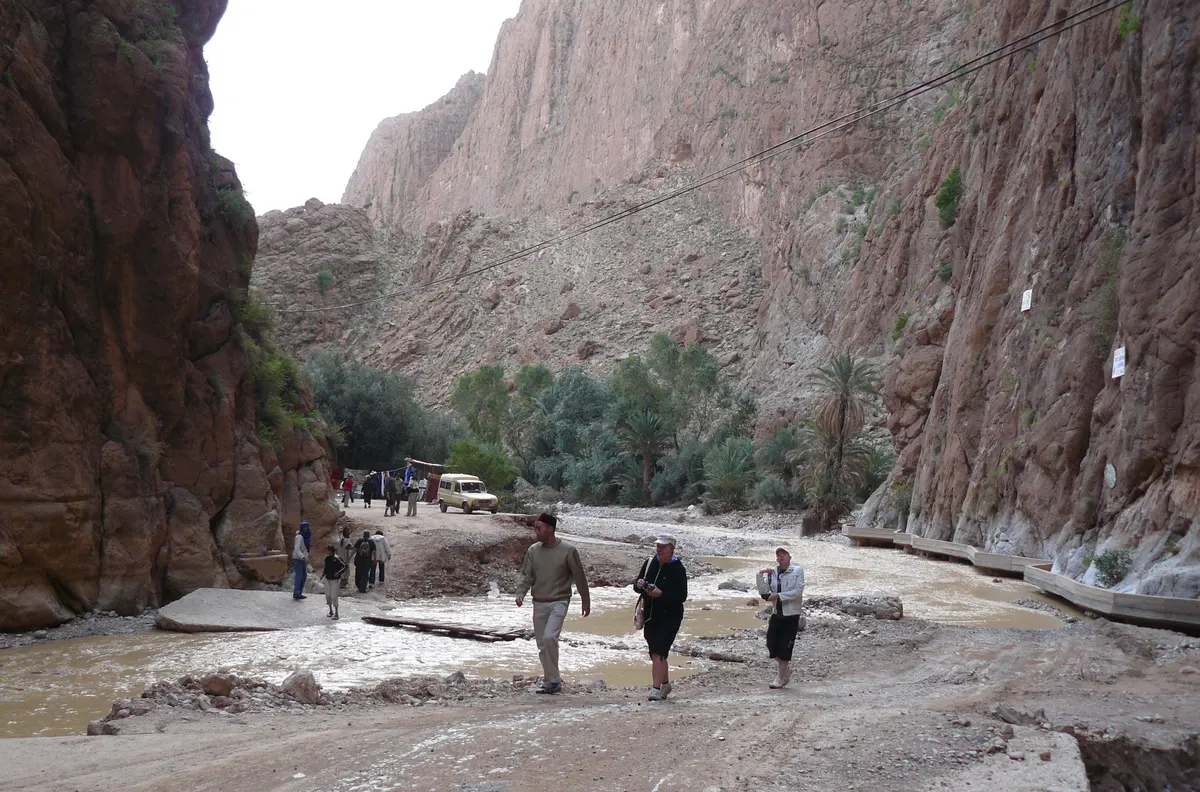
Drâa-Tafilalet
The narrowest half-hour on the road to the Sahara
Best time to visit
April to June and September to October. Cold and shaded in winter, over 40°C on the valley floor in July and August.
How long to stay
Thirty minutes if you are passing. Half a day if you walk beyond the narrows. Overnight only if you climb.
Getting there
On the main Marrakech–Merzouga road, about 6 hours from Marrakech and 3 from Merzouga. Fifteen kilometres north of Tinghir on a sealed road.
Todra Gorge is a limestone canyon in the eastern High Atlas where the walls reach about 300 metres and, at the narrowest point, stand roughly 10 metres apart. A road and a shallow river run through the bottom of it together.
Almost nobody travels to Todra. They stop at Todra — it sits on the main road between the Dades valley and Merzouga, and practically every Marrakech-to-desert itinerary passes through. That changes what you need to know about it.
Real driving times, not optimistic ones:
| Leg | Time |
|---|---|
| Marrakech → Aït Benhaddou | 3h |
| Aït Benhaddou → Dades valley | 2h 30 |
| Dades → Todra Gorge | 1h 30 |
| Todra → Merzouga | 3h |
On a three-day Marrakech–Fes desert crossing, Todra usually lands mid-morning on day two. That is unfortunate, because mid-morning is exactly when it is busiest.
The gorge has a rhythm and it is entirely predictable.
Coaches and 4x4s from the Dades hotels arrive between 10am and 1pm. That is the crowd. Before 9am the narrows are nearly empty and the light is coming down the walls rather than flattening them. After about 5pm it empties again.
If you are on a private trip, ask your driver to reach Todra before nine or after five. It costs nothing and it is the difference between a canyon and a car park.
The narrow section — the part in every photograph — is about 600 metres long. Walking it takes fifteen minutes. Most tours stop for thirty and that is genuinely enough to see the thing.
Beyond the narrows the gorge opens out and the road continues north toward Tamtattouchte. Almost nobody walks past the hotels, and that is where it gets good: fewer people, the same walls, and the river running beside you. An hour up and an hour back is a real walk with almost no company.
Todra is one of the better-known sport climbing venues in North Africa — several hundred bolted routes on solid limestone, mostly in the 5c–7b range, with the classics rising straight off the valley floor.
Season is March to May and September to November. Summer is unclimbable on the sunny side and winter is bitter in the shade.
There are local climbing guides based in Tinghir. If you want to climb, this is one of the few things at Todra worth building a stay around rather than passing through.
There are a handful of hotels on the gorge floor, right against the walls. The setting is remarkable and the sun disappears behind the rock by mid-afternoon — it gets cold early, and rooms are simple.
Tinghir, Morocco — fifteen kilometres south — has more choice, better food and a functioning town. Unless you are climbing, we usually put people in Tinghir or push on to Merzouga.
Most people drive through Tinghir looking at their phones and miss the best thing in the area: the palm oasis on the valley floor below the town. It runs for kilometres, it is still farmed in small plots, and you can walk into it from the edge of town.
It takes an hour and there is nobody there. Ask to stop.
You will probably do both — the two gorges are ninety minutes apart on the same route. The Todra gorges get the photographs; Dades gets the drive.
Todra is the dramatic one: sheer, narrow, over quickly. Dades is the scenic one: a longer valley with the switchback road, the kasbahs and the rock formations, better for driving through slowly.
If you only have time for one and you want the photograph, Todra. If you want the drive, Dades.
April to June, September to October. July and August exceed 40°C on the valley floor. December to February the gorge sits in shade most of the day and is genuinely cold.
The river is shallow year-round and often little more than ankle-deep. After heavy rain in the Atlas it can rise fast, and the road through the narrows has flooded before — rarely, but it happens. Your guide will know.
Layers. It is the thing people get wrong. You leave a hot valley floor, walk into the narrows, and the temperature drops noticeably in the shade of 300 metres of rock. There is no shade at all on the approach and full shade inside.
Also: proper shoes if you are walking past the narrows, and cash — the cafés at the entrance do not take cards.
Todra sits on our Marrakech to Fes desert crossing and every route we run through the High Atlas, and on a private trip we will time the stop for the quiet hour rather than the coach hour.
3 days / 2 nightsSignature routeMarrakechFes
Cross the High Atlas on the Tizi n’Tichka pass
From€155 / per person
View tour 10 days / 9 nightsSignature route
Marrakech
Every region that matters, in one loop
From€1,100 / per person
View tour 4 days / 3 nights
Marrakech
Two nights in a private-suite camp with proper beds and en-suite bathrooms
From€520 / per person
View tourTell us your dates and interests. We reply personally, usually within a couple of hours.
usually within 2 hoursNo deposit to planLicensed tour guide
+212 665 295 999
Try “Sahara”, “3 days”, or “Chefchaouen”.