Updated 5 August 2026
The souks of Marrakech are not a market. They are a working craft quarter north of Jemaa el-Fna, organised by trade — leather in one street, metal in the next, dyers in a third. Learn the order and you stop getting lost, and you stop overpaying. Both problems have the same solution.
What is a souk, and how the Marrakech souks are organised
A souk is a market quarter, not a building. There is no single souk. Marrakech has around twenty of them, each named for what it makes or sells, and they occupy a dense block of covered lanes running north from the square.
The organisation is medieval and it is still real. The trades were guilds; guilds shared a street, a fountain and a mosque. So the tanners are downwind and near water, the blacksmiths are together where the noise bothers nobody, and the spice sellers sit on the main artery where the customers are. Every souk Morocco has works this way, down to a Tuesday market in the Atlas.
A word on the name. Signage and printed maps here are in Arabic and French, so you will see le souk de Marrakech, and les souks de Marrakech on street plans. Older guidebooks spell it Marrakesh souk. English writing sometimes calls it the Marrakech bazaar, or a bazaar in Marrakech — a Persian word that nobody in Morocco uses.
The trades, street by street
Walking north from Jemaa el-Fna, roughly in this order:
| Souk | What is there |
|---|---|
| Souk Semmarine | The main artery. Textiles, souvenirs, the highest rents and the highest prices |
| Rahba Kedima | The old square: spices, dried herbs, apothecaries, hats and baskets |
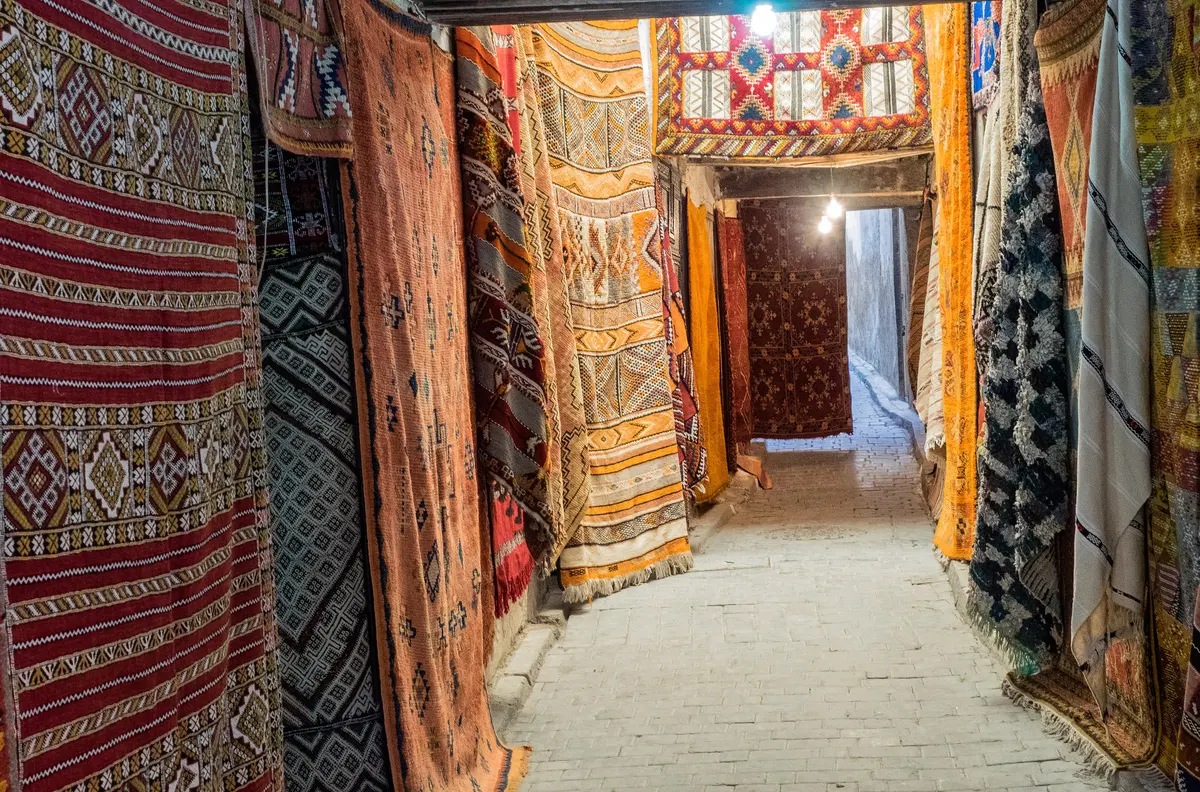
| Criée Berbère | Off Rahba Kedima. Rugs and blankets; a late-afternoon auction most days |
| Souk el Attarine | Perfume and spice, now largely lanterns and brass |
| Souk Smata | Babouches — thousands of pairs, hung in walls of colour |
| Souk Cherratine | Leather, and the workshops behind the stalls |
| Souk Haddadine | Blacksmiths. You will hear it before you see it |
| Souk Sebbaghine | The dyers, with wool hung overhead to dry. The photograph everyone wants |
| Souk Chouari | Woodworkers — thuya, cedar, olive |
Souk Semmarine, Marrakech’s spine, is the one every visitor walks. It is also the one where the goods are least likely to have been made locally. The further from it you get, the more likely you are standing in front of the person who made the thing.
How the crafts are actually made
Babouches. Sheep or goat leather, cut by hand, stitched by hand, glued to a leather sole. Yellow was traditionally men’s, and still is in the older quarters. A well-made pair has stitching you can see and no cardboard in the sole.
Rugs. Two families of thing. Knotted pile rugs — the Beni Ourain and Azilal from the Middle Atlas, thick and undyed. Flatweaves — hanbel and kilim, thin, reversible, cheaper by the metre. A Beni Ourain takes a woman months. Turn any rug over: the back should show you the knots and the pattern. If the reverse is blank, it is machine-made or glued.
Leather. Skins are still tanned in pits at Bab Debbagh here and at Chouara in Fes, with lime, pigeon droppings and vegetable dye. It is a genuinely medieval process and the smell is not a performance.
Metal. Lanterns are brass or tin-plated steel, pierced with a punch by hand. Look inside: hand-punched holes leave a burr, a stamped panel is uniformly clean.
Wood. Thuya root burl comes from around Essaouira and is worked wet; the swirl in the grain is the burl, not a veneer.
Zellige. The tile mosaic on walls and fountains is cut piece by piece with a small hammer from a fired square. Each shape is one cut, by one man, sitting down.
Which claims are true, and which are sales patter
The good news: most of what you are told about how things are made is true. The specific claims below are the ones that are usually not.
- “Cactus silk.” Almost always rayon — mercerised viscose, woven and shiny. Real sabra fibre exists and is not what is on that shelf. Lovely cushion covers; not silk, and not cactus.
- “Antique Berber rug, sixty years old.” Some are. Many are new, washed, sun-bleached and lightly worn on purpose. Age is the easiest claim to make and the hardest to check.
- “Pure saffron.” Real saffron is one of the most expensive substances on earth. If a bag of it costs less than lunch, it is safflower or dyed turmeric. Buy saffron by the gram, in a labelled tube, from a spice shop that sells only spices.
- “Silver.” Usually nickel silver, which contains none. Genuine silver carries a hallmark and a price to match. Old Amazigh jewellery is often low-grade silver alloy and is honest about it.
- “My family’s cooperative in the mountains.” The shop is a shop. Genuine cooperatives exist, mostly for argan and weaving, and they have paperwork, a signboard and fixed prices.
- “Amber.” Frequently copal or resin. If it is warm to the touch and light, be sceptical.
None of this is fraud in the sense of a crime. It is a sales register, practised daily, by people much better at it than you. Knowing which sentence to discount is the whole skill.
What things cost, and how the haggling works
Prices are not marked because the price depends on the buyer, and the buyer’s job is to give away as little as possible about themselves. Your accent, your shoes and your hesitation are all being read — the language page explains what the six-language greeting is actually doing.
How it goes in practice:
- Greet first. Salam alaikum. Transacting before greeting is the single most common visitor mistake, and it costs money.
- Do not name the first number. Ask, then react without insulting the object.
- Decide your own price before you start, based on what it is worth to you at home. It is the only number in the room that means anything.
- Expect the opening figure to be several times the closing one on small brass, leather and textiles. On silver, argan and saffron the spread is much narrower, because the material has a real cost.
- Walking away is normal. Walking away after agreeing a price is not — that is the one thing that will genuinely offend.
If haggling exhausts you, the state-run Ensemble Artisanal and the licensed cooperatives sell at fixed prices, a little above a good souk price and well below a bad one. Nobody will think less of you.
Hours, Friday, and when to go
Most shops open between 9 and 10am and trade until 8 or 9pm, later in summer. Around midday on Friday a good number close for congregational prayer and lunch, for an hour or two — the medina noticeably empties, and it catches people out. Sunday is a normal trading day.
Go at 9am if you want to see anything. Go at 6pm if you want the atmosphere, the lights and three times the crowd.
Navigating without a phone
Your phone will lose its signal and its sense of direction under the covered lanes, where reed roofing throws stripes of light and confuses every landmark. This is normal and it is not a failure of your handset.
Navigate by trade instead. Spices and perfume mean you are near Rahba Kedima. Hammering means Haddadine, in the north-east. Wet dye and the smell of wool mean Sebbaghine. If you are truly lost, walk downhill and towards noise: everything drains south to Jemaa el-Fna, and any shopkeeper will point. Say the name of the square, not the name of your riad.
“That way is closed today”
You will be told, politely, that your route is shut, that the tannery is open this afternoon only, that the Berber market ends today. It is a redirection, and it ends in a shop that pays a commission.
There is nothing sinister in it and no reason to be rude. La, shukran, keep walking, do not stop to argue. If you are genuinely lost, ask a shopkeeper standing in his own doorway rather than anyone who approaches you in the street.
Do you need a guide?
On a first afternoon, yes — not to be shown sights, but to be walked through the geography once so that it makes sense afterwards. A licensed guide carries a card with a number on it. Expect roughly 250 to 400 dirhams for a half-day Marrakech medina tour, agreed in advance; rates move, so confirm the figure when you book rather than at the end.
What a guide should not do is take you into shops. If that starts, say so plainly. The commission is real and it comes out of your price.
The souks in Fes, Essaouira and Chefchaouen
Fes — bigger, older, harder and much less used to tourists. The best craft in Morocco and the least comfortable shopping.
Essaouira — small, laid out on a grid, salt air, thuya wood and silver. The easiest souk in Morocco to shop in.
Chefchaouen — the Chefchaouen souk is tiny, mostly wool blankets, and the mountain weaving is genuine.
Agadir — In Agadir, Souk El Had is a municipal market rather than a tourist quarter, walled and enormous.
The rest of the old city — the gates, the quarters, why your taxi cannot reach your riad — is in the Marrakech medina explained, and the etiquette that surrounds all of this is in customs and etiquette. Afterwards, the hammam is what Marrakchis do with an afternoon like that.
We walk clients through the souks once, on the first day, and leave them to it after that. Tell us what you want from your trip, or read more in the Moroccan culture guide.
Frequently asked questions
What is a souk?
A market quarter organised by trade rather than a single market building. Each street holds one craft — leather in one, metal in the next — because the trades were guilds, and the guilds were neighbours. Most are workshops as well as shops.
What time does the souk open in Marrakech?
Most stalls open between 9 and 10am and trade until 8 or 9pm. The covered lanes fill up around 11am. Early morning is when you can actually see the goods and hear yourself think.
What time do the souks close in Marrakech?
Usually 8 to 9pm, later in summer and during Ramadan evenings. Individual shops close whenever the owner decides, and many take an hour or two off around Friday midday prayers.
Are the souks in Marrakech open on Sunday?
Yes. Sunday is a normal trading day and slightly quieter than Saturday. Friday around midday is the closest thing to a weekly pause.
Where are the souks in Marrakech?
Immediately north of Jemaa el-Fna, inside the medina walls. Souk Semmarine runs north from the square and everything else branches off it. Rue Mouassine and Bab Laksour are the western entrances.
How many souks are in Marrakech?
Around twenty named trade souks, depending on how you count — several have merged or moved as crafts died out. Nobody, including Marrakchis, agrees on a number.
What is the best souk in Marrakech?
For craft you can watch being made, Souk Haddadine and Souk Cherratine. For buying, Rahba Kedima and the Criée Berbère. Souk Semmarine is the busiest and the most expensive.
Do I have to haggle in the souks?
In the souks, yes — prices are not marked and the first number is an opening position. In the fixed-price cooperatives and the Ensemble Artisanal, no. Both exist and both are legitimate.