Updated 5 August 2026
Moroccan food is slow-cooked, heavily spiced and almost never hot. It is built on bread, olive oil, preserved lemon and one pot left over a low flame for hours. The cuisine in Morocco splits cleanly in two: what restaurants serve visitors, and what families eat at home. Both are worth knowing.
Most of what is written about Moroccan food in Morocco is written by people who ate it once, on holiday, in a riad. This page is written by the people who cook it.
Moroccan food in Morocco: two different cuisines
Every list of Moroccan cuisine dishes opens with the same three — tagine, couscous, pastilla — and then stops. Those are real, but they are the formal dishes. They are what you cook for guests, for Friday, for a wedding.
The everyday food in Morocco is quieter than that. It is soup. It is pulses. It is a plate of sardines because Morocco is one of the world’s largest sardine exporters and they cost almost nothing here. It is bread and olive oil and a tomato.
If you only eat the traditional Moroccan food that appears on printed menus, you will leave having eaten well and having missed the point.
What makes it taste like this
Four things, and they are not the ones the spice-stall performance sells you.
Cumin. In everything, on everything, in a small dish on the table next to the salt.
Preserved lemon. Lemons packed in salt for a month until the peel goes soft and the flavour turns from sharp to something else entirely. This is the taste people cannot place when they get home and try to reproduce a tagine.
Smen. Butter, salted and aged, sometimes for years. Pungent, and used in small amounts in tanjia and couscous. It is the one ingredient visitors reliably notice and cannot identify.
Olive oil, and a lot of it. Poured over bissara, over salads, into everything. Moroccan oil is greener and more peppery than most supermarket oil in Europe.
Ras el hanout — the famous blend — is genuinely variable. Every shop mixes its own and any stall claiming to sell the recipe is guessing. It is a finishing blend, not a base.
Spicy or spiced?
Spiced, not spicy. This is the most common misunderstanding about typical Moroccan food.
Cumin, paprika, ginger, turmeric, saffron, cinnamon and pepper do the work. Chilli heat is marginal — harissa is Tunisian, and where you meet it here it is on the side, in a dish, for you to add. Some fish marinades carry a bite. Nothing else will.
If you have a low tolerance for heat, Morocco is one of the easiest countries in the region to eat in.
Tagine: the pot, the dish, and the version you will be sold
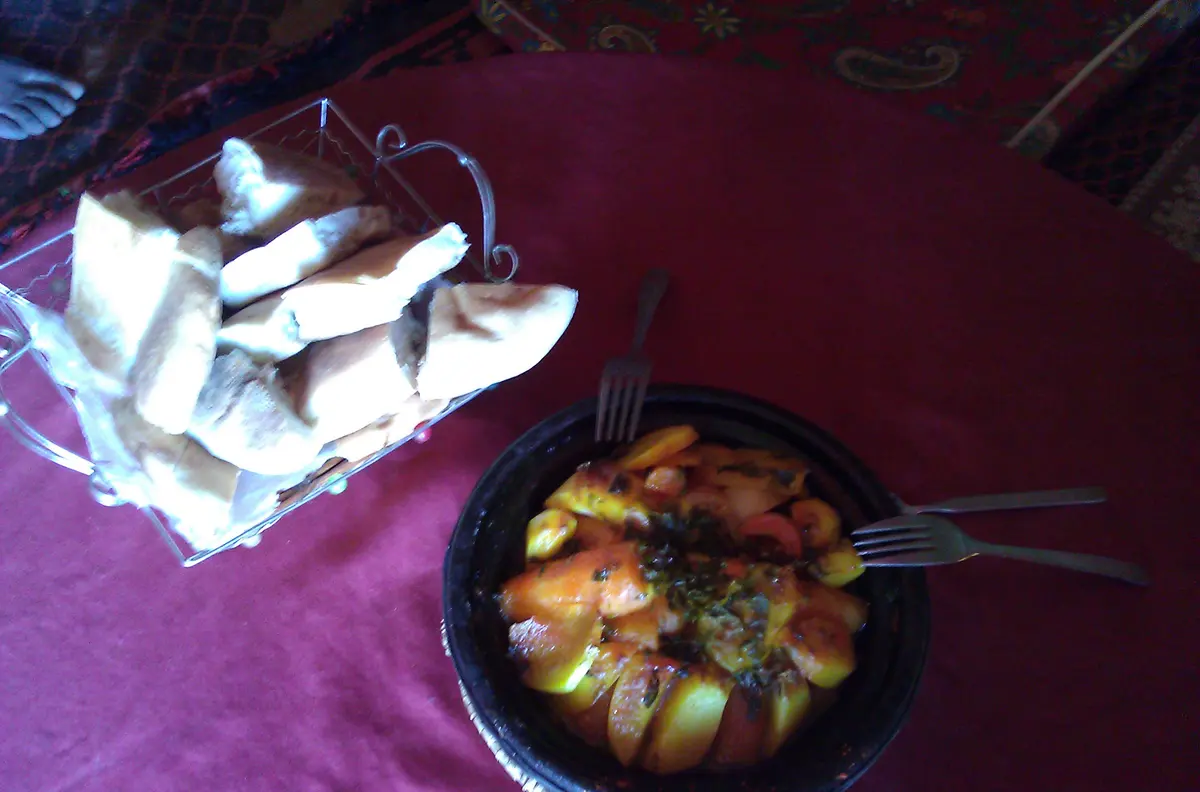
A tagine is two things at once, which causes endless confusion. It is a conical clay pot, and it is the stew cooked in it.
The cooking pot is plain unglazed terracotta, usually blackened, and it is ugly. The painted, glazed, beautifully decorated tagines stacked in every souk are serving dishes and ornaments. A lot of them have never been near a fire and would crack if they were.
Here is the part nobody writes down: the tagine you get on a medina terrace is often not a tagine. “Tagine of the day” at a tourist restaurant is frequently cooked in a large pot in the kitchen, portioned into a clay dish, and held warm. It arrives at the table under the cone because the cone is the photograph.
A real one cooks for two to three hours over charcoal or a low gas ring, and you can tell: the sauce has reduced and gone slightly sticky, the onions have collapsed, and the meat comes away without a knife. If it arrives seven minutes after you ordered it and the sauce is thin, it was reheated. That is not a scandal, it is a lunch service — but it is not what anyone’s mother cooks.
The full guide to tagine covers the varieties and how to tell a good one before you order.
Couscous is a Friday dish
This single fact reframes most Moroccan restaurant menus.
Couscous is cooked on Friday, after congregational prayer, as the family meal of the week. Semolina is rolled by hand and steamed three separate times over the broth below it. It takes most of a morning.
Which means a restaurant serving couscous on a Tuesday steamed it earlier, or yesterday. It will be fine. It will not be the thing people describe when they talk about Moroccan couscous.
If you can only arrange one meal in advance on your trip, make it couscous on a Friday.
What a Moroccan household eats on a normal Tuesday
Not the eight-dish spread in the photographs. Roughly this:
- Harira — the tomato, chickpea and lentil soup, thickened with flour and finished with coriander. Eaten year-round, and every evening during Ramadan.
- Bissara — dried fava beans cooked down to a purée, poured into a bowl, flooded with olive oil and dusted with cumin and paprika. Winter breakfast and working lunch. Costs almost nothing.
- Lentils and white beans — adas and loubia, cooked in a tomato base, eaten with bread.
- Grilled or fried sardines — on the coast daily, inland often.
- Cooked salads — zaalouk (smoked aubergine and tomato), taktouka (green pepper and tomato). These arrive as a starter in restaurants and are a meal at home.
- Whatever vegetable is cheap this week, in a pot, with cumin.
Meat once or twice a week for most families. The daily tagine is a tourist’s idea of Morocco, not a Moroccan’s.
The Moroccan dishes worth changing your plans for
These are the classic Moroccan dishes that are genuinely better here than anywhere else, and in rough order of how strongly I would push you towards them.
Tanjia. Marrakech’s own dish and the best argument for eating in this city. Beef or lamb, preserved lemon, cumin, garlic and smen sealed into a clay urn, then cooked for five or six hours in the ash of the furnace that heats the neighbourhood hammam. Traditionally a man’s dish — the bachelor’s lunch. Most restaurant versions are oven-cooked and therefore not really tanjia. Ask whether it went to the farnatchi.
Mechoui. Whole lamb, slow-roasted in a pit until it pulls apart. Sold by weight, eaten with bread, cumin and salt, standing up. The stalls in the alley off the north side of Jemaa el-Fna do it properly.
Pastilla. Layered pastry pie, traditionally pigeon and now usually chicken, with almonds, cinnamon and icing sugar on top. Sweet and savoury in the same mouthful. People either love it immediately or refuse the second bite. On the coast there is a seafood version with no sugar.
Fish straight off the boat. Essaouira is where this stops being about Moroccan cooking and becomes about the fish itself — grilled, salted, lemon, nothing else.
Msemen and harcha. Griddle breads, eaten at breakfast and at four in the afternoon with tea.
Breakfast is where the surprise happens
Nothing prepares most visitors for being handed a bowl of olive oil at seven in the morning.
There are three completely different Moroccan breakfasts and travellers usually only ever meet one of them: the riad spread of griddle breads, jams and orange juice, which is staged for guests. The second is a bowl of bissara or harira eaten standing at a counter before work, for the price of a bus ticket. The third is the Amazigh breakfast in the mountains — bread, olive oil, honey, amlou and tea, off one shared plate.
The riad version is lovely. The other two are the country. There is a full guide to Moroccan breakfast with what each costs.
Bread is not a side dish
Khobz arrives before anything else and it is the cutlery. You tear a piece with the right hand and use it to pick food out of the shared dish in front of you — your own wedge of it, never reaching across.
Bread has a status here that surprises visitors. It is not thrown away in front of people; leftover bread gets left on a wall for someone to collect. If you take one behavioural note from this page, take that one. The rest of the table customs are in culture and etiquette.
Morocco food prices, from a stall to a palace
Bands, not quotes. Prices move and these are for late 2026 — check current figures before you budget tightly.
| What | Typical price |
|---|---|
| Harira from a street counter | Under 10 MAD |
| Msemen or a griddle bread at a stall | A few dirhams |
| Mint tea, café | 5-15 MAD |
| Tagine, neighbourhood restaurant | 40-70 MAD |
| Full plate at a Jemaa el-Fna stall | 50-100 MAD |
| Rooftop dinner, Marrakech medina | 150-300 MAD a head |
| “Gastronomic” riad dinner | 400 MAD upwards |
The uncomfortable truth in that table is that the 90 MAD lunch is frequently better than the 600 MAD dinner. What the expensive places sell is the room. A full breakdown of trip costs is in the Morocco travel budget guide.
Nasty Moroccan food: what visitors genuinely dislike
People do type that into Google, so here is the honest version rather than the defensive one.
The sugar. Mint tea is sweeter than most visitors expect and pastries are sweeter still. You are allowed to ask for less.
The sameness. Ten days of tagine and couscous on a standard tour circuit is repetitive, and it is repetitive because tour menus are conservative, not because the cuisine is narrow. Push your guide off the fixed menu.
Offal and heads. Sheep’s head, brain and snail stalls are real street food, not a stunt, and they are not for everyone. Nobody will mind if you walk past.
Warm-held buffets. Hotel buffets are where Moroccan food goes to die. If your itinerary has three of them, change the itinerary.
Vegetarian in Morocco, honestly
Easy for vegetarians, hard for vegans, and anyone who tells you otherwise is selling optimism.
Salads, bread, olives, olive oil, bissara, lentils, msemen, fresh fruit and vegetable couscous will carry you comfortably. The trap is that vegetable tagine is often finished with meat stock, and couscous broth almost always has meat in it somewhere. “No meat” is understood everywhere; “no animal products” frequently is not.
Desert camps are the pinch point — they buy for the day and cannot improvise. Give 48 hours’ notice, through your operator, and it is a non-issue.
Regional differences that are actually noticeable
Marrakech — tanjia, heavy grill culture, the most tourist-shaped restaurant scene in the country. Fes — the refined end. Pastilla, complex sweet-savoury cooking, the strongest claim to being Morocco’s culinary capital. The coast — Essaouira and the Atlantic towns: fish, and very little interest in dressing it up. The Atlas and the south — Amazigh cooking. Barley couscous, fewer spices, more butter and milk, amlou at breakfast, and a lot of bread. The north — Spanish and Andalusian influence, better seafood, more paprika.
What to order first
If you have three meals in Morocco: tanjia in Marrakech, couscous on a Friday, and a fish grill on the coast. If you have four, add a bowl of bissara from a place with no menu, standing up, before nine in the morning.
The rest of the silo goes deeper — breakfast, street food and the Jemaa el-Fna stalls, mint tea and whether you can drink alcohol here.
On our trips the food is not an afterthought bolted to a driving schedule. We stop where our drivers eat, we book the Friday couscous, and we brief every riad and camp on dietary requirements in advance and in Darija.
Tell us how you like to eat and we will build the trip around it, or look at the Marrakech to Fes desert crossing to see what a week of meals actually looks like.
Frequently asked questions
What is Moroccan food?
Slow-cooked, heavily spiced and almost never hot. It is built on bread, olive oil, preserved lemon, cumin and one pot. Tagine and couscous are the famous dishes; soup, pulses, fish and vegetables are what households actually eat most days.
What is the national dish of Morocco?
Couscous. It is the Friday meal, cooked after congregational prayer and eaten from a shared plate. Tagine is more famous abroad, but couscous is the dish with a fixed place in the week.
What to eat in Morocco?
Order tanjia in Marrakech, couscous on a Friday, a fish grill on the coast, and harira or bissara at least once from a place with no menu. Skip the "tagine of the day" on a tourist terrace.
Is Moroccan food spicy?
Spiced, not spicy. Cumin, paprika, ginger, turmeric, saffron and cinnamon do the work. Chilli appears mainly as harissa on the side, which is a Tunisian import, and in some fish marinades.
How much does food cost in Morocco?
A tagine in a neighbourhood restaurant is roughly 40-70 MAD, harira soup can be under 10 MAD, and a rooftop dinner in the Marrakech medina runs 150-300 MAD a head. Prices drift, so check before you budget tightly.
Is Moroccan food halal?
Yes, almost universally. Meat is halal by default, pork appears only in a handful of French-run restaurants and imported sections of big supermarkets, and you do not need to ask.
Is Moroccan food healthy?
The everyday version is — pulses, vegetables, olive oil, fish, very little processed food. The restaurant version is heavier, and the sugar in the tea and the pastries is where visitors get caught out.
What is the difference between a tagine and a couscous?
A tagine is a stew cooked slowly in a conical clay pot; couscous is steamed semolina served under a broth of vegetables and meat. Different equipment, different method, different day of the week.