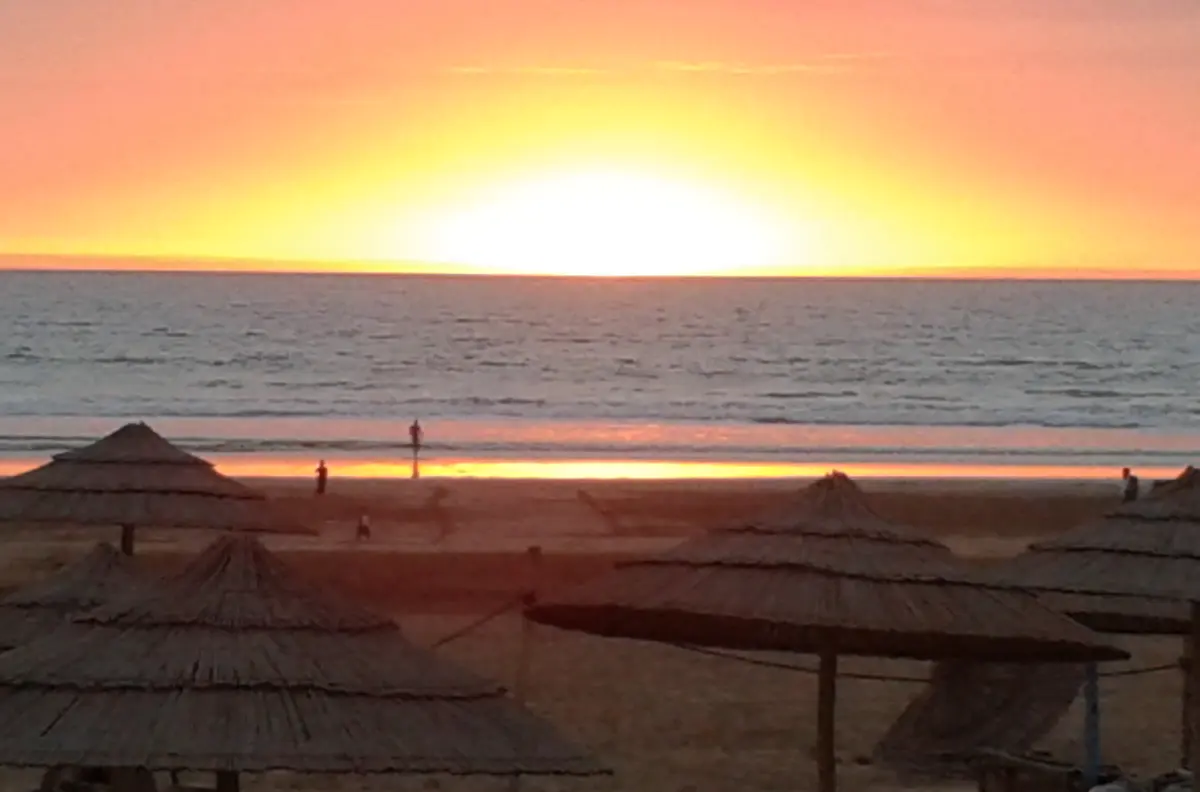
Souss-Massa
Agadir, Morocco: A Beach Resort, Not a Medina
Ten kilometres of sand, and almost no history left standing
Best time to visit
All year, and that is the point. October to April for winter sun and surf, June to September for a warm sea and full hotels.
How long to stay
Three nights if you are using it as a base. A beach week if that is genuinely what you booked.
Getting there
Al Massira airport is 25 km south-east with direct European flights. No railway — coaches from Marrakech take three and a half to four hours.
Agadir, Morocco is a beach resort, not a Moroccan city in the way most visitors expect one. The earthquake of 1960 destroyed the old town, and what was rebuilt is a seafront of hotels behind ten kilometres of sand. Come for the beach and the surf coast. Do not come for a medina.
The 1960 earthquake, and why there is nothing old here
On 29 February 1960, an earthquake of moderate magnitude but very shallow depth struck directly beneath the city. It lasted about fifteen seconds. Around 15,000 people died, roughly a third of the population, and the old town, the mellah and most of the kasbah were flattened.
The decision afterwards was to rebuild two kilometres south of the ruins and to leave the old site as a burial ground. So Agadir has no medina, no souk lanes, no seventeenth-century gates and no palaces. It has 1960s and 1970s architecture, wide boulevards and a promenade.
That is not a criticism of the city. It is the single most important thing to know before you book it, and almost nobody says it.
Who Agadir is right for
Be honest with yourself about the trip you are booking, and this page becomes easy.
Agadir works for: winter sun between November and March, families who want a hotel with a pool and a safe beach, anyone learning to surf, golfers, and travellers who want one week of nothing after two weeks of driving.
Agadir does not work for: a first trip to Morocco, anyone who wants a medina, souks, monuments or old streets, or anyone hoping to feel they have arrived somewhere unfamiliar. You will spend the week wondering where Morocco went.
If the second list describes you, book Essaouira instead. It is 175 km up the coast, about two and a half hours, and it is a walled Atlantic port with an intact eighteenth-century medina, a fishing harbour and the same wind.
Agadir beach, and the water temperature nobody mentions
The beach is the asset and it is a genuinely good one: a crescent of sand about ten kilometres long, sheltered by the bay, shallow and gently shelving, cleaned daily and patrolled in season. It is one of the safest swimming beaches in the country.
The sea is another matter. This is the open Atlantic, cooled by the Canary current, and it sits around 17-18°C in winter and 21-22°C at the end of summer. The air can be 22°C in January while the water is bracing. Bring a wetsuit if you plan to be in it for more than a swim.
Winter sun, which is the actual product
Northern Europe books Agadir in January for one reason, and it is a sound one. The city sits far enough south to keep daytime temperatures around 20-22°C through December, January and February, with long spells of clear sky and very little rain. It is reliably mild rather than hot.
Two caveats. Evenings drop quickly once the sun goes — you will want a jumper by seven, and hotel pools are cold unless heated. And in high summer the city is pleasant rather than scorching, usually 25-28°C, because the Atlantic caps it; the heat everyone imagines is 250 km inland in Marrakech.
The one weather feature worth knowing is the morning cloud. A grey marine layer often sits over the bay until late morning between June and September, burns off by midday, and returns at dusk. It is normal, it is not a bad forecast, and no hotel brochure has ever photographed it.
Agadir town centre, the marina and the kasbah
Agadir town centre is functional rather than interesting: hotels, banks, restaurants along the beach road, and a marina at the north end with cafés and moorings.
Two things are worth your time.
Souk El Had is the exception to everything above — a walled market with thousands of stalls selling spices, argan oil, produce, clothes and hardware to people who live here. It closes on Mondays. Go in the morning, go with cash, and treat it as the only place in the city that is not built for you.
Agadir Oufella, the kasbah on the hill, was a sixteenth-century fortress reduced to its walls by the earthquake. It has been restored and now has a cable car up to it. Go for the view over the bay and the port, not for the ruins. The Arabic hillside inscription below it reads “God, Country, King” and is lit at night.
Taghazout and the surf coast
This is the real reason to be here, and it is twenty kilometres north.
Taghazout was a fishing village and is now the centre of Moroccan surfing: Anchor Point, Killer Point, Panorama and Hash Point are all within a few kilometres, and the swell season runs roughly from September to April. Tamraght and Banana Beach next door are where beginners learn, on gentler sand-bottom waves.
Further north, Imsouane has one of the longest right-hand waves in Africa. Note that much of its informal village was cleared by the authorities in 2024 and the place is still changing, so check what is actually open before you plan a stay there.
Paradise Valley, Taroudant and the Souss
Inland is where the region gets its character back.
Paradise Valley is a palm gorge about 35 km up the Immouzzer road, with a string of rock pools cut into pink stone. Go in spring, when the water is running. By late summer in a dry year the pools can be down to puddles, and after heavy rain the valley floods fast — this is a place to have a local read the weather for you.
Taroudant, Morocco’s best-kept walled town, is an hour and a quarter east across the Souss plain. Seven kilometres of intact sixteenth-century mud ramparts, two working souks and almost no coaches. If you booked Agadir and want one day that feels like the country you flew to, this is it.
South, the Souss-Massa national park protects one of the last wild colonies of northern bald ibis. Further again, near Sidi Ifni, Legzira has red rock arches over the beach — one of the two collapsed in 2016, and the remaining one is still worth the two and a half hour drive.
The Souss is Tashelhit-speaking country, not Arabic-speaking in daily life, which surprises people who studied a phrasebook. There is more on that in language in Morocco.
Getting to Agadir
Al Massira airport is 25 km south-east of the city, about half an hour by taxi, and takes direct flights from a long list of European cities. It is the practical way in.
| Route | Realistic time |
|---|---|
| Marrakech to Agadir, by road | 3h 30 |
| Marrakech to Agadir, by coach | 3h 30 – 4h |
| Agadir to Marrakech, returning | 3h 30 |
| Essaouira → Agadir | 2h 30 |
| Agadir → Taghazout | 30 min |
| Agadir → Taroudant | 1h 15 |
There is no train. The Moroccan railway ends at Marrakech, and nothing runs south or west of it. Supratours and CTM coaches do the job, and Supratours sells tickets inside Marrakech railway station, which is why people keep looking for a service that does not exist.
Is Agadir, Morocco safe?
Yes, and noticeably so. It is a resort city with a heavy tourist police presence, lit promenades and a beach that is patrolled. Walking back to a hotel at night is normal.
What you will meet is commercial rather than criminal: beach vendors, camel photographs, taxi drivers who would rather agree a price than run the meter. Agree the fare first. There is more in safety in Morocco.
We use Agadir the way it works best — as a base, with the good days spent north at Taghazout or inland at Taroudant, not on the promenade.
Tell us what you want from the week, or look at the rest of our destinations.
Frequently asked questions
Is Agadir, Morocco safe?
Yes. It is a purpose-built resort city with a large tourist police presence, and it is one of the easier places in Morocco to walk around at night. The realistic annoyances are beach touts and taxi drivers who will not use the meter, not crime.
Does Agadir have a medina?
Not a real one. The old city was destroyed by the earthquake of 29 February 1960 and never rebuilt. What is signposted as the medina is Medina Polizzi, a craft village built from 1992 by an Italian architect using traditional methods. It is well made and it is not old.
Is Agadir worth visiting?
It depends entirely on what you want. For winter sun, a family beach week, surfing or golf, yes. For medinas, monuments, souks and Moroccan history, no — go to Marrakech, Fes or Essaouira instead. Agadir is a good base and a poor destination.
How long does it take to get from Marrakech to Agadir?
Three and a half to four hours by coach, and about three and a half hours by road in a car. There is no train; the Moroccan railway ends at Marrakech. Supratours and CTM run several coaches a day in each direction.
How warm is the sea at Agadir?
Cooler than the sunshine suggests. This is open Atlantic: roughly 17-18°C through the winter and around 21-22°C at the end of summer. Plenty of people swim in January. Most of them are wearing a wetsuit if they stay in long.
Is Agadir or Marrakech better?
They are not competing for the same trip. Marrakech is a medina, a food culture and the gateway to the Atlas and the desert. Agadir is a beach with hotels behind it. A first visit to Morocco wants Marrakech. A family wanting a week of sun and a pool wants Agadir.
What is there to do in Agadir besides the beach?
Souk El Had, the kasbah on the hill and the marina fill a day at most. The reason to be here is what is within two hours — Taghazout, Paradise Valley, Taroudant, the Souss-Massa national park and the coast south towards Sidi Ifni.
When is the best time to visit Agadir?
October to April if you came for winter sun, mild days around 20-22°C and the surf season. June to September if you want a warm sea, accepting full hotels and higher prices. There is no month that does not work, which is the whole business model.
Gallery
Let's plan your Morocco trip
Tell us your dates and interests. We reply personally, usually within a couple of hours.
usually within 2 hoursNo deposit to planLicensed tour guide