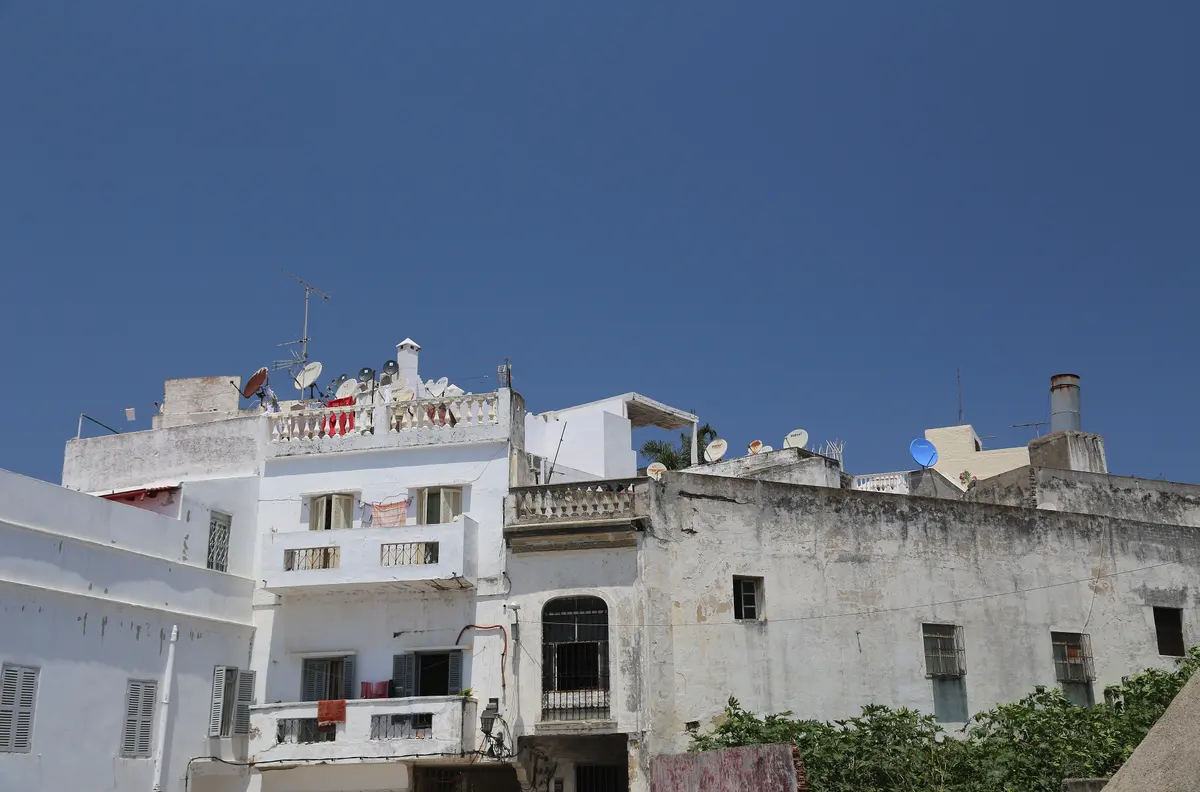
Tanger-Tétouan-Al Hoceïma
Tangier, Morocco
Where Africa looks at Europe across fourteen kilometres
Best time to visit
April to October. Winter is mild but wet and windy.
How long to stay
One or two nights, usually as an entry point.
Getting there
Ferries from Tarifa take one hour. Ibn Battouta airport has European flights, and the high-speed train reaches Casablanca in two hours ten.
Tangier, Morocco stands at the north-western tip of the country on the Strait of Gibraltar, about 14 km from Spain — which you can see from the beach on any ordinary day. It is the closest point in Africa to Europe. Give it two nights, not the four hours a day-trip ferry allows.
Where is Tangiers, and why the spelling changes
Tangiers is the old English form, Tanger is the French and Spanish one, and Tanger is what is written on the train station and on every road sign in the country. Tangier city, Morocco’s northern gateway, is all three.
Geographically it sits where the Mediterranean meets the Atlantic. Stand at Cap Spartel and one sea is on your left and the other on your right. The strait narrows to about 14 km, and on a clear evening the lights of Tarifa are ordinary scenery.
The reputation problem
If you have read anything about Tangier written before about 2005, discard it.
The city spent 1923 to 1956 as an International Zone administered by no one in particular, which produced smuggling, currency dealing, spies and expatriate writers. It then spent forty years neglected, and the port was a genuinely unpleasant place to arrive with luggage. That is the Tangier of the stories.
Between roughly 2010 and 2020 it was rebuilt: the cargo port moved 40 km east to Tanger Med, the old port became a marina and cruise terminal, a corniche was laid along the bay, and the high-speed railway arrived. What is left is a working city of about a million people with a very good medina in it.
What did not change: touts still work the ferry terminal, because that is where people arrive confused.
Two nights, and why the ferry day trip is the worst version
A large number of visitors see Tangier on an organised day trip from Tarifa or Algeciras. They land in a group, get walked past a carpet shop and a snake charmer, eat a set lunch, and sail back convinced they have seen Morocco.
That trip is designed around the ferry timetable, not around the city. If you have one day and are coming from Spain, come independently and stay the night.
Two nights gives you a day for the Kasbah, the medina and the cafés, and a half-day for the cape. It also means you leave in the direction of the country rather than back towards Europe.
The medina, the Kasbah and the Petit Socco
Tangier’s medina is small by Moroccan standards and easy after Fes. It climbs from the Grand Socco, the big open square at the edge, up to the Kasbah on the headland.
Inside the Kasbah, Dar el-Makhzen — the old sultan’s palace — is now the museum, and the terrace outside it gives you the whole strait. The lanes around it are white, quiet and residential.
The Petit Socco, halfway down, is the small café square where most of the literary history happened. It is unglamorous in daylight and much better at dusk.
Also worth an hour: the American Legation, the first property the United States ever owned abroad, given by Sultan Moulay Slimane and now a museum in the middle of the medina. Americans in particular tend to be surprised by it.
Cap Spartel and the Cave of Hercules — honest verdict
Cap Spartel is worth the trip: a lighthouse on a headland 14 km west with the Atlantic on one side and the Mediterranean on the other, and a good coast road out to it.
The Cave of Hercules is a sea cave with an opening that resembles the map of Africa. The photograph is genuinely good. The visit is fifteen minutes, there is a queue at midday, and there are stalls. Go, take the photograph, do not build the afternoon around it.
Combine both with the beach at Achakar and it is a half-day.
Literary Tangier
Paul Bowles lived here for over fifty years. William Burroughs wrote most of Naked Lunch in a room off the Petit Socco. Matisse painted the view from the Grand Hôtel Villa de France.
Café Hafa has been open since the 1920s, on terraces cut into the cliff above the sea, and it still serves mint tea to students, old men and now a lot of visitors. The Gran Café de Paris on Place de France is the other one, unchanged, and used in more films than anyone can count.
You can do this circuit in an afternoon and it costs the price of four glasses of tea.
Eating in Tangier
The fish is the point. Whatever else you plan, eat at least one grilled fish lunch — sea bream, sole, sardines — either at the small places behind the fish market or on the port side.
The city also has the strongest Spanish influence of anywhere in Morocco: tapas bars, calamari, and a habit of eating late that will suit anyone who has just come off a Spanish schedule.
Beaches, the bay and the marina
The city beach runs the whole length of the bay east of the port, backed by a promenade that was rebuilt with the rest of the waterfront. It is a working city beach: football, families, cafés, and water that is Mediterranean-calm compared with the Atlantic side.
For something better, go west. Achakar, near Cap Spartel, is an Atlantic beach with proper surf and far fewer people, and it pairs with the caves in a single half-day.
The old commercial port is now Tanger City Port, a marina with restaurants, a cruise terminal and the ferry berths for the Tarifa boats. It is pleasant, new, and has almost nothing to do with the rest of the city — which is fine, because it is where you arrive.
Where to stay
The Kasbah and the upper medina have the small guesthouses with terraces over the strait, and they are the reason to stay in the old city. As in every Moroccan medina, a car cannot reach the door.
The Ville Nouvelle along the bay has the larger hotels, parking and a flat walk to the station side of town. The grand old places on the Boulevard Pasteur ridge sit between the two and have the best views in the city.
Getting to Tangier, Morocco
| Route | Realistic time |
|---|---|
| Tarifa → Tangier Ville, fast ferry | ~1h |
| Casablanca → Tangier, Al Boraq | ~2h 10 |
| Tangier to Casablanca, returning | ~2h 10 |
| Tangier → Fes, by train | 3h 30 |
| Tangier to Marrakech, changing at Casablanca | allow ~6h |
Two ports share the name: ferries from Tarifa dock at Tangier Ville, in the city; ferries from Algeciras mostly dock at Tanger Med, 40 km east, which needs a shuttle or a taxi afterwards. Check which one your ticket says before you book a hotel.
Ibn Battouta airport — named for the fourteenth-century traveller, who was born here — takes flights from several European cities. The train station is Tanger Ville, and the Al Boraq is worth taking for itself.
Onward from Tangier
- Chefchaouen — two to two and a half hours south through the Rif, and the most common next stop. Our Chefchaouen day trip guide covers the timings.
- Asilah — forty-five minutes down the Atlantic coast. A small walled town with painted walls and a good beach, and a genuinely easy half-day.
- Fes — three and a half hours by train, and the natural southern move.
Tangier opens our imperial cities and Chefchaouen week for anyone arriving from Spain. Everywhere else is on the destinations page.
Is Tangier safe?
Yes. Violent crime against visitors is rare, the medina is comfortable to walk in the evening, and the city is far calmer than its reputation.
The realistic risks are pickpocketing around the port, the Grand Socco and the beach promenade, and the unofficial guides who work arriving ferries. The standard opening is an offer to show you the medina, followed by a shop. Say no once and keep walking. There is more in safety in Morocco.
Tangier is the best place in Morocco to start if you are already in Europe, and the worst place to judge the country from in four hours.
Frequently asked questions
Where is Tangier?
At the north-western tip of Morocco, on the Strait of Gibraltar, where the Mediterranean meets the Atlantic. Spain is about 14 km away and clearly visible from the city on a normal day. It is the closest point in Africa to Europe.
Is Tangier, Morocco safe?
Yes. Tangier's reputation for hustlers describes the 1980s and 1990s, not the city today. Pickpocketing near the port and the Grand Socco is the realistic risk. Walking the Kasbah and the medina in the evening is normal and comfortable.
Is Tangier worth visiting?
Yes, for two nights. It has a genuine medina and Kasbah, a spectacular position over the strait, a literary history you can still sit inside, and the cape where two seas meet. It is not worth the four hours you get off a day-trip ferry.
How do you get from Tangier to Chefchaouen?
By road, two to two and a half hours through the Rif. There is no train. CTM coaches run daily, grand taxis leave when full, and a private car lets you stop at the viewpoints. It is the most common onward move from Tangier.
How long is the ferry from Spain to Tangier?
The fast ferry from Tarifa to Tangier Ville port takes about an hour and lands you in the city. Ferries from Algeciras go to Tanger Med, 40 km east, which then needs a shuttle or taxi. Check which port your ticket names.
How do you get from Tangier to Casablanca?
The Al Boraq high-speed train, which is the fastest in Africa and covers Tangier to Casablanca in about two hours ten minutes. It runs several times a day from Tanger Ville station and books out on holiday weekends.
What is there to do in Tangier?
The Kasbah and the Dar el-Makhzen museum, the medina and Petit Socco, Café Hafa on the cliff, the Cave of Hercules and Cap Spartel to the west, the American Legation museum, and the seafront promenade around the bay.
How many days do you need in Tangier?
Two nights. One full day covers the Kasbah, the medina and the cafés; a half day covers Cap Spartel and the caves. Anything more is a rest rather than a visit, unless you are using the city as a base for Asilah and the coast.
Gallery
Let's plan your Morocco trip
Tell us your dates and interests. We reply personally, usually within a couple of hours.
usually within 2 hoursNo deposit to planLicensed tour guide