 10 days / 9 nightsSignature route
Marrakech
10 Days in Morocco: The Grand Tour Itinerary
Every region that matters, in one loop
- 2–12
- Easy
- 3 Oct
From€1,100 / per person
View tour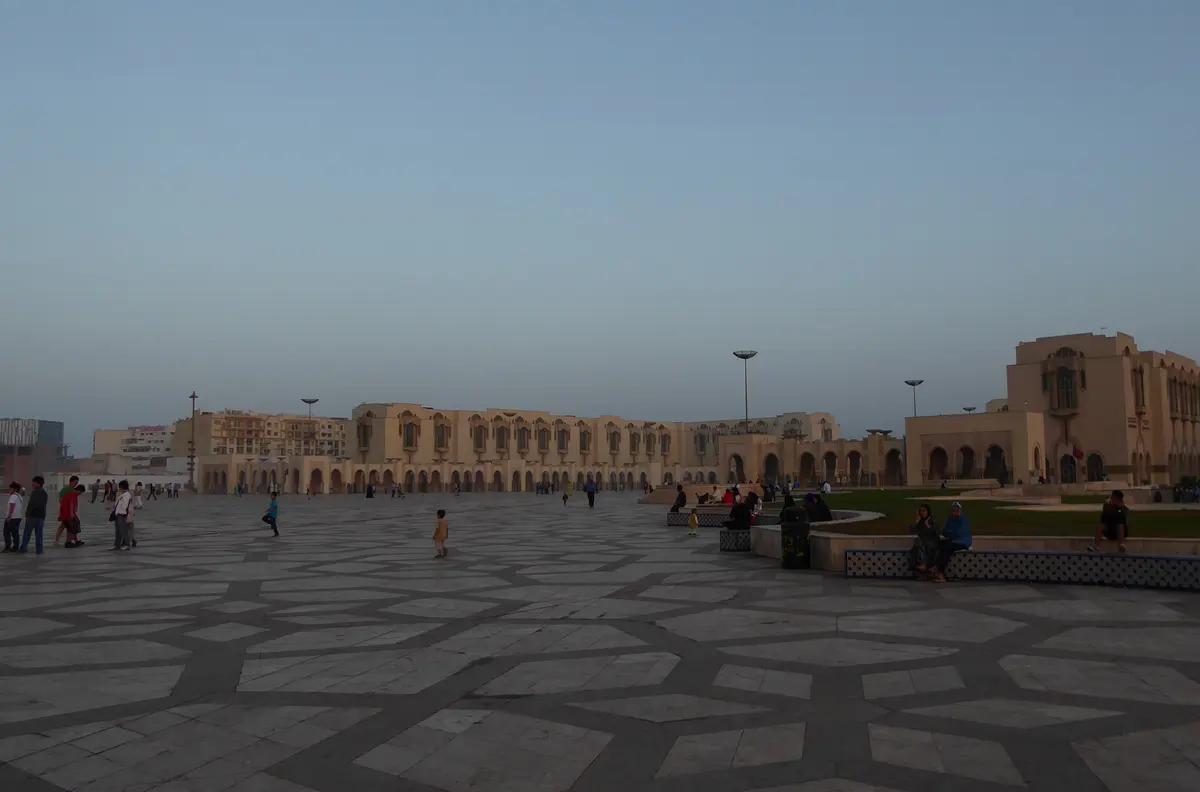
Casablanca-Settat
The working capital, and one extraordinary mosque
Best time to visit
All year. Coastal, so rarely extreme in either direction.
How long to stay
One night, usually on arrival or departure.
Getting there
Mohammed V is Morocco’s main international airport, with a direct train into the city and on to Marrakech, Fes and Tangier.
Casablanca is Morocco’s largest city and its economic capital, on the Atlantic coast about 240 km north of Marrakech. It is a working city of more than three million people rather than a tourist one. Most visitors give it half a day, and the half day is worth having.
Honest answer: worth a stop, rarely worth a stay.
Almost everyone who lands in Morocco lands here, because Mohammed V is the main international airport. What the city gives you in return for an afternoon is the Hassan II Mosque, a downtown of 1920s and 1930s architecture that most guidebooks undersell, and the experience of a Moroccan city that is not performing for anyone.
What it does not give you is a medieval medina, souks worth the name, or a reason to book three nights. If you have twelve days in the country, Casablanca gets one of them at most.
Only if you land after about eight in the evening.
There is a train station underneath the airport terminal. From it you can be at Casa-Voyageurs in well under an hour and in Marrakech about three hours later, or in Rabat in an hour and a half. An early-afternoon arrival should keep moving.
A late arrival should stop. Book near the airport or in the city centre, sleep, see the mosque in the morning and take a midday train. That is the pattern we use for most clients arriving from North America, where flights tend to land in the evening.
This is the reason to be here. It was completed in 1993, it stands partly over the Atlantic, its minaret is 210 metres, and it holds 25,000 people inside with tens of thousands more on the esplanade. Part of the prayer hall floor is glass over the sea.
It is also one of a very small number of working mosques in Morocco that admit non-Muslims, and only on a guided visit at fixed times. Buy tickets at the office beside the plaza. Visits pause around Friday prayers, and the schedule shifts in Ramadan, so check the day’s times before crossing the city for it.
Dress as you would for any place of worship: shoulders and knees covered. Shoes come off at the door.
Casablanca runs in French more than any other Moroccan city — menus, signage, half the conversation. If you search in French, que faire à Casablanca returns far more useful local listings than anything in English will.
The Aïn Diab strip along the Corniche has beach clubs, pools and restaurants, and it is where the city spends its weekends. The sand is fine, the water is Atlantic-cold most of the year, and there are rip currents — swim where there are people and, in summer, lifeguards.
For a beach as the point of the holiday, Essaouira further south is the better answer, and even there the appeal is the wind rather than the water.
If you are choosing one, choose Marrakech. It has the medina, the souks, the palaces, the food and the day trips into the mountains and the desert.
Casablanca is the better city to live in and the weaker one to visit. Choose it over Marrakech only if you are here on business, if your flights make it easier, or if modern Moroccan architecture and a real working port interest you more than a souk does.
Americans ask, so: the 1942 film was shot entirely on sound stages in California. Not one frame of it was filmed in Morocco.
Rick’s Café near the old medina is a real restaurant, opened in 2004 by a former American diplomat and built to resemble the set. It is well done, it is expensive, and it is knowingly a piece of theatre. Go for the piano and the story, not for a piece of history.
| Route | Realistic time |
|---|---|
| Casablanca → Marrakech, by train | ~3h |
| Casablanca → Rabat, by train | 1h – 1h 30 |
| Casablanca → Fes, by train | 4h |
| Casablanca → Tangier, Al Boraq high-speed | ~2h 10 |
Trains leave from Casa-Voyageurs, not from the older Casa-Port, for most long-distance routes. The Al Boraq to Tangier is the fastest train in Africa and worth taking for its own sake. More on the network in getting around Morocco, and the practical side of arriving in safety in Morocco.
Everywhere the trains go is on our destinations page.
We meet a lot of clients at Mohammed V and drive them straight south, and we tell most of them the truth: one night in Casablanca, the mosque in the morning, and then the country starts.
For half a day, yes — for the Hassan II Mosque, which is one of the few in Morocco that non-Muslims may enter. As a destination in its own right it is a working business city of over three million people, not a tourist town, and one night is usually the right amount.
Yes, with normal big-city care. Pickpocketing around the Corniche and the medina edge is the common complaint; violent crime against visitors is rare. Use registered red petits taxis or a booked driver at night, and keep phones out of sight in crowds.
The Hassan II Mosque on a guided visit, the art deco streets around Place Mohammed V, the 1930s Habous quarter for its bookshops and pastries, the Corniche at Aïn Diab for sunset, and the central market. That is a comfortable half-day on foot plus one taxi.
About 240 km. The train from Casa-Voyageurs takes roughly three hours and runs through the day; driving the motorway takes two and a half to three. There is no need to change stations if you are coming from Mohammed V airport.
Yes — it is one of a very small number of working mosques in Morocco that admit non-Muslims, and only on a guided visit at fixed times. Visits pause around Friday prayers. Buy at the ticket office beside the plaza and check the day's times before you travel across the city.
Yes. The station is underneath the terminal and trains run to Casa-Voyageurs, from where you can continue to Marrakech, Rabat, Fes or Tangier. It is the reason many itineraries never spend a night in Casablanca at all.
Marrakech, if you are choosing one. It has the medina, the souks, the palaces and the day trips. Casablanca has one extraordinary building and a real Moroccan city around it. Most trips see Casablanca because the plane lands there.
There is a real restaurant called Rick's Café near the old medina, opened in 2004 and modelled on the film's set. The 1942 film itself was shot on sound stages in California — no scene in it was filmed in Morocco.
10 days / 9 nightsSignature routeMarrakech
Every region that matters, in one loop
From€1,100 / per person
View tour 7 days / 6 nightsSignature route
CasablancaMarrakech
All four imperial capitals — Rabat, Meknes, Fes and Marrakech
From€610 / per person
View tourTell us your dates and interests. We reply personally, usually within a couple of hours.
usually within 2 hoursNo deposit to planLicensed tour guide
+212 665 295 999
Try “Sahara”, “3 days”, or “Chefchaouen”.