Updated 5 August 2026
The Marrakech medina is the walled old city: about 19 km of red rammed-earth ramparts around a dense grid of alleys mostly too narrow for cars. Your taxi cannot reach your riad, and that is not a mistake or a scam. Here is how the place is laid out, and how arrival actually works.
What a medina is, and what the walls enclose
Medina is simply Arabic for city. In Morocco it means the pre-colonial walled city, as distinct from the ville nouvelle the French built outside the walls after 1912. Of Morocco’s imperial medinas — Marrakech, Fes, Meknes, Rabat — this one is the most visited, and it has been UNESCO World Heritage since 1985.
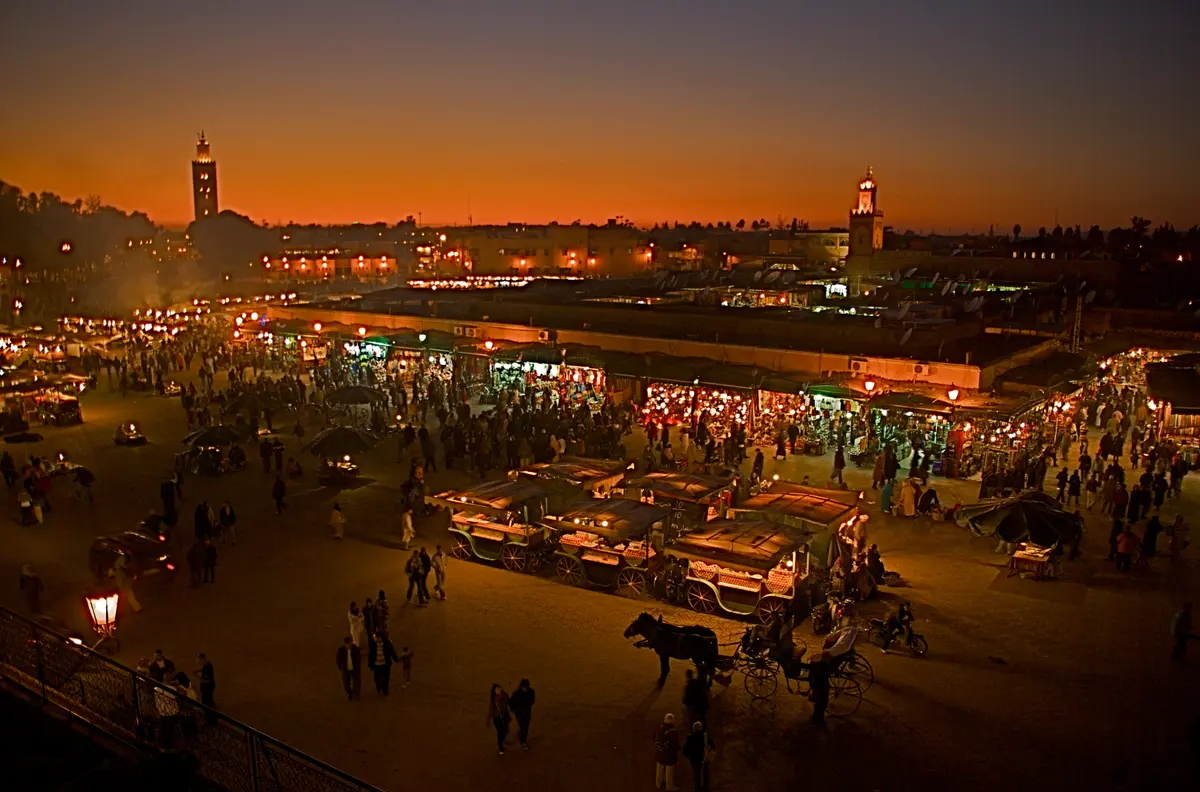
The medina — Marrakech, Morocco’s oldest quarter — was founded around 1070 by the Almoravids, who raised the first walls in the 1120s. Inside it are the souks, Jemaa el-Fna, the Kasbah, the Mellah, the great monuments and nearly every riad you have been looking at. It is the Marrakech town centre in every sense that matters, even though the offices and the banks moved out a century ago.
Arriving: why the taxi cannot reach your riad
This is the crisis of everyone’s first hour, and almost nobody writes it down plainly.
The alleys — derbs — are typically one to three metres wide. A car cannot enter and a taxi driver will not try. He will stop at the nearest gate or square and point. From there it is a walk of anything from two to ten minutes, with your luggage, through lanes that all look the same and have no street names on them.
So: tell your riad your arrival time and accept the offer to be met. Every riad makes it, most send someone with a handcart, and the ones that do not will at least name the gate to give the driver. Inside the medina, Marrakech is a walking city, and your bag is the only real problem.
Where taxis actually stop, by quarter
| Your riad is in | Ask for |
|---|---|
| Mouassine, Dar el Bacha | Bab Laksour or Rue Mouassine |
| Around the souks and Rahba Kedima | Jemaa el-Fna |
| Kasbah, Saadian Tombs | Bab Agnaou or Rue Bab Agnaou |
| Mellah, Bahia Palace | Place des Ferblantiers |
| Riad Zitoun | Jemaa el-Fna, then walk south |
| North-west medina, Bab Doukkala | Bab Doukkala |
| Eastern medina | Bab Ghmat or Bab Aylan |
Give the driver the gate, not the riad name. Riad names repeat, drivers guess, and you end up walking further.
The porter with the handcart
At every gate there are men with two-wheeled barrows. This is a real trade, not a hustle. He takes the bags, walks fast, and delivers you to the door.
Agree the number before he loads. Twenty to thirty dirhams is normal for a short run inside the medina; more for a long one with heavy cases. Have it in small notes — nobody has change at 11pm — and confirm the figure at the gate rather than at the door, because the conversation is much easier before the work than after it.
Addresses, and the number on the door
A Marrakech medina address looks like this: Derb el Hammam 24, Mouassine. A derb is the alley. The number is painted on the door. There is no street sign at either end, and there is often no name on the building.
This is why a Marrakech medina map does less than you expect and why your phone does even less. Under the reed roofs of the covered souks the signal drops and the blue dot wanders through walls. Everyone experiences this. Nothing is broken.
What works instead: photograph your riad’s door and the nearest recognisable corner on the way out. Learn the name of the nearest gate and the nearest square. If you are lost, walk downhill and towards noise. The old medina Marrakech is famous for has a single square at the bottom of it and everything drains that way, and any shopkeeper standing in his own doorway will point you.
The quarters, roughly
- Mouassine and Dar el Bacha — the fashionable half. Restored riads, concept shops, the Musée des Confluences and the best coffee.
- The souks and Rahba Kedima — trade, all day, loudly. What people call the Marrakech medina market is really twenty markets, one per craft, explained in the souks of Marrakech.
- The Kasbah — Marrakech’s southern citadel quarter, behind Bab Agnaou: the Saadian Tombs, El Badi Palace, quieter streets and a real neighbourhood feel.
- The Mellah — the old Jewish quarter east of the Kasbah, with the spice and jewellery market and the restored synagogue.
- Riad Zitoun el Kedim and el Jedid — the two long streets running south from the square towards the Bahia. Handy, cheap, noisy.
- Bab Doukkala and the north-west — residential, few tourists, the medina as it is lived in.
Medina or Gueliz: where to stay in Marrakech
| Medina | Gueliz | |
|---|---|---|
| Sleep | Scooters, cats, the 4.30am call to prayer | Quiet, double glazing |
| Getting about | Walk everywhere; no car to your door | Taxi 10–15 minutes to the square |
| Rooms | Riads: courtyards, roof terraces, small rooms, no lift | Hotels: pools, lifts, air conditioning |
| Eating | Riad dinners, terraces, street food | Restaurants open late, alcohol licences |
| Suits | First-timers, short trips, couples | Families with small children, July and August, longer stays |
Our honest view after twelve years of putting people in both: the medina for a first, short visit, because being inside it at 7am is the reason to come. Gueliz if sleep is a priority, if you are travelling with a toddler and a pushchair — a pushchair in the medina is a genuinely bad afternoon — or if you are here in high summer and want a pool more than a courtyard.
There is a longer version of this argument, with the sights in the order we would do them, in the Marrakech destination guide and the three-day itinerary.
Noise, and what a riad is really like
A riad is a house built inward around a courtyard, with blank walls to the street. The point is the courtyard: cool, private, and acoustically a drum. Hard tile, no soft furnishings, sound travels straight up. You will hear the couple on the terrace, and they will hear you.
The call to prayer at around 4.30am in summer is not negotiable and is closer than you think — the medina has hundreds of mosques. Most people stop noticing on the third night. If you know you will not, take a room off the courtyard on the ground floor, or stay in Gueliz.
At night
The arteries — Semmarine, Mouassine, Riad Zitoun, the ring around Jemaa el-Fna — are busy and lit until midnight or later, and walking them is unremarkable. Small residential derbs are unlit and empty by 10pm. Nothing about that is dangerous by the standards of a European city, but it is disorientating, and disorientation is what makes people uneasy.
The simple fix is to take a taxi to your gate rather than to the square. The general picture, without the scaremongering, is on is Morocco safe.
Fes, Essaouira and Chefchaouen, briefly
Fes — bigger, older and genuinely harder. Thousands of lanes, no cars at all, and gradients. You will need a guide on day one; here you do not.
Essaouira — laid out on a grid by a European engineer, walled, flat and impossible to get lost in.
Chefchaouen — small, steep, blue, and about a twenty-minute walk end to end.
We meet clients at a named gate and walk them to the door, because nobody should start a holiday lost with a suitcase. The customs that go with all of this are in culture and etiquette, and after a first day on your feet, the hammam is what Marrakchis do about it.
Tell us what you want from your trip, or read the rest of the Moroccan culture guide.
Frequently asked questions
What is the medina in Marrakech?
The walled old city — the original Marrakech, founded around 1070 and enclosed by about 19 km of rammed-earth ramparts. It holds the souks, Jemaa el-Fna, most of the monuments and almost every riad.
How big is the medina in Marrakech?
About 19 km of ramparts enclose it. Walking from Bab Doukkala in the north-west to the Kasbah in the south takes roughly 45 minutes if you do not get lost, which you will.
Where is the medina in Marrakech?
It is the eastern half of the city, ringed by the ramparts. Gueliz and the new town lie west of it, about a 20-minute walk or a short taxi ride from Jemaa el-Fna.
Is the medina in Marrakech safe?
Yes, including for women, with ordinary city sense. The main arteries are busy until late. Unlit dead-end alleys at 1am are a different proposition, and taking a taxi to the nearest gate solves it.
How do you get from Marrakech airport to the medina?
A petit taxi takes 15 to 20 minutes. Agree the fare before you get in — this is the one journey where the meter is rarely used. The bus is far cheaper and stops at the edge of the medina, not at your door.
Should I stay in the medina or in Gueliz?
The medina for a first, short trip — the riads, the noise, the walk to everything. Gueliz for young children, high summer, a pool, or if sleeping matters more than atmosphere.
Can a car get to my riad in the medina?
Almost never. Most alleys are between one and three metres wide. Your riad will offer to meet you at a named gate with a porter, and you should accept.
Do you need a guide for the medina?
Not to walk around it, no. For one first orientation walk, a licensed guide is worth the half-day rate. After that the place is yours.