Updated 5 August 2026
Morocco breakfast food is bread-based, savoury more often than sweet, and nothing like a hotel buffet. Griddle breads, olive oil, honey, fresh cheese, olives and coffee. What surprises visitors most is being handed a bowl of olive oil at seven in the morning — and how good it turns out to be.
There are actually three completely different Moroccan breakfasts, and most travellers only ever meet one.
The three Moroccan breakfasts
One: the riad breakfast. Msemen and harcha in a basket, four small dishes of jam, honey, butter, fresh orange juice, an omelette if you want one, coffee, and a pot of tea. It is generous, it is genuinely good, and it is a performance staged for guests. No Moroccan household eats this on a Wednesday.
Two: the working breakfast. A bowl of bissara or a bowl of harira, eaten standing at a counter with a piece of bread, in about four minutes, for the price of a bus ticket. This is what a large part of the country actually eats before work.
Three: the Amazigh breakfast. Flat bread, olive oil, honey, amlou if the household has it, and tea. Off one shared plate, in the middle of the table, with no cutlery. This is breakfast in the High Atlas and it is the version our clients get on the Toubkal and Berber village days.
If your whole trip is riads, you will eat version one eleven mornings in a row. Ask your driver to stop at a counter once.
The breads, and how to tell them apart
This is where most descriptions of a traditional Moroccan breakfast go vague. They are four different things.
Msemen — square, folded, flaky. Semolina dough oiled and folded several times, then flattened on a hot plate. Slightly chewy, slightly greasy in the good way. The default.
Harcha — round, pale, crumbly, made from coarse semolina and butter. Closer to a savoury scone than a pancake. Best split and filled with fresh cheese and honey.
Baghrir — the pancake with a thousand holes, made with yeast so the surface opens up as it cooks. The holes exist to hold melted butter and honey, which is exactly what goes on it.
Khobz — the round everyday loaf, from the neighbourhood oven. Also the plate, the spoon and the fork.
Batbout — soft pocket bread cooked in a pan. Often filled and eaten on the move.
A street griddle sells msemen for a couple of dirhams and it will be better than the one on the buffet.
Amlou, and why it is not Nutella
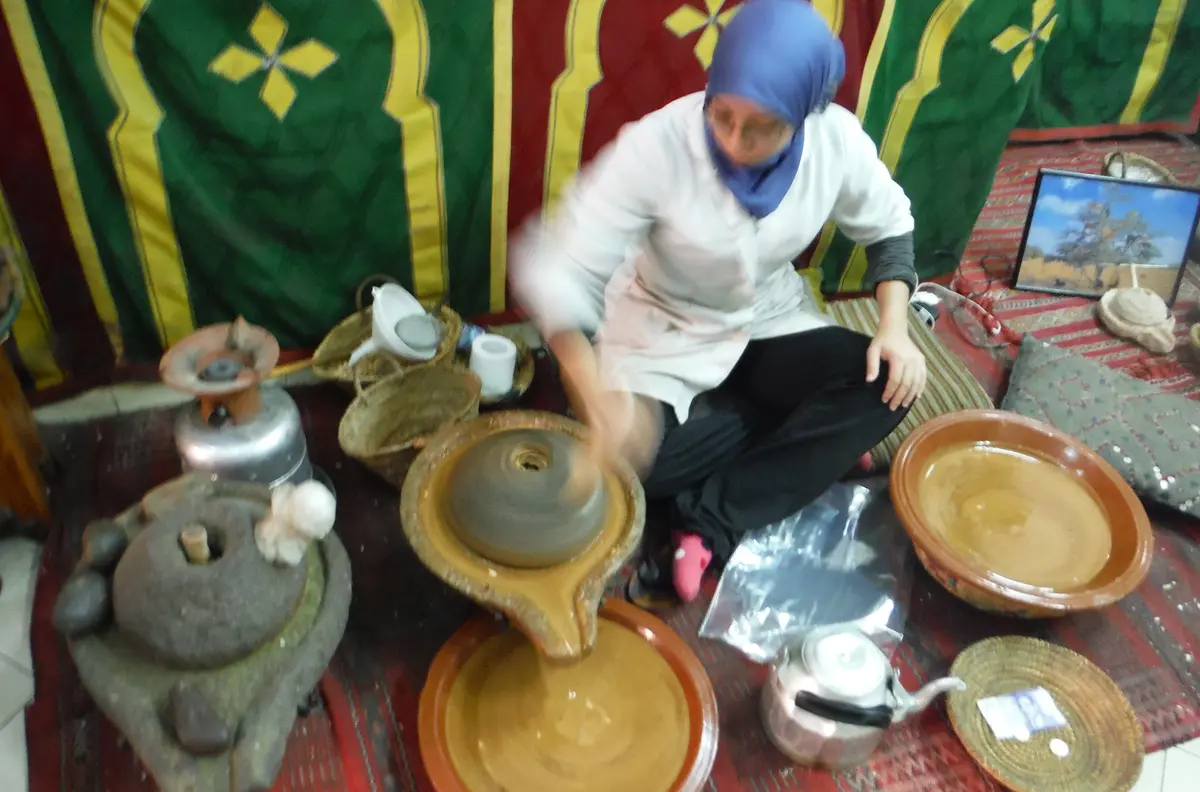
Roasted almonds ground with argan oil and honey until they become a thick, pourable paste. It is the single best thing on a Moroccan breakfast table and the thing visitors most often try to take home.
It tastes of toasted nuts, not of sugar. It is expensive — argan oil is expensive, and the culinary version is roasted, which is why it smells of nuts rather than of cosmetics. Outside the argan belt between Essaouira and Agadir you will often be served an almond-and-honey spread made with ordinary oil, which is fine, but it is not amlou.
Bissara: the breakfast almost no visitor eats
Dried fava beans, cooked down for hours until they collapse into a purée. Served in a bowl with a slick of olive oil across the top, cumin and paprika shaken over it, and bread.
It costs roughly 8 to 15 dirhams. It is filling enough that you will not want lunch. In winter there is a queue at every counter that sells it, and in summer many close.
If you eat one thing from this page, eat this. It is the honest answer to what people here have for breakfast and it is almost never on a hotel menu.
Eggs, khlii and the things riads do not serve
Eggs cooked in a small tagine dish with tomato, cumin and olive oil, brought to the table still bubbling. Common in cafés, rare in riads.
Khlii — meat preserved in spiced fat, dried and kept for months, then fried with eggs. It is a Fes speciality and it is intense: salty, fatty, deeply savoury. People either want it every morning afterwards or never again.
Jben — fresh white cheese, mild and slightly sour, eaten with honey on harcha.
Olives and olive oil, on the table, at breakfast, always.
Tea or coffee in the morning?
Contrary to the postcards, most urban Moroccans drink coffee at breakfast. The standard order is a nous-nous — half coffee, half milk, in a small glass.
Mint tea is an afternoon drink, a hospitality drink and a negotiating drink more than a breakfast drink. In the mountains and the countryside that flips: tea at breakfast is normal there, poured from height, sweet. The full guide to mint tea and Moroccan drinks covers the ritual and how to ask for less sugar.
What Morocco breakfast food costs
| Where | Typical price |
|---|---|
| Msemen from a street griddle | 2-5 MAD |
| Bissara with bread, standing at a counter | 8-15 MAD |
| Café breakfast — bread, jam, coffee | 25-40 MAD |
| Riad breakfast | Usually included in the room |
| Four-star hotel buffet | The most expensive and the least interesting |
Bands for late 2026 — check current prices before you plan around them. The wider cost picture is in the Morocco travel budget guide.
Where to eat breakfast in Marrakech
Not a list of names, because the good counters change hands and the famous ones coast. What to look for instead:
A griddle with a queue, on a medina side street, any morning between seven and ten. If the woman making msemen has a stack going and people are waiting, that is the one.
A bissara counter near a medina gate. They open early, they are marked by a large pot and almost nothing else, and they close when the pot is empty — usually by eleven.
A café on the new-town side if you want to sit down with a coffee and watch the city work. Best breakfast in Marrakech, for most visitors, is a griddle bread eaten walking plus a coffee sitting still.
Avoid the terraces on the main square before nine. The view is the product.
Ramadan
There is no breakfast during Ramadan. Households eat suhoor before dawn and the next meal is at sunset.
Cafés that normally serve breakfast are shut, riads and hotels serve visitors as usual, and the whole rhythm of the morning changes. Plan around it — the culture and etiquette guide explains what else shifts.
If you came for Moroccan breakfast recipes
Two honest notes rather than a recipe card. Msemen is not difficult but it is a technique — the folding and the resting are the whole thing, and the first six are always bad. And harcha needs coarse semolina, not fine; with fine semolina you get a biscuit.
Breakfast on our trips is not a box to tick between drives. In the mountains you eat what the household eats, and on the road we stop where the drivers stop.
Tell us what you want your mornings to look like, or start with what Moroccan food actually is.
Frequently asked questions
What do Moroccans eat for breakfast?
In cities, bread or a griddle bread with olive oil, jam or cheese, and coffee. Before work, many people eat a bowl of bissara — fava bean purée with olive oil and cumin — standing at a counter. Tagine is never breakfast.
What is a traditional Moroccan breakfast?
Msemen or harcha, olive oil, honey, amlou, fresh white cheese, olives, and mint tea or coffee. In the mountains it is bread, oil and honey off one shared plate, with tea poured from height.
What is a Berber breakfast?
Flat bread, olive oil, honey, amlou and tea, eaten from a shared plate in an Amazigh household. There is no juice, no jam and no cutlery. It is the breakfast you get on our High Atlas and Toubkal days.
What is msemen?
A square, layered griddle bread — semolina dough folded with oil several times, then fried flat on a hot plate. Flaky, slightly chewy, eaten with honey, jam or plain with tea. Two to five dirhams from a street griddle.
What is amlou?
Roasted almonds ground with argan oil and honey into a thick spread. It tastes of toasted nuts and is not sweet the way chocolate spread is sweet. It is expensive to make and rarely served outside the argan-growing south.
Do Moroccans drink tea or coffee for breakfast?
Coffee, mostly, in cities — often a nous-nous, half coffee and half milk. Mint tea is more an afternoon and hospitality drink. In the mountains and the countryside, tea at breakfast is normal.
How much does breakfast cost in Morocco?
A griddle bread from a street stall is a few dirhams. A bowl of bissara with bread is roughly 8-15 MAD. A riad breakfast is usually included in the room rate. Bands drift, so check current prices.
Is breakfast included in Moroccan riads?
Almost always, and it is usually the best meal a riad serves — bread baked that morning, fresh juice and eggs cooked to order rather than held on a buffet.
What is bissara?
Dried fava beans cooked down to a thick purée, served in a bowl with a pool of olive oil, cumin and paprika, and bread to push it around with. Winter breakfast and working lunch, and one of the cheapest good meals in the country.