Updated 5 August 2026
Marrakech street food is safe if you choose for turnover, and it is where a lot of the best eating in Morocco happens: cooked in front of you, at a stall with a queue, for a fraction of restaurant prices. The real risk is not the street. It is food left standing warm.
That, and salad washed in tap water. Here is how to read a stall, what to order, and the honest verdict on the Jemaa el-Fna stalls at night.
How to read a stall in ten seconds
Four signals, in order of importance.
Turnover. A queue means the food was cooked recently and will be cooked again shortly. An empty stall with full trays means the opposite. This one signal does more work than every other rule combined.
Cooked in front of you. Grills, griddles, fryers and pots that are actively boiling are all fine. Anything sitting in a tray under a lamp is a question.
One thing, done all day. The stall that sells snails sells snails. The stall offering tagine, couscous, pizza, pasta and paella is a warming cabinet with a menu.
Who is eating there. If the customers are Moroccan men on their way home from work, you have found it. If the customers are all holding phones and cameras, you have found a different thing.
The fifth signal is negative: the harder the sell, the worse the food. A stall that needs a man outside with a laminated menu is a stall that cannot fill itself on reputation.
Jemaa el-Fna at night: the honest version
Every guide describes the square at sunset as a food destination. It is a spectacle first and a food destination second, and pretending otherwise does nobody a favour.
The numbered grill stalls in the middle — the long banks of tables under the lights — are largely interchangeable. Many are run by related families, the produce comes from the same suppliers, and the difference between stall 14 and stall 31 is mostly who shouted at you first. They are hard-touted, the “free” salad plates arrive unasked and appear on the bill, and prices are quoted to you rather than posted.
Go once. It is genuinely one of the great sights in Morocco and the atmosphere is not fake. Just do not expect the best food in the city, and agree the price before anything is put on the table.
The edges are where the food is:
- The snail carts (babbouche) — small snails in a spiced broth, served with a pin. You drink the broth after. Cheap, excellent, and locals queue for them all evening.
- The fried fish stands — flour-dusted, straight out of the oil, with a cumin-heavy dip.
- The mechoui pits, in the alley off the north side of the square — whole lamb, slow-roasted, sold by weight with bread, cumin and salt. This is the best thing on or near the square, by a distance.
- The harira counters — a bowl of soup, a date, a hard-boiled egg. Under 10 dirhams and completely correct.
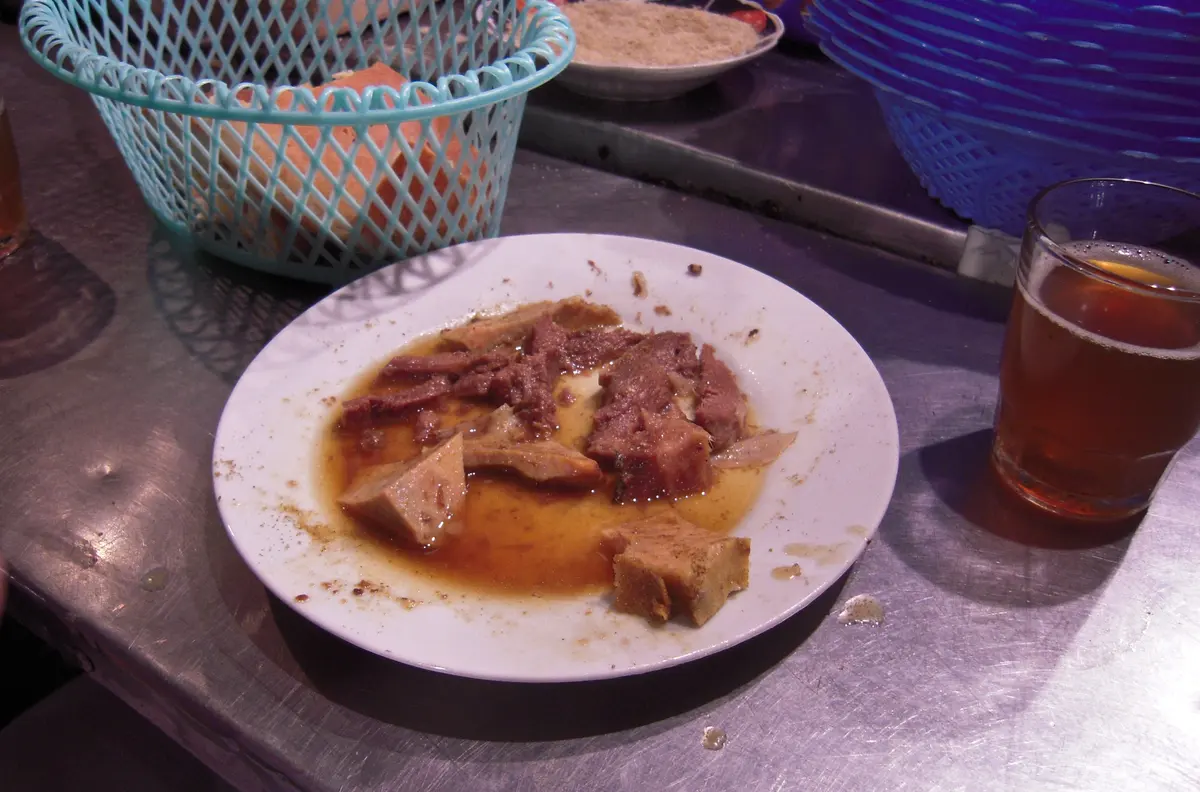
- The sheep’s head stalls — genuine, popular, and not for everyone. Nobody will mind if you walk on.
The price conversation
Have it first. Every time.
Prices on the square are quoted, not posted. Small plates of bread, olives and salad appear on the table unasked and are charged for. Neither of these is a scam — it is a system, and it works exactly as well as the customer’s willingness to say something.
Ask what a plate costs before you sit. Say no to the extras you do not want, once, politely. Check the bill. The whole interaction takes twenty seconds and the difference is often two hundred dirhams. This is the same muscle as haggling in the souk, and it is covered in money and tipping.
What actually makes visitors ill
Not what most travel blogs say.
Tap water is chlorinated in Moroccan cities and Moroccans drink it. What visitors experience is usually a reaction to different mineral content, not contamination. We still hand out bottled water in the vehicles for the first few days, because being wrong about this on a nine-hour drive to Merzouga is genuinely miserable and bottled water is cheap.
Salad and raw herbs are the one real risk, and the issue is the water they were washed in, not the leaves. In a riad or a busy restaurant, eat it. From an unknown counter in August, order something cooked.
Food held warm — buffets, trays under lamps, a tagine that has been sitting since eleven. This causes more trouble than any street grill.
Dehydration and the schedule. The single biggest cause of a ruined day in the south is not food at all. It is 40°C, six hours in a vehicle, and not drinking enough. Most upsets happen in the first 48 hours of a trip and they are dietary change, not poisoning.
Shellfish in high summer — on the coast, in the hottest weeks, be more selective. A busy fish grill in Essaouira is fine. A tray of oysters that has been out in the sun is not.
Ice, coffee, tea and freshly squeezed juice in cities are not worth worrying about. The full safety picture, including pharmacies, is in safety in Morocco.
What to actually order
If you eat five things from a Moroccan street counter, make it these.
Harira from a counter with a queue, standing up, before eight in the evening. Mechoui by weight — point at the shoulder, ask for 200 grams, eat it with bread and cumin. Grilled sardines on the coast, straight off the boat, salt and lemon only. Msemen from a morning griddle, hot, plain or with honey. Snails, once, because you will not do it at home.
And one to skip: the “tagine of the day” on a terrace overlooking a square. You are paying for the view. Order a proper tagine somewhere with charcoal instead.
What it costs
| What | Typical price |
|---|---|
| Harira from a counter | Under 10 MAD |
| Msemen from a griddle | 2-5 MAD |
| Bowl of snails | Around 10-15 MAD |
| Mechoui, 200g with bread | 40-70 MAD |
| Full plate at a Jemaa el-Fna stall | 50-100 MAD |
| Fresh orange juice on the square | A few dirhams — ask first |
Bands for late 2026. Prices move, and prices on the square in particular move depending on who is asking.
Beyond Marrakech
Essaouira — the port grills. You choose fish by weight from the board, and the extras arrive unasked here too. Agree the kilo price before it goes on the scale.
Fes — better bakeries, better sweets, and the medina food is more local and less performed than Marrakech’s because fewer visitors leave the main axis.
Chefchaouen — small, mountain food, goat’s cheese, and a much gentler version of the same thing.
The desert road — roadside grills where you pick the meat from the butcher next door and the café next to him cooks it. This is one of the best meals on any drive south and no visitor finds it alone.
Vegetarians
Street food is where Morocco gets easy. Msemen, harcha, bissara, fried aubergine, chips, olives, bread, roasted almonds, snails aside. Harira usually contains meat stock; bissara does not. The wider position is in the Moroccan food guide.
Our evening walks go to the stalls our guides eat at, in Darija, at Moroccan prices — and we walk past the ones that pay commission, because we do not take it.
Tell us how you want to eat, or read what Moroccan breakfast actually looks like before your first morning.
Frequently asked questions
Is Moroccan street food safe?
Yes, if you pick for turnover. Food cooked to order in front of you, at a stall with a queue, is one of the safest things you can eat in Morocco. What causes trouble is food held warm for hours and salad washed in tap water.
Is it safe to eat street food in Morocco?
It is, and it is where much of the best food is. Watch for three things — is it cooked in front of you, is there a queue, is there a bin. If yes to all three, eat.
Is it safe to drink tap water in Morocco?
It is chlorinated and Moroccans drink it. Visitors often react to the mineral change rather than to contamination. We give bottled water in the vehicles for the first days because it is simpler than testing the theory on a nine-hour drive.
Is it safe to eat salad in Morocco?
This is the one genuine risk, and it is the washing water rather than the leaves. In a busy restaurant or a riad, fine. From an unknown counter in high summer, skip it and eat something cooked instead.
Is it safe to eat fruit in Morocco?
Peel it and it is fine — oranges, bananas, melon you cut yourself. The fruit you do not peel is subject to the same washing-water question as salad. Buy it whole from a cart rather than pre-cut.
Are the Jemaa el-Fna food stalls worth it?
Once, for the spectacle. The numbered grill stalls in the middle of the square are largely interchangeable and heavily touted. The genuinely good food is around the edges — the snail carts, the fried fish, the mechoui pits in the alley off the north side.
What to eat in Marrakech?
Tanjia, mechoui by weight with cumin and bread, a bowl of harira from a counter, grilled sardines, and msemen from a griddle in the morning. Skip anything a man with a laminated menu is shouting about.
How much does street food cost in Morocco?
A bowl of harira can be under 10 MAD, msemen a couple of dirhams, a full plate at a Jemaa el-Fna stall roughly 50-100 MAD. Agree the price before you sit down. Bands drift — check on the ground.
What causes stomach upsets in Morocco?
Usually the change of diet, dehydration and long hot drives, not contaminated food. Most upsets happen in the first 48 hours. Drink more water than you think you need, especially in the south.