Updated 4 August 2026
What currency is it in Morocco? The Moroccan dirham — MAD, written DH — and it is a closed currency. You cannot legally buy it before you arrive and you are not supposed to take it home. Roughly 10.9 dirhams to the euro. Everything else on this page follows from that one rule.
Say it deer-ham. One dirham splits into 100 centimes, which nobody uses.
The closed-currency rule, and what it means before you fly
You will not find dirhams at your home airport, and if a bureau there offers them, the rate is punishing. Do not try to solve this in advance. Land with a card and a small float of euros, and take your first dirhams from an ATM in the arrivals hall.
The rule works in the other direction too: you are not meant to leave with dirhams. Spend down towards the end, or reconvert at the airport exchange desk before security. That desk usually wants to see the receipt from your original exchange or an ATM slip, so keep them in your passport.
Sanity-checking the rate
The dirham is managed against a euro-dollar basket, so the rate moves slowly. Around 10.5–11 MAD to the euro is a useful mental anchor; check the live figure before you fly, because it drifts.
Two arithmetic shortcuts that will serve you all week: divide dirhams by 11 for euros, and by 10 for a rough dollar figure. If a stallholder’s price does not survive that division, it was not a serious price.
Getting cash: ATMs, airport desks and the fees
ATMs. Bank machines in every city and most towns take foreign Visa and Mastercard. Use one attached to an actual bank branch rather than a free-standing machine in a tourist street. Every withdrawal carries a fixed fee at the Moroccan end plus whatever your own bank adds, so take out larger amounts less often.
Always decline the machine’s own conversion. When it offers to charge you in euros or dollars “for your convenience”, that is dynamic currency conversion and the spread is bad. Choose to be charged in dirhams and let your own bank convert.
Airport desks are fine and the rates are regulated. Hotel desks are not. Independent bureaux in the medina are usually good — compare two before committing.
Bring euros as a backup, not as spending money. A €100 note in a money belt covers the day your card gets blocked.
Where cards work, and where they emphatically do not
They work in: riads and hotels, restaurants in the new towns, supermarkets, petrol stations, pharmacies, and the larger fixed-price craft shops.
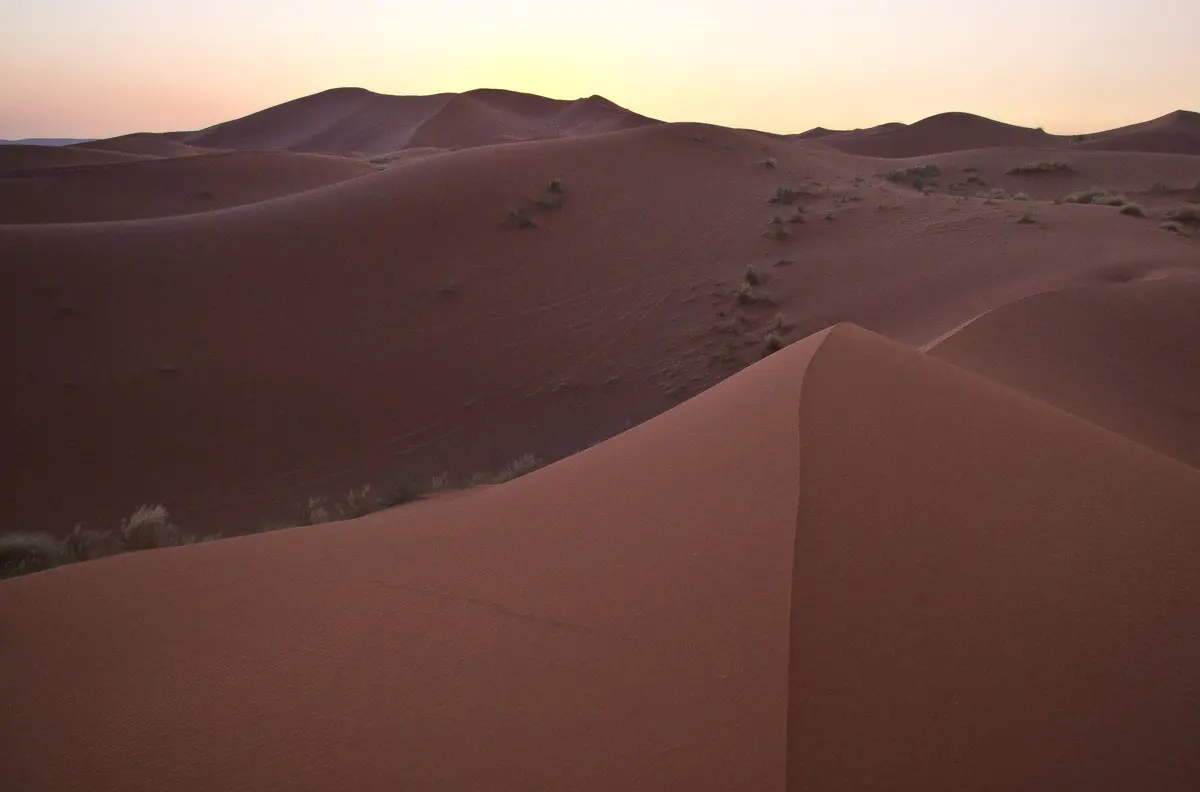
They do not work in: the medina, souks, grands taxis, petits taxis, most rural restaurants, mountain guesthouses, the desert, hammams, roadside cafés, or anywhere a camel is involved.
The line is roughly the same one that governs getting around Morocco. North and urban, cards are unremarkable. South and rural, cash is the only instrument that exists.
The small-notes problem
This ruins more transactions than any scam. ATMs dispense 200 dirham notes. A tea seller, a parking attendant, a petit taxi driver and a man carrying your bag up three flights of riad stairs cannot change one and will not pretend to.
Break your 200s the moment you have them — at a supermarket, a petrol station or a busy café. Keep a deliberate reserve of 20s, 10s and coins in a separate pocket. Everything about tipping and taxis gets easier the moment you do.
Is Morocco cheap? What things actually cost
Cheaper than Spain or Portugal for food, transport and guiding; roughly comparable for good accommodation. That is the honest summary.
Per person per day, excluding international flights:
| Style | Per day | What it buys |
|---|---|---|
| Frugal | €35–55 | Guesthouse or dorm, street food and local cafés, buses and shared grands taxis |
| Mid-range | €80–140 | A good riad with a private bathroom, a mix of local and rooftop restaurants, private transfers |
| Comfortable | €200+ | Boutique riads and kasbah hotels, private driver-guide, luxury desert camps |
A tagine at a neighbourhood restaurant runs €4–8. Harira soup is a euro or two. Mint tea is a few dirhams. Museum and monument entry is usually 70–120 MAD. Prices move, so treat these as bands and check current figures before you budget tightly — the full breakdown is in what a week in Morocco actually costs.
Is Marrakech expensive? It is the priciest city in the country and still cheap by European standards. Where people overspend is narrow and predictable: the airport taxi, the desert tour booked through a riad at a 30–40% resale margin, and the first price in a souk.
Tipping in Morocco: the numbers, by role
Tipping in Morocco is not legally required and is socially expected. Vague advice — “10%, use your judgement” — is useless when you are standing there holding a 200 note. So here are the figures we give our own clients.
| Who | What we suggest |
|---|---|
| Driver-guide, multi-day | €10–15 per group, per day, given at the end |
| Licensed city guide, half day | €10–20 from the group |
| Desert camp staff | 50–100 MAD per group, into the shared box |
| Riad housekeeping | €5 a night, left at the end of the stay |
| Restaurant, formal | Round up, or 10% |
| Restaurant, local | Round up to the nearest 10 dirhams |
| Petit taxi | Round the fare up. That is the whole rule |
| Porter, bag carried | 10–20 MAD |
| Parking attendant | 2–5 MAD |
| Hammam attendant | 20–50 MAD |
| Toilet attendant | 2 MAD, and have the coin ready |
Two principles behind the table. Tip at the end, not daily — handing a driver money every evening is awkward for both of you. And tip in dirhams where you can; a €5 note is a trip to a bureau for someone who would rather have 50 MAD now.
Our own staff are paid a wage, not a tip-dependent one. The tip is a bonus for good work, not a subsidy, and you will not be pursued for it.
When not to tip
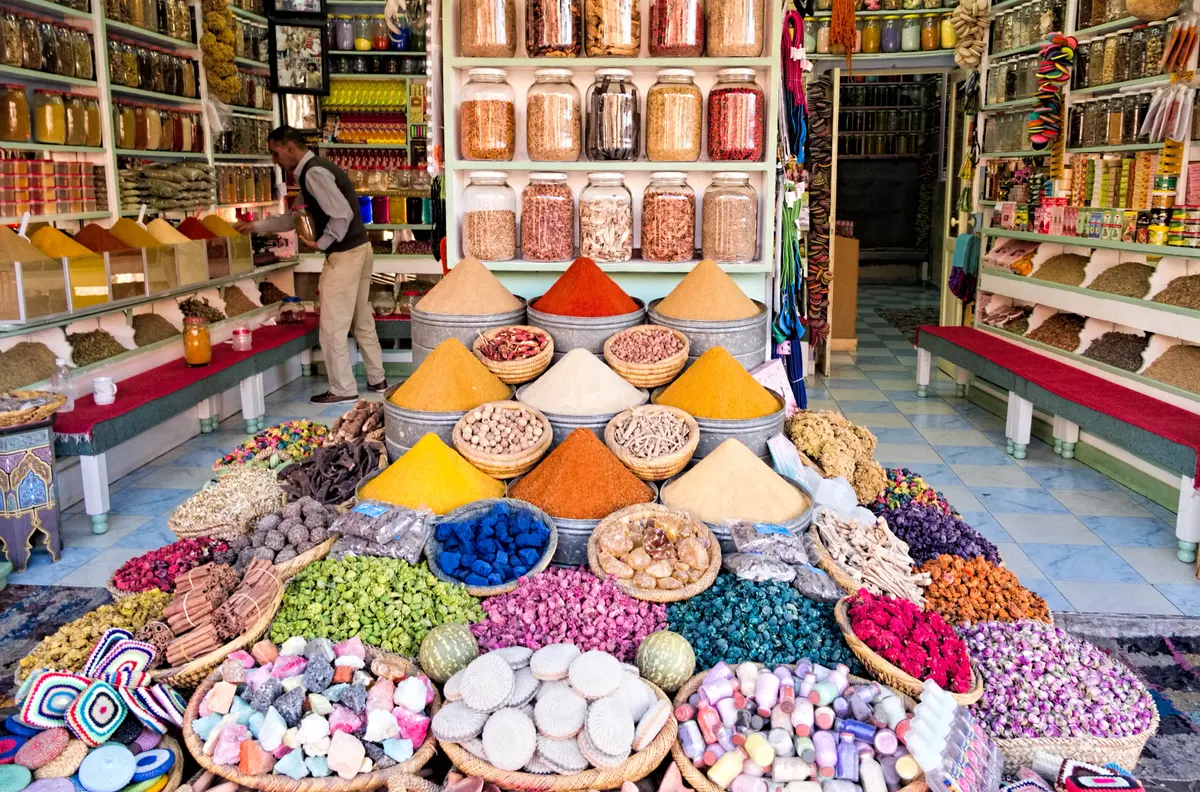
There is a difference between a service and an ambush. The bracelet tied onto your wrist, the henna started before you agreed, the monkey placed on your shoulder, the “guide” who walked you three streets you did not ask about — none of those is a service and none of them earns a tip. Say la, shukran, keep walking, and read what else to expect.
Photographs of performers on Jemaa el-Fna are a genuine transaction. Agree the amount before the shutter, not after — 10–20 MAD is normal, and after the photograph the number becomes 100.
Bargaining, briefly
Bargaining is the format, not a confrontation, and declining to engage is what reads as rude. The opening price in a souk is typically two and a half to four times the settling price.
Decide what the object is worth to you. Open at around 40% of the first quote. Be willing to walk. If they let you go, you were below their floor; if they follow you, you were not. Do it in good humour, because it is a conversation, not a fight.
Fixed-price shops exist and are marked as such. Cooperatives — argan oil, rugs, ceramics — generally do not bargain, and their prices are fair to the makers. A little Darija or French changes the opening number more than any tactic; see language in Morocco.
What we ask clients to bring in cash
For a desert trip, we tell people to carry roughly 1,000–1,500 MAD per person in mixed notes for a three-day run south. That covers lunches, tea stops, tips, a scarf you did not plan to buy, and the fact that there is no working ATM between Tinghir and Merzouga worth relying on.
For a city-only week in Marrakech or Fes, far less — top up every couple of days and keep the rest on the card.
Our tour prices are quoted in euros, all-in, with what is and is not included written out. Ask for a quote and you will get the whole number, not a starting one.
Frequently asked questions
What currency is it in Morocco?
The Moroccan dirham, written MAD or DH. It is a closed currency, which means you cannot legally buy it before you arrive and you are not supposed to carry it out. Get your first dirhams from an airport ATM or bank desk.
What currency is used in Marrakech?
The same dirham used everywhere in Morocco. There is no separate Marrakech currency. Euros are informally accepted in tourist shops at a rate that always favours the seller, so pay in dirhams.
Can I use euros or dollars in Morocco?
In tourist shops, riads and some restaurants, yes — but the exchange rate applied is silent and poor. Treat euros as a backup to change at a bureau, not as spending money. Dollars are less widely accepted than euros.
Is tipping mandatory in Morocco?
Not legally, but it is expected and it matters to the people receiving it. Round up taxi fares, leave 10% in a formal restaurant, and budget 100-150 MAD per group per day for a driver-guide. Small notes are the practical constraint.
How much do you tip a tour guide in Morocco?
For a licensed city guide on a half day, €10-20 from the group. For a driver-guide on a multi-day trip, €10-15 per group per day, handed over at the end rather than daily. Tip in dirhams where you can.
Is Morocco cheap?
Cheaper than Spain or Portugal for food, transport and guiding; comparable for good accommodation. A frugal traveller manages on €35-55 a day, most of our clients sit at €80-140, and the ceiling is as high as anywhere.
Is Marrakech expensive?
Marrakech is the most expensive city in Morocco and still cheap by European standards. Where people overspend is airport taxis, riad-booked desert tours and the first price in a souk — not on food or entry tickets.
Do ATMs in Morocco accept foreign cards?
Yes. Bank ATMs in every city and most towns take Visa and Mastercard. Always decline the machine's own currency conversion and let your bank do it. Withdraw larger amounts less often, because each withdrawal carries a fixed fee.
Can I take dirhams out of Morocco?
No, beyond a small allowance. Spend down before you fly or reconvert at an airport exchange desk, which usually asks to see your original exchange receipt or ATM slip. Keep them.
How much cash should I carry in Morocco?
More than feels comfortable if you are heading south. Cards fail in medinas, rural towns and the desert. For a week outside the big cities, plan on cash for everything except your hotel.