Updated 4 August 2026
What to pack for Morocco depends far more on where you are going than on the month. The country runs from Atlantic surf to 4,000 m mountains to the edge of the Sahara, often inside one week. This Morocco packing list is built from what clients actually ask us for mid-trip, logged over years of doing it.
Start with the one rule that governs half the list: loose, long, light clothing works everywhere here, and it is genuinely cooler in heat than shorts and a vest.
What to wear in Morocco: shoulders and knees
There is no law and nobody will stop you. Moroccan women in Casablanca and the Gueliz district of Marrakech dress across the entire range you would see in Barcelona.
But shoulders and knees covered in medinas and small towns measurably reduces the amount of attention you attract, and that is the honest reason to do it — not religion, not respect in the abstract. It works. The women in our team dress this way in the old city and differently in the new one, for exactly that reason.
Do you need to cover your hair? No. Nowhere, unless you are entering a working religious building, and most of those are closed to non-Muslims anyway. Carry a scarf for sun, dust, cold and the occasional courtyard, not for modesty.
Men: shorts read as beachwear away from the coast. In Essaouira and Agadir nobody blinks. In the Fes medina you will feel it. Light long trousers are also simply better in 38°C.
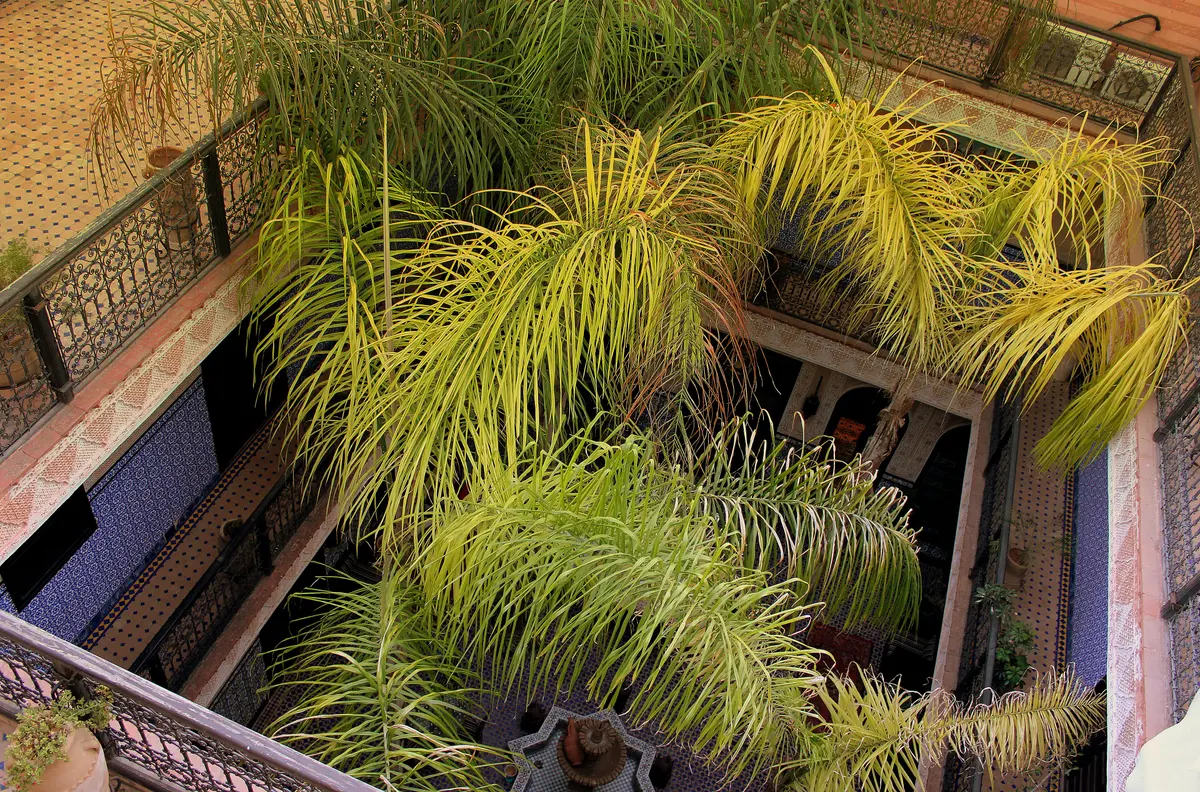
Where none of this applies: riad courtyards and rooftops, hotel pools, beach resorts. Those are private space and the rules relax entirely. More on the social side in culture and etiquette.
The core list, whatever the month
- Loose long trousers or a long skirt — two pairs is enough
- Long-sleeved light shirts — linen or cotton, three or four
- A scarf. The most useful single item you will bring. Sun, dust, cold, hair, mosque courtyards, an improvised bag
- Closed, comfortable shoes, already broken in. Medina lanes are uneven, wet in places, and full of steps you did not see
- One warm layer. Every month of the year. See below
- Sunglasses, high-factor sunscreen, lip balm
- A refillable bottle — and buy sealed water to fill it
- Head torch. Camps cut the generator around 23:00 and riads have unlit stairs
- Rehydration sachets. The single most useful thing in the bag
- Power bank and a two-pin European adaptor
- A soft overnight bag for the desert leg, on top of your main luggage
The five things clients most often wish they had brought
- A head torch. Every time. The generator goes off and the walk to the loo tent is a hundred metres of sand.
- Rehydration salts. Stomach trouble costs more days than anything else on a Morocco trip.
- Blister plasters. Fes and Marrakech are 15,000-step cities on cobbles.
- A proper warm layer in April. Because the forecast said 26°C and nobody read the small print about the night.
- Small denomination cash. Not clothing, but the most common mid-trip regret. See money and tipping.
The five things every packing list recommends that you will not use
- A money belt. Uncomfortable, obvious, and a front pocket does the same job.
- A mosquito net. Riads and camps do not need one.
- A water purification kit. Bottled water costs a few dirhams and is everywhere.
- Hiking boots, unless you are actually walking in the Atlas. Trainers are right for everything else.
- A hairdryer. Every riad has one and it will blow your adaptor.
Desert nights: the swing nobody believes
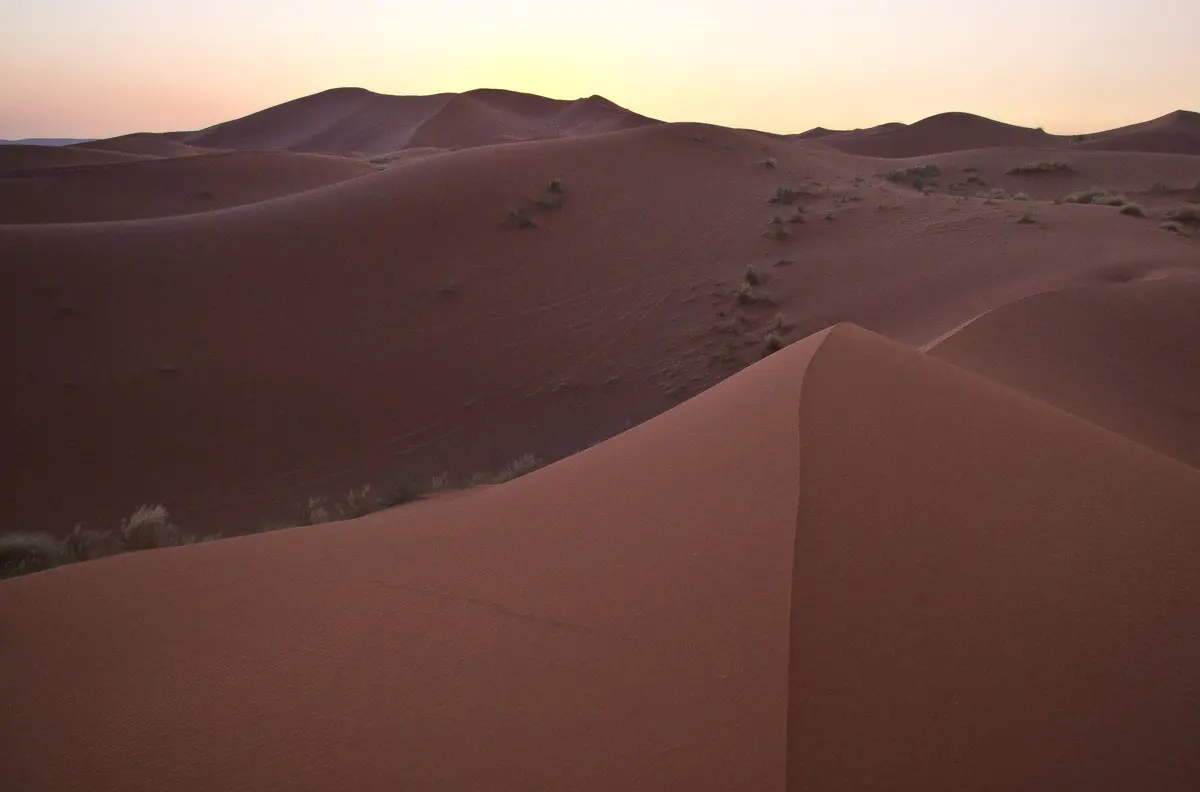
Between November and February, camp nights approach freezing after daytime highs of 18–20°C. The temperature falls roughly twenty degrees within an hour of sunset. Camps provide heavy blankets and it is still cold.
In April and October, nights sit around 10–15°C and are genuinely pleasant. In July and August they stay above 25°C and the problem reverses.
So: a fleece is adequate, a light down jacket is better, and a hat and gloves in December are not an overreaction. The detailed kit list is in what to pack for the Sahara, and what the night is actually like is in the desert camp guide.
Mountains, coast and cities
High Atlas. Layers, a windproof shell, and real boots if you are going above the villages. Snow on the passes is normal from December to March, and the valleys run about ten degrees cooler than Marrakech in summer.
Atlantic coast. A windproof jacket, in August as much as in January. Essaouira is windy year-round and the sea peaks at around 21–22°C in September — that is the Atlantic, not the Mediterranean.
Cities. One outfit you feel good in. Riad rooftops and the better restaurants in Marrakech and Casablanca are dressier than the rest of the trip.
Winter and summer, specifically
Morocco packing list, winter (December–February). Add a warm mid-layer, a hat, a scarf that is actually warm, and waterproof shoes. Days inland are 18–20°C and pleasant; nights inland and in the desert are cold, and old riads are not centrally heated.
Morocco packing list, summer (June–August). Subtract almost nothing. Marrakech hits 38–43°C and the desert 45°C, and long loose linen beats bare skin every day of it. Add a wide-brimmed hat, double the sunscreen and a second refillable bottle.
Electronics
Morocco uses the European two-pin plug, 220V. UK and US visitors need an adaptor; most of Europe does not.
A power bank matters more than you think — long driving days, no sockets in a camp, and a phone doing navigation and photography all day. Bring a lens cloth or a bag for the camera, because fine desert dust gets into everything and does not come out.
An eSIM or a local SIM is cheap and coverage on the main routes is good. It drops out in the gorges and between the dunes.
Luggage: soft, not hard
A hard-shell case is the wrong tool here. Medina cobbles destroy the wheels, porters carry cases on their heads down lanes no vehicle can enter, and — the practical one — a soft bag rides on a camel and a suitcase does not.
If you are travelling with us, leave your main case at your Marrakech riad and take an overnight bag south. Every riad we use holds luggage, free.
Backpacking Morocco with a rucksack works well: buses take hold luggage, grands taxis have boots, and hostels exist in every city on the transport spine.
Medication and what pharmacies stock anyway
Bring prescription medicine in its original packaging with the label, plus a copy of the prescription. Bring rehydration sachets and any painkiller you are loyal to.
Do not bring a full first aid kit. Moroccan pharmacies are excellent, on every second corner, staffed by pharmacists who work in French and who will hand you the right thing across the counter without a doctor’s appointment. Antihistamines, antiseptic, plasters, stomach remedies — all cheaper here than at home.
Leave at home
Drones without a permit. They are routinely confiscated at customs and getting one back is a bureaucratic ordeal. See entry requirements.
Valuable jewellery. Anything you would be upset to lose in a crowd. A hard case if you are going to a camp. And roughly a third of the clothes you have laid out, because laundry is fast and cheap and nobody here has seen your shirt before.
Leave space for the way home
Everyone underestimates this. A rug, a lamp, a tagine dish, four kilos of spices and an argan oil order for people at home.
Pack a folded soft holdall inside your case, or leave a third of it empty. It is the most consistently useful line on any Morocco packing list, and the one nobody writes.
We send every client a route-specific kit list once the itinerary is set — desert nights, Atlas altitude and coast wind all change it. Start planning.
If what to wear is really a question about how you will be treated, that is answered directly in Is Morocco safe for women and solo female travellers?
Frequently asked questions
What to pack for Morocco?
Loose long clothing, a scarf, closed comfortable shoes, one warm layer whatever the month, a head torch, rehydration sachets, a power bank and a soft bag rather than a hard case. Everything else you can buy here for less.
What to wear in Morocco?
Shoulders and knees covered in medinas and small towns. That is the whole rule and it is about attention, not law. Cities like Casablanca and the Gueliz district of Marrakech are relaxed, riads and beaches more so again.
What to wear in Morocco as a woman?
Loose trousers or a long skirt, a top that covers the shoulders, and a scarf in the bag. You do not need to cover your hair anywhere except inside a working religious building. Covering more reduces street attention noticeably.
Do I need to cover my hair in Morocco?
No. Moroccan women in cities wear a headscarf or do not, according to preference, and no visitor is expected to. Carry a scarf for mosque courtyards, mountain villages, sun and dust — not for modesty in the street.
What is the dress code in Marrakech?
Gueliz and the new town are Mediterranean-relaxed. The medina and Jemaa el-Fna are more conservative and shorts on either sex draw comment. Riad rooftops and pools are private space where anything goes.
What to wear in the Sahara desert in Morocco?
Long, loose and light by day — covering up is genuinely cooler than shorts — and a proper warm layer for the night. Between November and February the temperature falls about twenty degrees within an hour of sunset.
What shoes should I wear in Morocco?
Closed, comfortable, already broken in. Medina lanes are uneven, wet in places and full of unexpected steps. Trainers are fine everywhere. Sandals are for the riad and the beach, not the souk.
Can men wear shorts in Morocco?
On the coast, at Essaouira and Agadir, yes. Inland, in a medina, shorts read as beachwear and mark you out. Light long trousers are cooler in the heat anyway, which is the argument that usually convinces people.
What should I pack for a Morocco desert tour?
A soft overnight bag — a hard suitcase does not ride a camel. Warm layer, head torch, scarf, sunglasses, lip balm, sunscreen, a power bank and any medication. Camps supply blankets and water. Leave the big case at your Marrakech riad.
What should I not bring to Morocco?
A drone without a permit, which will be confiscated at customs. Also a hard-shell suitcase if you are going to a camp, valuable jewellery, a hairdryer that every riad already has, and more clothing than five days' worth.