Updated 4 August 2026
Getting around Morocco splits at Marrakech. North of it, the trains are genuinely good — fast, cheap and punctual. South and east of it there is no railway at all, and public transport becomes slow, indirect and blind to everything worth stopping for. That one fact shapes almost every itinerary we write.
The line at Marrakech that decides everything
Draw a line across the map at Marrakech.
Above it — Tangier, Rabat, Casablanca, Fes, Meknes — you are in a country with a working rail network, motorways, and coach companies that run to a timetable. You do not need us. Take the train.
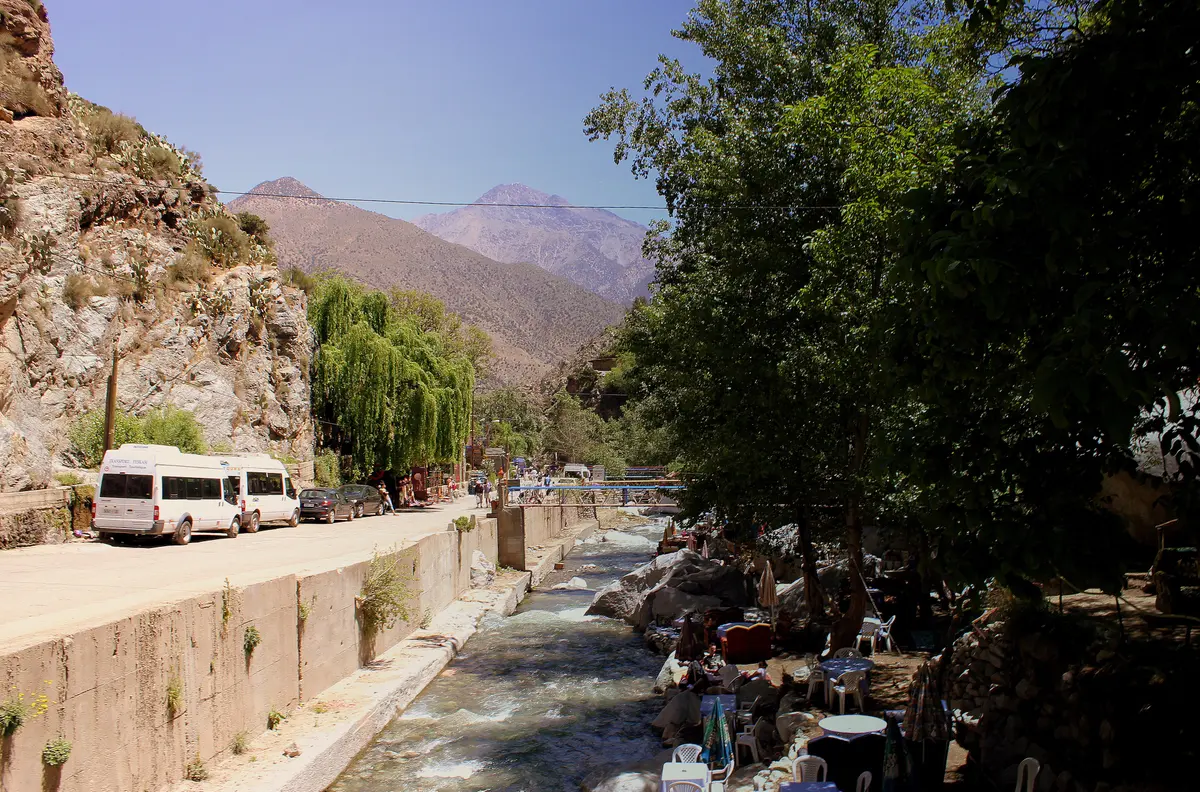
Below and east of it — Ouarzazate, the Dades, Todra, Merzouga, Zagora, the Anti-Atlas — the railway stops, the coaches run once or twice a day on fixed routes, and the things worth seeing are between the towns rather than in them. A kasbah on a bend, a gorge, the view back over the Tichka pass: none of these are bus stops.
Every article about transportation in Morocco lists six modes neutrally. The useful version tells you where the line is.
Trains in Morocco: where the network goes, and where it stops
ONCF runs the Morocco train network, and on its spine it is the best transport in the country.
Al Boraq, the high-speed line, covers Tangier to Casablanca in two hours ten. Standard trains link Casablanca to Marrakech in about three hours, Casablanca to Fes in around four, and Fes to Marrakech in roughly seven via Casablanca. Trains run through the day, they leave on time, and first class buys you a reserved seat in a six-person compartment for a small premium that is worth paying on a long leg.
Buy at the station, at a machine, or on the ONCF site. Fares change; check the current price rather than trusting a number in an article.
Where there is no railway: anywhere south of Marrakech. Not Essaouira. Not Ouarzazate. Not Merzouga or Zagora. Not Chefchaouen. Not Agadir. That is not an oversight in this page — the track does not exist.
CTM and Supratours: the only two coaches worth your time
CTM and Supratours run modern coaches with allocated seats, hold luggage and online booking. Supratours is owned by the railway and its coaches are timed to meet the trains, which is how most independent travellers reach Essaouira and Merzouga.
Everything else — the local buses that leave from the old station — is cheap and the timings are theoretical. If your day depends on arriving, use one of the two named above.
Realistic coach times: Marrakech to Essaouira about three hours. Marrakech to Merzouga is an overnight run of eleven to twelve hours and it is a long night.
Grands taxis: the shared Mercedes system, decoded
A grand taxi is an old Mercedes running a fixed route between two towns. It leaves when six passengers have gathered — four in the back, two in the front passenger seat — and it costs very little.
The system is simple once someone explains it. Go to the rank, say the name of the destination, and you will be pointed at the right car. Pay your share on arrival. If you do not want to wait or to share, buy the empty places: say j’achète les places and pay for the whole car.
They are quick, they are cheap, and they are the normal way Moroccans move between towns. They are also cramped and the driving can be brisk. For an hour to Imlil or Ourika, perfect. For six hours, less so.
Petits taxis and city rides
Petits taxis are city-only, metered, and colour-coded by town — beige in Marrakech, red in Casablanca, blue in Rabat. They legally take three passengers and will pick up others going your way, which is normal and not a scam.
Insist on the meter. Airport runs are on posted fixed rates: Marrakech airport to the medina should be 100–150 MAD, not the 400 you will first be quoted. Ride-hailing apps operate in Casablanca and Rabat and their legal position in Marrakech has been contested for years, so do not build a plan on one.
Renting a car in Morocco: who it genuinely suits
Car rental in Marrakech is cheap and the process is straightforward — an international licence is not required for most Western nationalities, but check your own before you fly.
Renting suits you if you are staying north, doing the coast, exploring the Atlas foothills from a base, or you simply like stopping when you feel like it.
It suits you less if it is your first trip and your route runs deep south. The driving days are long, fuel stations thin out, navigation in a medina is a genuinely bad experience, and parking anywhere old means paying a gardien a few dirhams to watch the car.
Morocco road signs are bilingual, in Arabic and French, and the motorways are excellent. Police checkpoints are frequent, routine and polite: slow down, have licence and papers to hand, and you will be waved through.
The one rule that matters more than any other: do not drive at night. Unlit mopeds, donkey carts and sheep on unbarriered mountain roads. It is the largest genuine risk in the country and we cover why in is Morocco safe.
Domestic flights: the two occasions they earn their place
Royal Air Maroc and Air Arabia connect Casablanca to most regional airports. Flying is worth it for Dakhla and Laayoune in the far south, and occasionally to save a day on Fes–Marrakech if your schedule is tight.
Everywhere else, once you count the transfer to the airport, the check-in and the transfer at the other end, the train has already won.
Private driver: what we do, and the honest case against it
This is our business, so read the next paragraph with that in mind.
A private driver makes sense south and east of Marrakech, because that is where the alternative stops working. For two or more people it often costs less than the sum of taxis and coach tickets, it turns transit into the interesting part of the day, and the driver knows which viewpoint is worth the ten minutes and which is a car park.
The case against: if your whole trip is Casablanca, Rabat, Fes and Marrakech, you do not need one and we will tell you so. Trains do that route better and cheaper than we can.
Getting around Morocco: the corridor table
Real times from our own itineraries, with stops, not the optimistic figure a mapping app gives you.
| Corridor | What we put you on | Realistic time |
|---|---|---|
| Tangier – Casablanca | Train, Al Boraq | 2 h 10 |
| Casablanca – Marrakech | Train | 3 h |
| Casablanca – Fes | Train | 4 h |
| Fez – Marrakech | Train, via Casablanca | 7 h |
| Marrakech – Essaouira | Supratours coach | 3 h |
| Marrakech – Ouarzazate | Road, over the Tichka | 4 h |
| Marrakech – Dades | Road | 7 h |
| Marrakech – Merzouga | Road, with stops | 9 h |
| Merzouga – Fes | Road, via Todra and the Ziz | 8 h |
| Fes – Chefchaouen | Road, via Volubilis and Meknes | 5 h |
| Chefchaouen – Casablanca | Road | 4 h |
Those southern figures are why we do not sell a “Marrakech to the desert and back” day trip. It cannot be done and anyone offering it is driving you through the Atlas in the dark.
Combining modes: what we actually advise
The pattern that works for most two-week trips: train the north, drive the south.
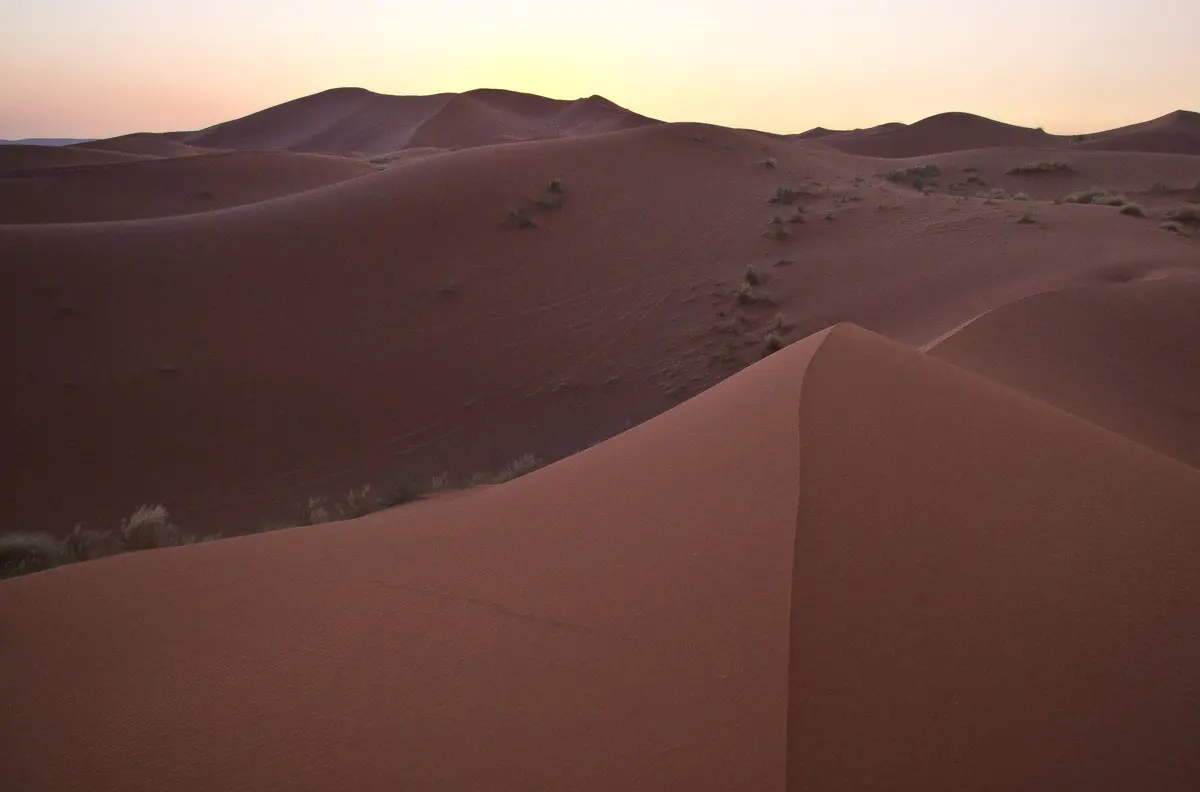
Fly into Casablanca or Marrakech. Take trains between the imperial cities. Pick up a driver or a car in Marrakech for the run over the Atlas, through Ouarzazate and the kasbah road to the dunes at Merzouga, and back up through Todra Gorge. Finish with a coach to Essaouira if you want a few flat days by the Atlantic.
That way you pay for a vehicle only on the days a vehicle is the right answer.
One practical note: whatever you take, carry cash. Nothing in this article accepts a card except the train and the coaches — see money and tipping.
Tell us your route and we will tell you honestly which legs you need us for and which you do not.
Frequently asked questions
How to get around Morocco?
Trains between Tangier, Rabat, Casablanca, Fes and Marrakech. CTM or Supratours coaches to Essaouira, Chefchaouen and Merzouga. Grands taxis for short hops between towns. A private driver or hire car anywhere south and east of Marrakech, where public transport thins out.
What is the best way to travel around Morocco?
It depends which half of the country you are in. North of Marrakech the train is faster, cheaper and more comfortable than anything else. South of it there is no railway at all, and the choice is a hire car, a coach on a fixed route, or a private driver.
Is there a train from Fes to Marrakech?
Yes, a direct service running roughly seven hours via Casablanca. It is comfortable and cheap, and for most people it beats flying once you count the airport time at both ends. Book first class for a reserved seat.
How long is the train from Casablanca to Marrakech?
About three hours on the standard line, with departures through the day. Tangier to Casablanca on the Al Boraq high-speed line is two hours ten. Tickets are sold by ONCF online and at the station.
Is it safe to drive in Morocco?
In daylight and on main roads, yes. Motorways are good and well policed. The risks are city traffic, mountain passes without barriers, and night driving with unlit mopeds and animals on the road. Do not drive after dark.
Is it worth renting a car in Morocco?
Worth it for the coast, the Atlas foothills and the north if you want to stop where you like. Less so for a first trip through the deep south, where the driving is long, the navigation is unforgiving and a driver costs little more.
What is a grand taxi in Morocco?
A shared long-distance taxi, usually an old Mercedes, running a fixed route between two towns and leaving when six passengers have gathered. Cheap, quick and cramped. You can buy the empty seats and leave immediately.
Do taxis in Marrakech use the meter?
They are required to, and many drivers will tell you the meter is broken. Agree the fare before you get in or insist on the meter. Airport to the medina is a posted fixed rate, not a negotiation.
Is there a train to Essaouira or Merzouga?
No. Neither has a railway and neither ever has. Supratours runs coaches to both from Marrakech, timed to connect with the trains, which is how most independent travellers get there.
How do you get from Marrakech to the Sahara?
By road, and it is long — roughly nine hours to Merzouga with stops, over the Tizi n'Tichka pass. There is no train and no useful flight. A coach, a hire car or a driver are the three real options.