Rabat-Salé-Kénitra
Rabat, Morocco: The Capital Most Itineraries Skip
The capital that works rather than performs
Best time to visit
March to June and September to November. The Atlantic keeps summer near 27°C while Marrakech is above 40°C.
How long to stay
A long half-day. One night if you are breaking a journey north or south.
Getting there
On the main railway line, with two stations. Rabat Ville for the medina and the Kasbah, Rabat Agdal for the high-speed Al Boraq. Casablanca is an hour, Tangier an hour and twenty minutes.
Rabat is the capital of Morocco, on the Atlantic coast between Casablanca and Tangier. Most itineraries leave it out, and for a first two-week trip that is defensible. But it holds three first-rate sites, no queue at any of them, and the calmest medina in the country.
Where is Rabat, Morocco?
Rabat sits on the Atlantic at the mouth of the Bou Regreg, the river that divides it from Salé. Casablanca is 87 km south and an hour away by train. Tangier is 250 km north, an hour and twenty minutes on the high-speed line. Fes is about two and a half hours east.
That position is the whole practical case for the city. Almost every north–south journey in Morocco passes through it, which means a stop costs you a few hours rather than a day.
The capital is Rabat, not Marrakech and not Casablanca
This is the most common misunderstanding about the country. Marrakech was the capital under the Almoravids and the Saadians. Fes held it longer than anywhere. Meknes had a spectacular seventeenth-century run under Moulay Ismail. The French protectorate moved the seat of government to Rabat in 1912, and independence left it there.
Casablanca is the bigger city and the money. Rabat is the state.
What the city is actually like
This is a working administrative city. Rabat, Morocco’s capital since 1912, runs on civil servants, students and diplomats rather than on visitors, and it shows in ways you notice within an hour.
Nobody follows you. The medina has shops for people who live there. There are wide streets, a tram, clean pavements and a seafront, and the whole centre is walkable. UNESCO listed Rabat in 2012, and unusually the listing covers the twentieth-century art deco quarter alongside the old city.
The flip side is honest too: it is quieter than Marrakech and less startling than Fes. If you came to Morocco for intensity, this is not where you will find it.
Things to do in Rabat, Morocco
In Rabat, things to do divide into three, and the three sit within twenty minutes of each other by taxi. Everything else on the list is optional.
The Kasbah of the Udayas
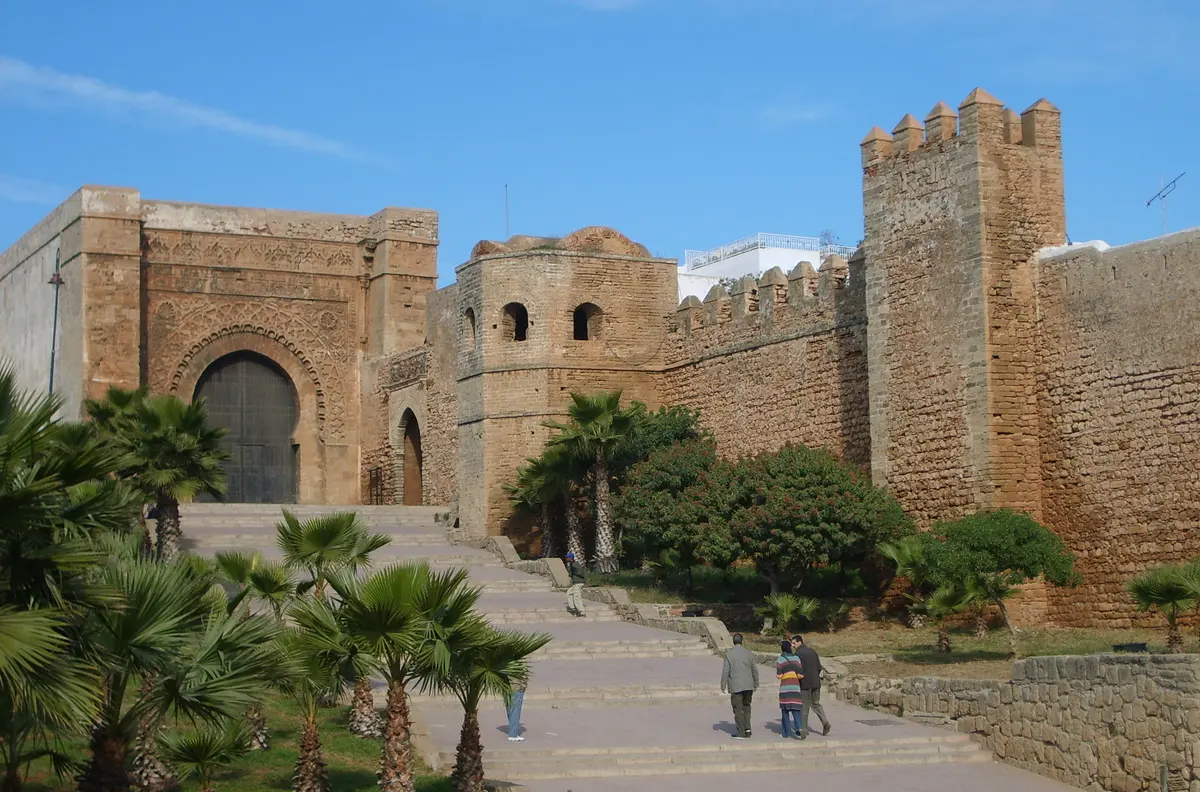
A twelfth-century Almohad fortress on the headland above the river mouth, entered through Bab Oudaia, one of the great gates of Morocco — carved sandstone, about 1195, and still the way in.
Inside it is a residential village of white walls painted blue to shoulder height, and it is genuinely quiet. The Andalusian garden, laid out under the protectorate inside the old palace grounds, is free and shaded. The café terrace at the far end looks over the Bou Regreg to Salé and out to the Atlantic.
Allow an hour. People compare it to Chefchaouen for the blue, which undersells it; the setting over the water is better.
Chellah, and the storks
The best thing in Rabat and the one nobody arrives knowing about. Chellah is a walled site outside the centre containing, in the same enclosure, the ruins of the Roman town of Sala Colonia and a fourteenth-century Merinid necropolis built over it.
Fig trees grow through the tombs. Storks nest on top of the minaret and clatter at each other all spring. There is a Roman forum, a Merinid gate, a ruined mosque and a lot of overgrown garden, and on most mornings you will share it with a dozen people.
It has closed for restoration work in recent years, so ask before you make the trip out.
The Hassan Tower and the Mausoleum of Mohammed V
The Hassan Tower is the minaret of a mosque that was never finished. Yacoub al-Mansour began it in 1195, intending the largest mosque in the western Islamic world, and construction stopped when he died in 1199. The tower reached about 44 metres. The prayer hall got as far as its columns, and the Lisbon earthquake of 1755 flattened most of what stood.
What is left is a field of broken columns and one enormous unfinished tower, which is a stranger and better sight than a completed mosque would have been.
Facing it across the esplanade is the Mausoleum of Mohammed V, finished in 1971, holding Mohammed V and his son Hassan II. Entry is free, the royal guard is on the door, and the interior is worth the five minutes.
The medina, and why it is the easy one
Rabat’s medina was laid out in the seventeenth century by Andalusian Muslims expelled from Spain, which is why it is on a grid rather than a knot. You cannot get properly lost in it.
Rue des Consuls is the carpet and craft street, named for the foreign consuls who were once required to live on it. Prices are negotiable, as everywhere, but the pressure is a fraction of what you meet in Marrakech, and it is a reasonable place to learn how the process works before you face a harder souk.
For a century that gets skipped, the same estuary held the Republic of Bou Regreg — the corsair state of the Salé Rovers, who raided as far as Iceland in the 1620s. There is not much left to see of it, but it explains the fortifications.
Eating, and the one museum worth an hour
Rabat feeds civil servants at lunchtime, which means the food is good, the portions are normal and nobody is running a tourist menu. The fish comes off the Atlantic the same morning: grilled sardines, sea bream, and the fried-fish places near the river mouth below the Kasbah are the cheap version of a very good lunch.
The Mohammed VI Museum of Modern and Contemporary Art, on Avenue Moulay Hassan, was the first museum of its kind in Morocco. It is small, air-conditioned and well hung, and it is the only place in the country where you can see a century of Moroccan painting in one room. An hour, and a good one if the afternoon is hot.
The beach, the river and Salé
There is a beach at the river mouth below the Kasbah, and more of them south at Harhoura and Témara. This is open Atlantic: cold water, real currents, surfers rather than swimmers. Treat it as a walk, not a swimming holiday — for that, go to Essaouira or the coast south of it.
The tram crosses the Bou Regreg to Salé, which has an older and rougher medina than Rabat’s and almost no visitors. The 250-metre Mohammed VI Tower on that bank is now the tallest building in Africa. It is a twenty-minute outing for the price of a tram ticket.
How long you need, and what to do in Rabat in half a day
One night, or a long half-day between trains.
The half-day version: Chellah first thing, the Hassan Tower and the Mausoleum next, lunch, then the Kasbah of the Udayas and the medina in the afternoon. That is the city, honestly covered.
Rabat works best as a break in a longer journey rather than a destination in itself, and it fits neatly into the imperial cities and Chefchaouen week. The Rabat–Chefchaouen distance is about 250 km and four hours of driving, which makes it a sensible overnight before the Rif.
Getting to Rabat
Rabat town centre is small enough to cross on foot, and both stations sit inside it or just outside.
| Route | Realistic time |
|---|---|
| Rabat to Casablanca, by train | ~1h |
| Casablanca airport to Rabat, direct train | ~1h 30 |
| Rabat to Tangier, Al Boraq | ~1h 20 |
| Rabat to Fes, by train | ~2h 30 |
| Marrakech to Rabat, by train | ~4h |
Two stations, and this is the one thing to get right. Rabat Ville is the central one, ten minutes from the medina. Rabat Agdal is 3 km south-west in the business district and is where Al Boraq calls. Trains coming up from Casablanca and Marrakech reach Agdal first, so do not stand up at the first announcement.
Rabat-Salé airport is small. Most people arrive through Casablanca’s Mohammed V, which has a station under the terminal and a direct train north. More on the network in getting around Morocco.
Is Rabat safe?
Yes — it is the least stressful large city in the country to walk around. The government quarter means visible policing, the medina is residential and small, and the hustle that shapes people’s expectations of Morocco is largely absent here.
Ordinary precautions still apply: phones on the tram, bags on Avenue Mohammed V after dark, agreed fares in petits taxis or the meter switched on. There is more in safety in Morocco.
We add a Rabat night to northern itineraries when the timings suit, and skip it when they do not — it is a stop, not a stay, and we will say so.
Tell us your route and we will tell you whether Rabat earns a night, or see every destination we run.
Frequently asked questions
Is Rabat, Morocco safe?
Yes, and it is the easiest big Moroccan city to walk around. It is the seat of government, so there is a permanent police presence, and the medina has almost none of the following and pressure that Marrakech and Fes do. Normal city sense applies: watch your phone on the tram and on Avenue Mohammed V at night.
Is Rabat worth visiting?
For half a day or one night, yes. The Kasbah of the Udayas, Chellah and the Hassan Tower are all first-rate and none of them is crowded. As a three-day base it is thinner than Fes or Marrakech, and we would not build a trip around it.
Is Rabat the capital of Morocco?
Yes. It has been the capital since 1912 and has stayed the capital ever since. Marrakech, Fes and Meknes were all capitals earlier, and Casablanca is much larger, but the parliament, the royal palace, the ministries and every foreign embassy are in Rabat.
What is there to do in Rabat?
Three sites carry the city — the Kasbah of the Udayas above the river mouth, Chellah with its Roman ruins and Merinid tombs, and the Hassan Tower with the Mausoleum of Mohammed V opposite. Add the medina, Rue des Consuls and the tram across to Salé and you have a full day.
How do you get from Rabat to Casablanca?
By train, in about an hour, on a service that runs several times an hour through the day. It is the busiest rail corridor in Morocco. Rabat Ville and Rabat Agdal both serve it, and no advance booking is needed for the shuttle trains.
Which Rabat station should I get off at?
Rabat Ville for the medina, the Kasbah of the Udayas and the centre — it is a ten-minute walk from most of what you came for. Rabat Agdal is about 3 km south-west in the business district and is the station Al Boraq uses. Trains from the south call at Agdal first.
How many days do you need in Rabat?
One night is plenty and a long half-day works. Arrive mid-morning from Casablanca, do Chellah and the Hassan Tower before lunch, the Kasbah and the medina after it, and take an evening train onward. Two nights only if you want the beaches and Salé as well.
Is Rabat safe for women travelling alone?
It is the city we suggest first to solo women who are nervous about Morocco. Street harassment exists as it does everywhere in the country, but it is markedly lower here than in the tourist cities, and the medina is small, lit and residential rather than a maze.
Gallery
Let's plan your Morocco trip
Tell us your dates and interests. We reply personally, usually within a couple of hours.
usually within 2 hoursNo deposit to planLicensed tour guide