A Night in a Morocco Desert Camp: What to Expect
What a Morocco desert camp is actually like — the camel ride, the tents, the bathrooms, the cold at 3am, and the part nobody prepares you for.
Omar Ouhbi
Desert specialist
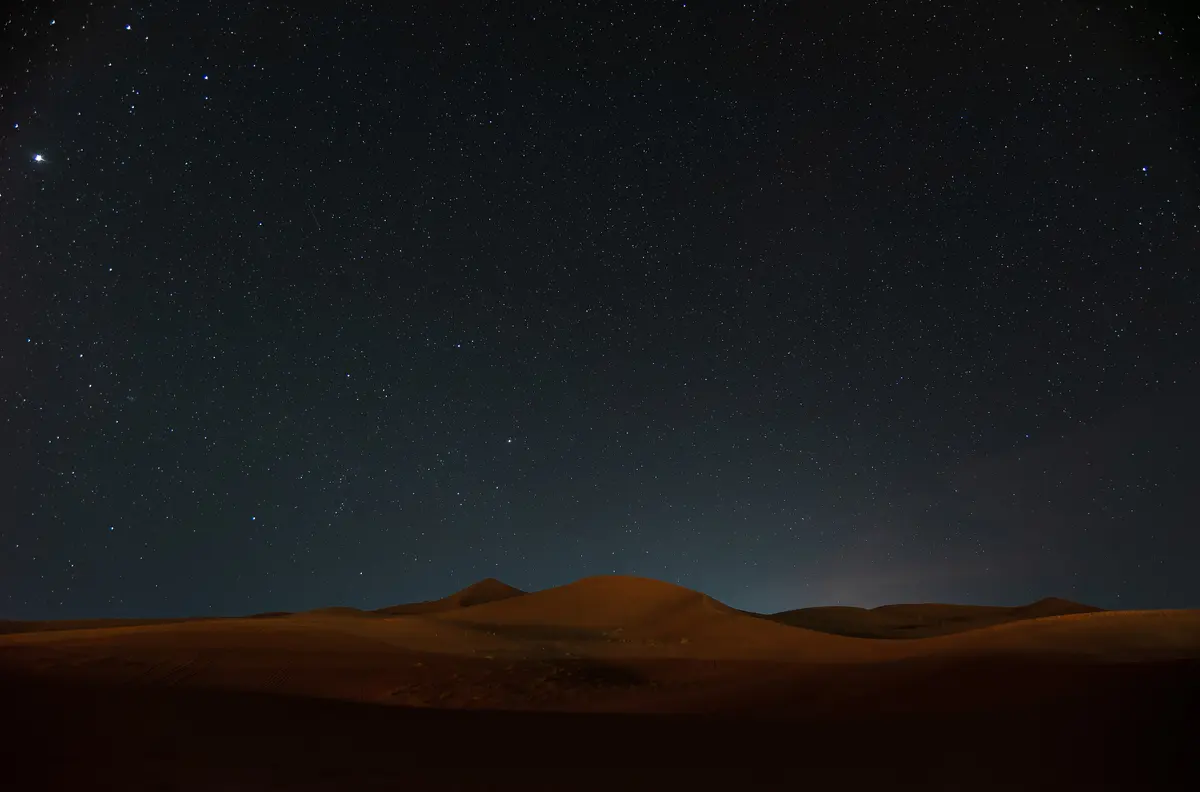
A Morocco desert camp is a permanent camp of canvas tents pitched between the dunes, with beds, blankets, hot showers and dinner cooked on site. It is neither the luxury advert nor the survival documentary people arrive expecting. Here is what actually happens between arriving at sunset and leaving at eight the next morning.
I have run camps at Erg Chebbi for years. This is the version I give people who ask me directly.
Getting there
You leave the road at Merzouga in the late afternoon and cover the last few kilometres by camel — about sixty to ninety minutes, timed so you are on the dunes at sunset.
It is more comfortable than expected going up and considerably less so coming down. The camel kneels to let you on and stands up back-to-front, which is the moment everyone shouts. Hold the front bar, lean back.
If camels are not for you, a 4x4 runs the same route in about fifteen minutes and arrives at the same time. Nobody minds and roughly a third of our travellers take it — bad backs, pregnancy, fear of animals, or simply not wanting to. Ask when you book rather than at the dune.
Camel treks in Morocco all work this way: a short ride into a camp, not a caravan across the Sahara. If you want a genuine multi-day trek, that exists, and it is a different trip with different fitness requirements.
Standard, comfort, luxury — what the words actually mean
There is no official classification, and the words are used loosely by everyone including us. What they generally cover:
| Standard | Comfort | Luxury / private suite | |
|---|---|---|---|
| Tent | Canvas, rug floor | Canvas, larger | Canvas over a solid frame |
| Bed | Mattress on a low frame | Proper bed | Proper bed, linen |
| Bathroom | Shared block, short walk | Shared or private | En-suite in the tent |
| Power | Solar lamps | Solar + generator | Generator until late |
| Dining | Communal, one long table | Communal | Dining tent with a kitchen behind |
The photograph on a booking site is very often not the camp you get. Ask which camp, by name, and ask for photographs taken in the month you are travelling. Any honest operator will send them. We do it unprompted.
The tents
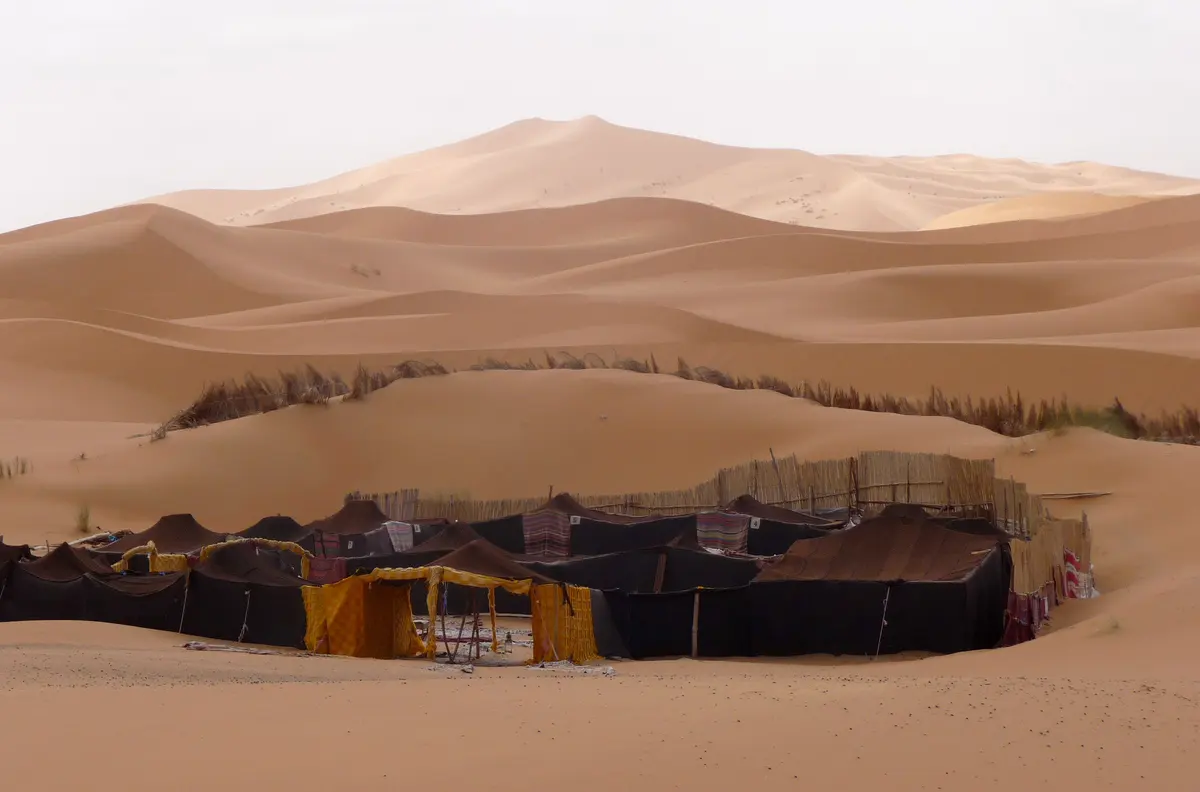
At the standard camps: a canvas tent, proper mattresses on low frames, heavy wool blankets, a rug floor, and a shared bathroom block with hot water a short walk away.
At the private-suite camps: an en-suite bathroom in each tent, real beds, electricity until midnight, and a dining tent with a proper kitchen behind it.
Both are warmer than you expect once the blankets are on. Neither is soundproof — canvas is canvas, and if the group two tents down is still up at one in the morning, you will know.
The bathroom question
This is the thing people are most reluctant to ask and most want answered.
Standard camps have a shared block with flush toilets and hot showers, usually thirty to sixty seconds’ walk across sand. Water is trucked in, so showers are short and the hot water is genuinely hot but finite. There is no plumbing to the dunes; everything arrives by tanker.
Luxury camps have a bathroom inside the tent, with the same water constraint.
Either way: bring a head torch. The walk to the block in the dark, across soft sand, with a phone held in your teeth, is a rite of passage nobody needs.
Dinner and the evening
Soup, then a tagine, then fruit, eaten communally at a long table. Bread, olives, mint tea. Vegetarians are catered for as standard — say so at booking rather than at the table, because the shopping happens in Rissani two days before you arrive.
Afterwards the staff bring out drums. This is either the highlight of the trip or twenty minutes you politely endure, and it varies entirely by group. Nobody is offended if you drift off early.
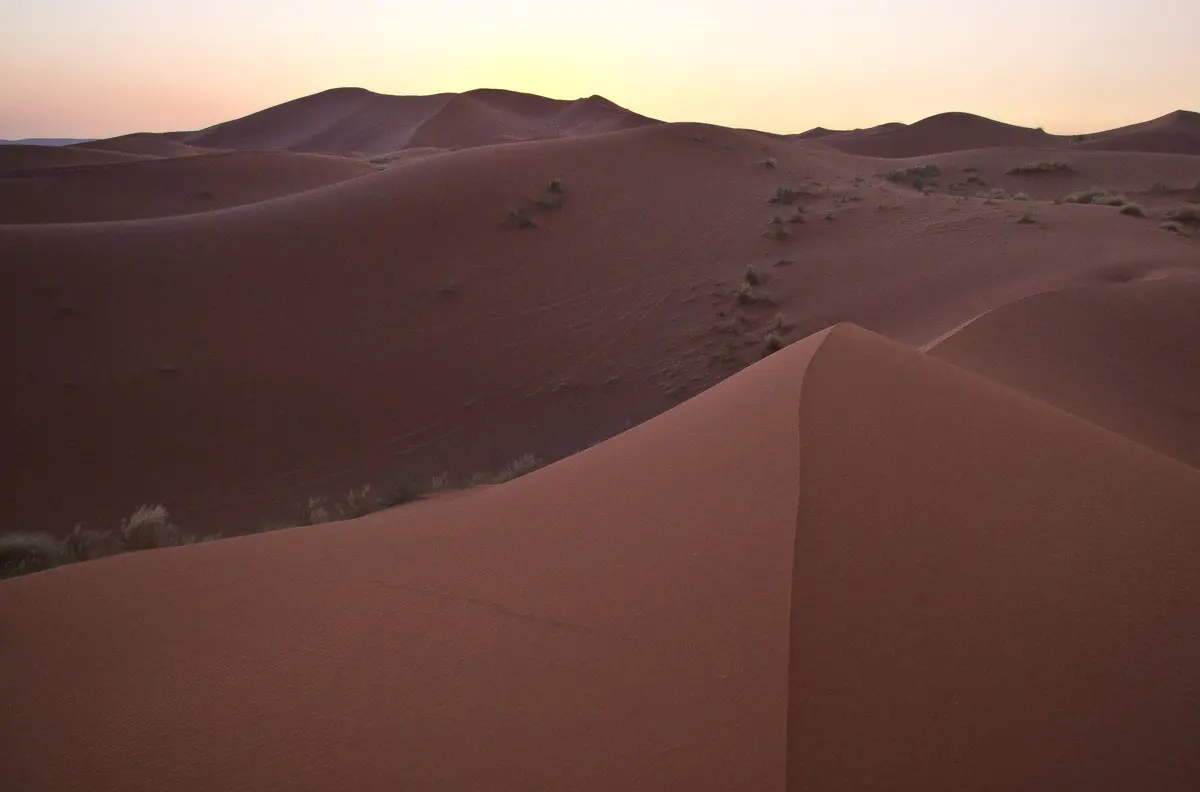
Then people go and sit on the dune. That is the actual event.
Alcohol is not served at most camps and is not usually available to buy in Merzouga. If you want wine with dinner, bring it from Marrakech and mention it — nobody will object, but nobody will supply it either.
The cold nobody believes
Between November and February it can approach freezing an hour after dark, after a daytime high of 18 to 20°C. That twenty-degree swing is the single most underestimated fact about a Sahara night.
The blankets handle it. What the blankets do not handle is the walk to the bathroom at three in the morning. Bring a fleece at minimum, a down jacket if you have one, and socks to sleep in.
In April and October, nights sit around 10 to 15°C and it is genuinely pleasant. In July and August the nights stay above 25°C and the problem reverses. The full seasonal picture is in when to visit Morocco, and the kit list is in what to pack for the Sahara.
Power, phones and wifi
Camps run on solar with a generator that goes off somewhere around eleven. Charge everything at dinner. Some camps advertise wifi; assume it does not work.
Mobile data at Erg Chebbi is usually 4G near the road and unreliable in the dunes. This is not a hardship — it is roughly eight hours — but tell whoever is expecting a message from you.
The silence
The thing nobody mentions and the thing everybody remembers.
Once the drums stop and the generator is switched off, there is no sound at all. No traffic, no wind in trees, no insects, no hum from a fridge somewhere. Most people find it unfamiliar for about ten minutes and then extraordinary.
The stars come with it. Erg Chebbi has effectively no light pollution and on a moonless night the Milky Way is a solid band. If you want photographs of it, bring a tripod — no phone will manage.
The morning
Get up for sunrise. It is the reason to be there, it lasts about twenty minutes, and everyone who sleeps through it says so afterwards.
Climb the dune behind camp in the dark — fifteen minutes, harder than it looks, sand takes half of every step. Tea is waiting when you come back down. Breakfast is around seven thirty and the camels leave at eight, because the sand is already warming.
The people who run it
Camps are staffed by four to eight people, almost all from Merzouga, Khamlia or Hassi Labied — the villages within a few kilometres. They cook, they lead the camels, they play the drums, and several of them sleep in a staff tent at the edge of camp all season.
Most speak Darija and French, some Amazigh first, and enough English to run the evening. If you learn shukran and use it, you will notice the difference by breakfast. A few words go further out here than they do in Marrakech, and a short list of them is worth the ten minutes.
Tipping is expected and it is not built into the tour price. Leave it with the camp manager at breakfast rather than pressing it on individuals — that is how it gets shared. Our guidance on amounts is in money and tipping.
Where the camps are
Almost every “Sahara camp” sold in Morocco is at one of three places:
- Erg Chebbi, near Merzouga — the big dunes, about nine hours from Marrakech, on the Marrakech to Fes route. Most camps, most choice.
- Erg Chigaga, near M’Hamid — remoter, reached by two hours of piste, fewer camps and fewer people.
- The Agafay stone desert, an hour from Marrakech — not the Sahara, no sand dunes, and honest operators say so. It works as an overnight when you have no time for the real thing.
Zagora is sold as a desert destination and its dunes are small. If the dunes in the photograph are what you came for, do not stop at Zagora.
Who should probably skip it
Anyone who cannot manage a nine-hour driving day each way. Anyone who needs reliable power for medical equipment. Anyone travelling in July who does not like heat.
Everyone else should go, and should go for two nights rather than one if the schedule allows — the second evening is when you stop photographing it and start being there.
We run the 3-day crossing to Fes and a 4-day version with a private-suite camp, and we will tell you which camp you are in before you book, by name.
Frequently asked questions
Where do you stay in the Sahara Desert in Morocco?
In a fixed camp pitched between the dunes, usually 30 to 60 minutes from the road at Merzouga or M'Hamid. Camps are permanent, run by local families, and range from shared-bathroom canvas tents to en-suite private suites.
Are there bathrooms in a Moroccan desert camp?
Yes. Standard camps have a shared block with flush toilets and hot showers, a short walk from the tents. Comfort and luxury camps have a private bathroom inside each tent. Water is trucked in, so showers are short.
How cold does it get at night in the Sahara?
Between November and February camp nights can approach freezing, after days of 18 to 20°C. In April and October nights sit around 10 to 15°C. The temperature falls roughly twenty degrees within an hour of sunset in winter.
How long is the camel ride to the desert camp?
About 60 to 90 minutes at Erg Chebbi, timed so you reach the camp at sunset. It is more comfortable going up a dune than coming down one. A 4x4 covers the same distance in fifteen minutes if you prefer.
Is there wifi in a Morocco desert camp?
Some camps advertise it and it rarely works. Mobile data at Erg Chebbi is usually 4G and usable near the road, patchy in the dunes. Camps run on solar with a generator that is switched off between about 23:00 and dawn.
What should you wear in the Morocco desert?
Long, loose and light by day — covering your arms and legs is cooler than exposing them. A fleece or down jacket for after dark, closed shoes for the sand, and a scarf you can pull over your face when the wind gets up.
Is the Sahara Desert in Morocco safe?
Yes. Camps are permanent, staffed, and in sight of other camps. The genuine risks are heat in summer, cold at night in winter, and dehydration. Nobody sleeps out on the sand alone, and the staff count heads at sunrise.
Is a Sahara desert camp suitable for children?
Generally yes, from about five upwards. Children take to the dunes faster than adults. The limits are the long drive to reach Merzouga and the camel ride, which small children usually share with a parent.
What is the difference between a standard and a luxury desert camp?
Bathrooms and beds, mostly. Standard means canvas tents, mattresses on low frames and a shared shower block. Luxury means an en-suite, a real bed, electricity later into the night, and a proper kitchen tent.
Related tour
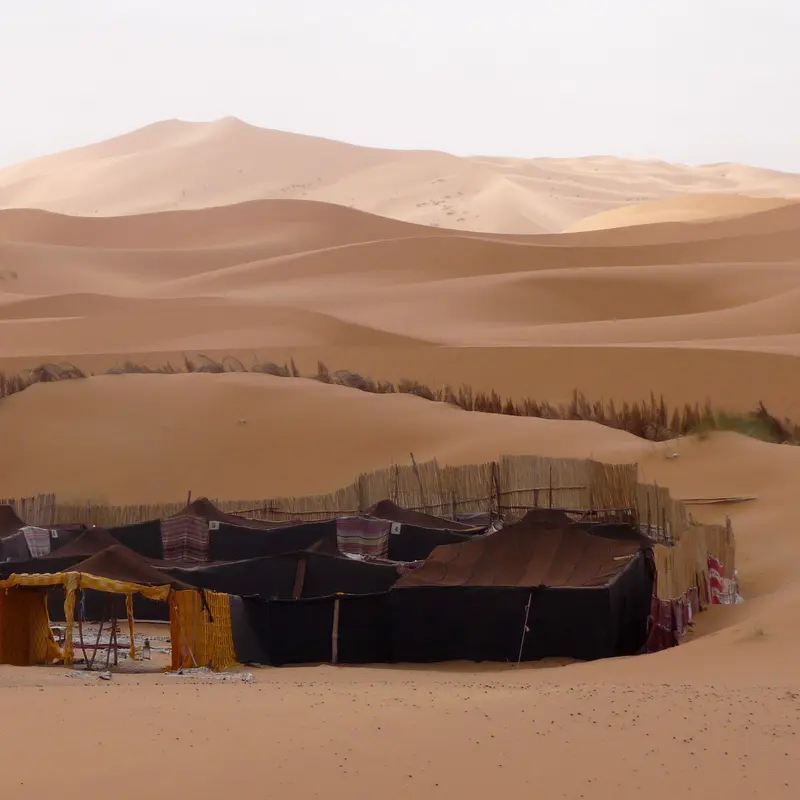
Morocco Luxury Desert Tour: 4 Days at Erg Chebbi
From €520 · 4 days / 3 nights
Morocco, once a month
Route ideas, when to book, and the odd honest warning about tourist traps. No spam, unsubscribe anytime.
Thanks — check your inbox to confirm.