Marrakech to Fes: Why the One-Way Desert Route Wins
Going Marrakech to Fes through the Sahara beats the round trip — same days, same price, nine fewer hours of repeated road. The honest day-by-day.
Youssef Ait Taleb
Senior driver-guide
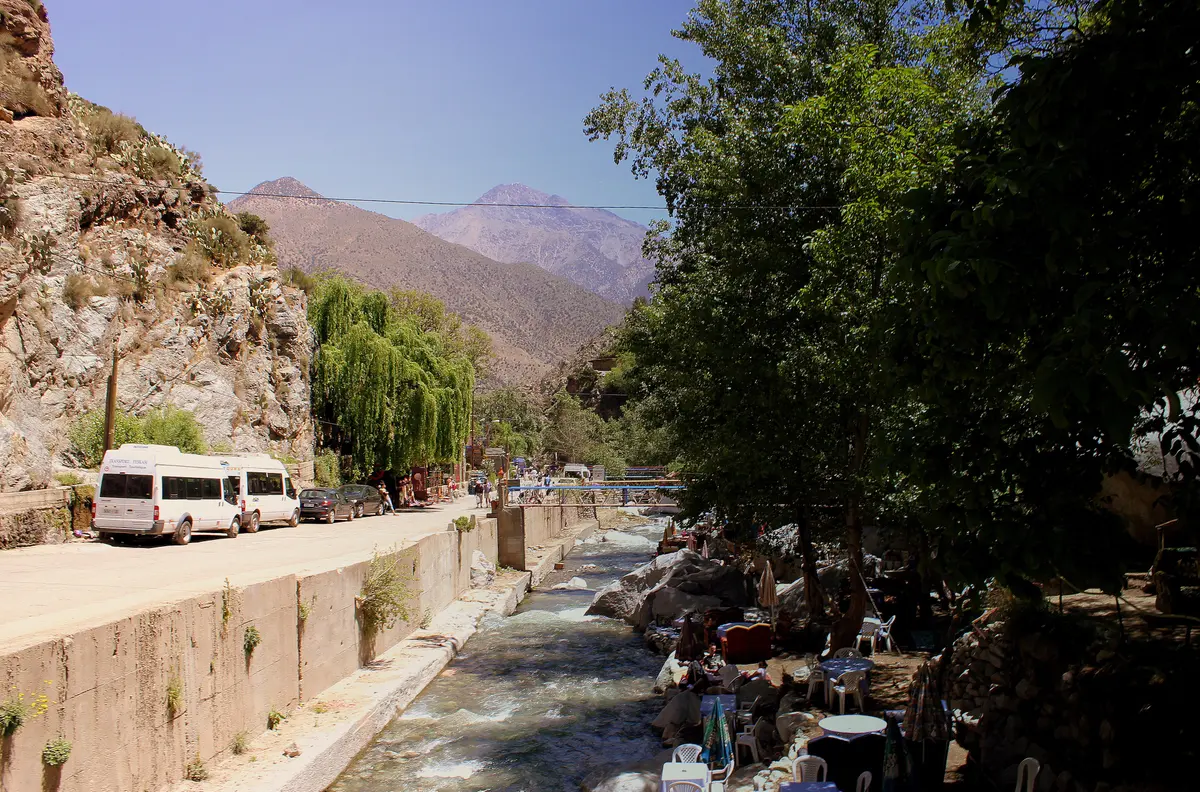
Going one-way from Marrakech to Fes through the desert beats the round trip from Marrakech. Same three days, same price, and about nine hours less driving on roads you have already seen. This is the most common question we get about the Sahara, and after years of running both versions the answer has not changed.
The arithmetic
Marrakech to Merzouga is roughly 560 km and about nine hours of driving with stops. That is the outbound leg on either version.
On a round trip you then drive it back. Around eighteen hours in the vehicle across three days, and half of it is scenery you looked at forty-eight hours earlier. The Tizi n’Tichka pass is spectacular the first time and a long climb the second.
Go north to Fes instead and the return leg becomes the Todra Gorge, the Ziz valley palm groves and the Middle Atlas cedar forest. Same number of days, same price, entirely new road.
| Round trip to Marrakech | One-way to Fes | |
|---|---|---|
| Total driving | ≈ 18 hours | ≈ 17 hours |
| Roads repeated | About half | None |
| New landscapes | Atlas, kasbah road, dunes | Atlas, kasbah road, dunes, gorge, Ziz, cedar forest |
| Ends in | Marrakech | Fes |
The driving hours are similar. What differs is what is outside the window.
What each version actually shows you
The round trip gives you the High Atlas, Aït Benhaddou, the Dades or Todra depending on the operator, and the Erg Chebbi dunes. Then it gives them to you again, backwards, at speed, because everyone wants to be back in Marrakech before dark.
The one-way adds the Ziz valley — a canyon of date palms running for kilometres below the road, which almost nobody photographs and which is the sleeper of the whole route — and the Middle Atlas cedar forest above Azrou, which is green, cool, and looks nothing like the Morocco of the brochure. There are Barbary macaques at the roadside. You finish in Fes instead of back where you started.
Marrakech to Fes, day by day
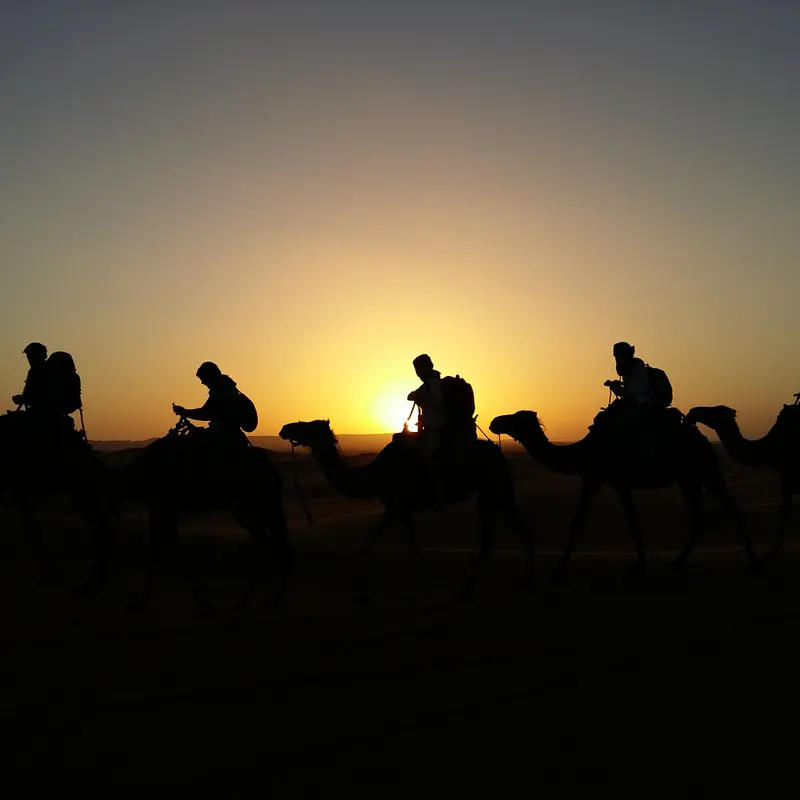
Day one is the long one. Pickup around seven. Over the Tizi n’Tichka at 2,260 m by mid-morning, a proper walk through the ksar at Aït Benhaddou rather than a photo stop from the car park, lunch by the river, then the Valley of a Thousand Kasbahs through Skoura and the Dades. You reach Merzouga in the early evening and swap the vehicle for camels to be on the dunes at sunset.
Nine hours of driving. It is a real day and there is no honest way to shorten it.
Day two stays in the desert. Sunrise from the top of the dune behind camp, then the nomad families and the Gnaoua musicians at Khamlia in the morning. Afternoon free — sandboard, sleep, or do nothing, which is what most people end up doing and do not regret.
Day three runs north. Todra Gorge early, before the coaches from the Dades hotels arrive between ten and one. The Ziz palm groves, lunch at Midelt, then the cedar forest and down into Fes in the evening. About eight hours with stops.
That is the shape of our Marrakech to Fes desert tour, and the driving times on that page are the ones we actually record, not the Google Maps versions.
Fes to Marrakech: the same route backwards
It runs equally well in reverse, and for some trips it is better.
Fly into Fes, out of Marrakech, and you finish the trip in the city with the international connections, the beaches within three hours, and the day trips. Ending in Marrakech means you can add Essaouira or the Atlas at the end without another long transfer.
The one thing that changes: the Tichka pass is on the last afternoon rather than the first morning, and in winter that is the leg most likely to be delayed by snow. If you are travelling in January or February, Marrakech-to-Fes is the safer direction.
Three days or four?
Three days works. Four days is better if either of these is true:
- You want the Dades valley properly rather than a photograph through the windscreen
- You are travelling with children, or with anyone for whom a nine-hour driving day is genuinely hard
The fourth day gets spent between Skoura and the Dades, which turns day one from nine hours into two shorter ones. The four-day version with a private-suite camp is the one we sell most to couples for that reason.
Five days and up starts to make sense only if you are adding the Draa valley or Erg Chigaga, which is a different desert and a different trip.
What you give up
One thing, and it is worth naming plainly: if your flights are both in and out of Marrakech, you have to get back.
The Fes–Marrakech train takes about seven hours with a change at Casablanca. It is cheap and comfortable, and it eats one travel day. There are also short domestic flights, usually via Casablanca. Details on both are in getting around Morocco.
For anyone flying into one city and out of another — which most European carriers make straightforward — there is no downside at all, and this is the version we recommend without hesitation.
The two-day desert tour, and why we do not sell it
They exist, they are cheap, and the numbers do not work. Two days from Marrakech to Merzouga and back is roughly twenty hours in a vehicle for about four hours in the dunes, with the camel trek at dusk and departure straight after sunrise.
People book them because three days does not fit. If that is genuinely your situation, the honest alternative is the Agafay stone desert an hour from Marrakech — a night under canvas, dunes made of rock rather than sand, and no ten-hour drive. It is not the Sahara and it does not pretend to be, which is more than can be said for a two-day Merzouga run.
Some two-day tours go to Zagora instead, which is closer but where the dunes are small and the erg is not really an erg. Say no to that one too.
The stops that get skipped
The difference between two operators running the same route is almost entirely what they stop for, and the cheap version of this trip is defined by what it drives past.
Aït Benhaddou is the clearest case. The car park is on the modern side of the river; the ksar is across it. A photo stop is fifteen minutes at the viewpoint. Walking up through the ksar to the granary at the top with someone who can explain what the pisé walls are and why they are rebuilt every few years is an hour and a half, and it is the single best hour of day one.
The Todra narrows take fifteen minutes to walk and most tours stop for thirty, which is genuinely enough — but only if you arrive before nine or after five. Mid-morning it is a car park with cliffs.
Khamlia, the Gnaoua village south of Merzouga, is twenty minutes of live music in a room, and it is either the best thing on day two or the most obviously staged, depending entirely on the group. We tell people which it is likely to be for them rather than selling it blind.
The Ziz viewpoint north of Erfoud costs nothing and takes ten minutes. Half the vehicles on that road do not pull over.
When to go
October, November, March and April are the desert months on this route: warm days, tolerable nights, good light on the dunes.
December to February — pleasant days around 18–20°C and camp nights that can approach freezing. The Tichka pass can close in heavy snow, usually for hours rather than days. Build slack into a winter itinerary.
June to August — 42–45°C at Merzouga. We still run it, with the camel trek pushed to the last hour before sunset, and we say plainly that midday is for lying still.
More on the trade-offs in when to visit Morocco.
The practical bits
Luggage. Take an overnight bag to camp; leave the main case in the vehicle or at your Marrakech riad, which every riad will store for free. Camel bags are soft-sided and a hard shell does not ride well. The full list is in what to pack for the Sahara.
Hotel drop-off in Fes. Fes medina vehicles cannot reach most riads. Expect to be dropped at the nearest gate and walked in — arrange it with your riad in advance and they will send someone.
The camp itself. Standard camps have shared bathrooms; private-suite camps have en-suites. Both are warmer than you expect once the blankets are on. What a night in a Sahara camp is actually like covers the rest.
Cost. Per-person prices depend almost entirely on group size, because the vehicle and driver cost the same whether there are two of you or six. The published bands are on the tour page. What you should compare between operators is not the headline number but what is included — camp category, meals, entry fees, and whether the guide is licensed.
We run this crossing in both directions most weeks of the year, with a licensed guide and published driving times.
See the 3-day Marrakech to Fes crossing · Tell us your dates and direction
Frequently asked questions
How do you get from Marrakech to Fes?
Three ways. Train, about seven hours with a change at Casablanca. Direct drive, around 530 km and eight hours of dull motorway and Middle Atlas road. Or the three-day desert route east through Merzouga, which takes the same money further.
Is there a train from Fes to Marrakech?
Yes, several a day, but not direct — you change at Casablanca Voyageurs. Total journey is roughly seven hours. It is comfortable, cheap and the scenery is mostly farmland. Book first class if you want a reserved seat.
Is the Sahara Desert in Morocco?
Yes. The Moroccan Sahara begins south-east of the Atlas. The dunes people picture are Erg Chebbi near Merzouga and Erg Chigaga near M'Hamid — Erg Chebbi is the one on the Marrakech-to-Fes route.
What city in Morocco is closest to the Sahara Desert?
Merzouga, a village rather than a city, sits at the foot of the Erg Chebbi dunes. Errachidia is the nearest town with an airport. From Marrakech it is around nine hours by road; from Fes, about eight.
How many days do you need for the Sahara from Marrakech?
Three, minimum. Two-day tours give you roughly four hours in the dunes for twenty hours in a vehicle. Three days gets you a full desert morning. Four days lets you slow the driving down and add the Dades or Skoura.
How do you get to the Sahara Desert in Morocco?
By road only. From Marrakech you cross the Tizi n'Tichka pass, follow the Valley of a Thousand Kasbahs east through Ouarzazate and the Dades, and reach Merzouga in about nine hours with stops. There is no train and no useful flight.
Is the Sahara Desert in Morocco safe?
Yes. The desert is one of the calmest parts of the country. The genuine risks are heat in summer, cold at night in winter, and the road — which is why we do not drive the last stretch after dark.
What should you wear in the Morocco desert?
Long, loose and light in the day, a warm layer for after sunset, closed shoes and a scarf for wind. Between November and February the temperature can fall twenty degrees within an hour of dark.
Related tour
Marrakech to Fes Desert Tour: 3 Days to the Sahara
From €155 · 3 days / 2 nights
Morocco, once a month
Route ideas, when to book, and the odd honest warning about tourist traps. No spam, unsubscribe anytime.
Thanks — check your inbox to confirm.